

In the past week, P-Doug and I have been back twice to a nice place on the Humber we had kind of forgotten about since last summer. Even though only three days separated the two visits, the difference in conditions was astounding.
Saturday we arrived around noon. The river was shallower than it had been the previous time I'd visited (a couple of weekends earlier, by myself), and the riverbed was clear and visible. When we stepped in and wandered down the river to our bathing spot, it barely even wet the hems of my shorts. When we arrived, we undressed and sat under the overhanging shade tree. The day was hot and humid, the water was quite warm for this early in the summer, and the sun was blazing. Even in the shade, you could feel its might.
A couple of summers ago, we had gone nude hiking into the hills there. That side of the river is on a large isthmus that is very nearly an island, and will be soon, I think. P-Doug wasn't game for it this time, fearing the bugs, but I set off on my own and climbed the hill, made my way down the far side, and crossed the river. A climbed the far bank and sat for a while on a bleached white log left in the grass by some long-ago flood, and watched the river. After I bit I crossed back over to the isthmus side and settled back in the grass to lie in the sun. Eventually I made my way back up into the forest and down to where he was still enjoying the water. The bugs had never bothered me. We both got a bit of a burn that day, though; his worse than mine because I spent about an hour of it in the forest.
Wednesday was Canada Day so we decided to go back. It was overcast and only warm, rather than hot. When we got to the river, it was the colour of hot chocolate, and obviously far deeper, even to look at. It had rained quite a bit in the previous two days and we had to undress before even stepping in. The current was surprisingly fast, and it was deeper than we'd even guessed, not to mention somewhat cooler. I was still wearing my shirt and eventually even the bottom of that was soaked. By the time we got to our usual spot and I could take it off, we were at parts that were armpit deep. I've never seen the river as deep as that at that spot. It was anytime we turned to work against the current that we realized just how strong it was; it was hard even to take a step against it. I decided to be prudent with my backpack and put it on road side of the river rather than the isthmus side so I wouldn't have to carry it back across. We spotted a flat, muddy landing on the isthmus side and struggled to reach it, and ended up spending most of our time there, half in and half out of the river. There was really no place shallow enough to actually sit down in the river itself this time. We spent some time there before fighting our way back to the road side where our clothes and food were, and ate sandwiches and oranges on the grassy side of the bank. We sat briefly under the tarp I carry on hikes when it started raining, just enough to give the day another interesting detail.
Eventually we decided to drift off. I prevailed upon P-Doug not to attempt wading back to the initial landing against the current on this day, but suggested instead climbing the steep valley wall behind us back to the old road. He was eventually persuaded, and I spotted what looked like a deer trail and made my way towards it. He gathered his things and followed, and ended up doing a few minutes of nude hiking in spite of things. When we reached the top, we dressed, checked out the trail a bit, and headed back. It was the nicest way to spend Canada Day and really celebrate the great outdoors of this country that I could think of. :)
Showing posts with label skinny dipping. Show all posts
Showing posts with label skinny dipping. Show all posts
Thursday, July 02, 2009

Monday, June 15, 2009
Conquering Richardson Road
This Saturday, P-Doug and I made our way to the other Nottawasaga River access we were interested in, Richardson Road. Actually, it was the one I spotted first and brought to his attention. He suggested McKinnon (where we went three weeks ago) as an alternate. But this weekend, we made our way to the river down the first road.
Seen from above, the road looks very open. Even with the trees crowding in, there's a definite space between them. And the road was, indeed, unmistakable nearly all the way down. But it wasn't really what I expected.
It was a bit after noon when we arrived. We parked at the end of the maintained road. We probably could have driven further, but first all, we came for the hike, and secondly, I really didn't want to bust an axel or something just to save ten minutes of walking. The road continued on down between two fields, till it came at last to a thick forest. It was overcast, so I wasn't all that concerned about the sun, but given that we were heading into wetlands, we got well set-up with bug repellent as we set out.


The forest trail was blocked off by a steel gate to keep out ATVs (thank you!!), but the way was also strewn with fallen trees every so often that would have made the trip impossible for them... some of them were troublesome even on foot. And they would have had to stay scrupulously on the trail. The nature of the road was unlike any I'd seen before. It was cut through a swamp reminiscent of things I've seen of the Everglades or the bayou in Louisiana. It had obviously been artificially raised above the swamp, with culverts cut into it that the swamp itself had seen fit to supersede with its own methods of transference over time. P-Doug was particularly impressed with what he called the high water marks on the trunks of the trees; they were at eye-height for us, even standing on the road.


As I said, there were a number of places where the swamp had taken it upon itself to balance the water on either side of the road. There were so many fords of water, streaming northeasterly, that I lost count of them. Six, maybe seven, and every one of them different in some aspect. Some were simply one foot in, one foot out; others were fifty feet wide. Some were deep with slippery clay bottoms; others were rafts of plants where I barely got my ankles wet. They were all a challenge, and one I would have delighted in wholly if it were not for the fact that I was carrying two of my cameras with me... and one of them had already been expensively repaired last fall after getting soaked in the Grand River. Otherwise I wouldn't have cared much at all about falling in. But as it was, I was concerned about the cameras, so I put them in the backpack for what little protection that would offer; at least they wouldn't be out, swinging around to potentially put me off-balance.


The road surface changed enormously as we went. It started off as dry gravel, became soft grass, and then in the forest, cool clay and earth. There were places where it was running wet. Mosquitoes were around, but they didn't seem really pronounced until we came to the strangest part of the road of all – completely overgrown with grasses, and ones that grew taller and thicker the further we went. In these places, great swarms of mosquitoes emerged to challenge us for our blood. Most were dissuaded by the bug spray, and those that weren't were often martyred to a quick slap. Even though they largely left us alone, the whining in the ears was highly disconcerting.


The grass on the road was so thick and full that I started wondering if we'd even know the river when we saw it, or would just fall in! Finally I could sunlit trees beyond the gloomy ones, and I knew we'd reached the river. But nature wasn't done with making it tricky yet. We encountered our big nemesis of the past couple of summers there as we approached the water's edge – stinging nettles. These saw-edged, stinging plants that are sheer torture. The slightest contact with them is like having a sharp blade run against your skin, combined with an itch. They really seem to concentrate near the edge of rivers, so for us, the last minute or two of getting to the Nottawasga was an ordeal that the mosquitoes couldn't hold a tiny candle to. They were raking my feet, my shins, my hands when I'd try to brush them aside. And just as we reached the river, we realized we were at the edge of a steep bank... with a very nice broad bank about fifty feet away to our right... through more of the forest. What could we do? We fought on through the nettles and finally reached the bank... where we stood on the clay, panting and cursing and waiting for the pain to subside.
This part of the river was strewn with old fallen trees and logs. There were plenty of places to sit down, so we did. We could finally look around. For all the trouble it took to get to it, it was glorious, and I got to see all the things I really love to see on these hikes. Everything natural. We had the river, places to sit, the bank to wander, the trees all around, and a sky that was first sheltering and then opened up the sun to us when we were ready to receive it.


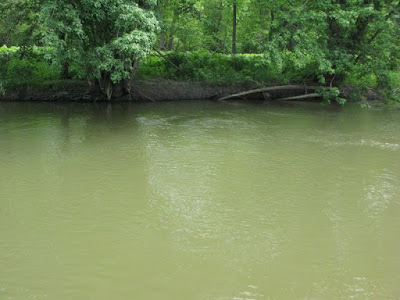
We decided to try out the river, even though we knew it was too cool yet to really get far. Upper thigh depth seemed to be the prudent place to stop. P-Doug did find a fallen tree that was just exactly positioned to allow him to sit but not get too immersed in the cool water; I reclined on the bank. The bank itself was clay that would support us in some places, but swallow us to the knees in others. I developed a habit of crawling, which seemed to work far better than having to step, sink, haul myself out, and repeat over and over. We covered the place in footprints before we settled back to just enjoy the place.


After a while, we got hungry and wandered back to where we'd left all our stuff and took on the tuna and cracker snack packs he'd brought with him, and the navel oranges. P-Doug had seen evidence of a previous visitor, probably a local fisherman, and he told the sort of tale Tonto might have told the Lone Ranger as he interpreted the missteps, falls, and foibles he read in the clay. After we'd been there an hour and a half or so, we washed in the river, suited up, and prepared ourselves to run the gauntlet of stinging nettles, smothering grasses, tripping hazards, mosquito clouds, and camera-eating fords again. He picked a course that was mercifully sparse of stinging nettles, and off we went.


The trip back seemed considerably shorter to me than the trip down. I think I enjoyed it more. I measured it all out this morning and it was about two-and-a-quarter miles, about half of it the most challenging course I think we've undertaken. But it's exactly what I miss whenever the weather gets cold. So here's to summer.

Seen from above, the road looks very open. Even with the trees crowding in, there's a definite space between them. And the road was, indeed, unmistakable nearly all the way down. But it wasn't really what I expected.
It was a bit after noon when we arrived. We parked at the end of the maintained road. We probably could have driven further, but first all, we came for the hike, and secondly, I really didn't want to bust an axel or something just to save ten minutes of walking. The road continued on down between two fields, till it came at last to a thick forest. It was overcast, so I wasn't all that concerned about the sun, but given that we were heading into wetlands, we got well set-up with bug repellent as we set out.


The forest trail was blocked off by a steel gate to keep out ATVs (thank you!!), but the way was also strewn with fallen trees every so often that would have made the trip impossible for them... some of them were troublesome even on foot. And they would have had to stay scrupulously on the trail. The nature of the road was unlike any I'd seen before. It was cut through a swamp reminiscent of things I've seen of the Everglades or the bayou in Louisiana. It had obviously been artificially raised above the swamp, with culverts cut into it that the swamp itself had seen fit to supersede with its own methods of transference over time. P-Doug was particularly impressed with what he called the high water marks on the trunks of the trees; they were at eye-height for us, even standing on the road.


As I said, there were a number of places where the swamp had taken it upon itself to balance the water on either side of the road. There were so many fords of water, streaming northeasterly, that I lost count of them. Six, maybe seven, and every one of them different in some aspect. Some were simply one foot in, one foot out; others were fifty feet wide. Some were deep with slippery clay bottoms; others were rafts of plants where I barely got my ankles wet. They were all a challenge, and one I would have delighted in wholly if it were not for the fact that I was carrying two of my cameras with me... and one of them had already been expensively repaired last fall after getting soaked in the Grand River. Otherwise I wouldn't have cared much at all about falling in. But as it was, I was concerned about the cameras, so I put them in the backpack for what little protection that would offer; at least they wouldn't be out, swinging around to potentially put me off-balance.


The road surface changed enormously as we went. It started off as dry gravel, became soft grass, and then in the forest, cool clay and earth. There were places where it was running wet. Mosquitoes were around, but they didn't seem really pronounced until we came to the strangest part of the road of all – completely overgrown with grasses, and ones that grew taller and thicker the further we went. In these places, great swarms of mosquitoes emerged to challenge us for our blood. Most were dissuaded by the bug spray, and those that weren't were often martyred to a quick slap. Even though they largely left us alone, the whining in the ears was highly disconcerting.


The grass on the road was so thick and full that I started wondering if we'd even know the river when we saw it, or would just fall in! Finally I could sunlit trees beyond the gloomy ones, and I knew we'd reached the river. But nature wasn't done with making it tricky yet. We encountered our big nemesis of the past couple of summers there as we approached the water's edge – stinging nettles. These saw-edged, stinging plants that are sheer torture. The slightest contact with them is like having a sharp blade run against your skin, combined with an itch. They really seem to concentrate near the edge of rivers, so for us, the last minute or two of getting to the Nottawasga was an ordeal that the mosquitoes couldn't hold a tiny candle to. They were raking my feet, my shins, my hands when I'd try to brush them aside. And just as we reached the river, we realized we were at the edge of a steep bank... with a very nice broad bank about fifty feet away to our right... through more of the forest. What could we do? We fought on through the nettles and finally reached the bank... where we stood on the clay, panting and cursing and waiting for the pain to subside.
This part of the river was strewn with old fallen trees and logs. There were plenty of places to sit down, so we did. We could finally look around. For all the trouble it took to get to it, it was glorious, and I got to see all the things I really love to see on these hikes. Everything natural. We had the river, places to sit, the bank to wander, the trees all around, and a sky that was first sheltering and then opened up the sun to us when we were ready to receive it.


We decided to try out the river, even though we knew it was too cool yet to really get far. Upper thigh depth seemed to be the prudent place to stop. P-Doug did find a fallen tree that was just exactly positioned to allow him to sit but not get too immersed in the cool water; I reclined on the bank. The bank itself was clay that would support us in some places, but swallow us to the knees in others. I developed a habit of crawling, which seemed to work far better than having to step, sink, haul myself out, and repeat over and over. We covered the place in footprints before we settled back to just enjoy the place.


After a while, we got hungry and wandered back to where we'd left all our stuff and took on the tuna and cracker snack packs he'd brought with him, and the navel oranges. P-Doug had seen evidence of a previous visitor, probably a local fisherman, and he told the sort of tale Tonto might have told the Lone Ranger as he interpreted the missteps, falls, and foibles he read in the clay. After we'd been there an hour and a half or so, we washed in the river, suited up, and prepared ourselves to run the gauntlet of stinging nettles, smothering grasses, tripping hazards, mosquito clouds, and camera-eating fords again. He picked a course that was mercifully sparse of stinging nettles, and off we went.


The trip back seemed considerably shorter to me than the trip down. I think I enjoyed it more. I measured it all out this morning and it was about two-and-a-quarter miles, about half of it the most challenging course I think we've undertaken. But it's exactly what I miss whenever the weather gets cold. So here's to summer.

Sunday, July 13, 2008
Summer utmost
I’ve spent a few summers now indulging in wilderness hiking and skinny-dipping in lush river valleys outside the city, but I think the experience yesterday was probably singular.
P-Doug picked me up at my place around 10 or so and we headed out on the 401 to the west end to ply the roads that follow the Humber, our river of choice, northwest into its still untamed upper reaches. I’m told that the Humber once, millennia ago, drained Lake Huron directly into Lake Ontario, but those days and water levels are long gone and today the Humber is a humbler river of a more manageable human scale. Where we were headed, a little pocket Eden we’ve come to refer to as “Otterwa”, for lack of a real name, the river twists and bends in a deep valley with a flood plain, alternating between runs a few inches deep over stones unfriendly to canoe bottoms and broad, silt-bottomed pools of chest-deep water.
Heading in, the forest floor, carpeted in russet pine needles, was bone dry under my bare feet. I remember thinking how little it would take, just the drop of a match or someone’s cigarette butt, to potentially send the place up. Neither one of us is a smoker, so it wouldn’t be us. The way in we take alternates several times between forest and clearing (one of which is perennially marked by the places deer have flattened sleeping) before the final forested slope down into the valley, where a brief, knee-deep marsh finally yields up the river.
P-Doug stepped into the river first and pronounced it cool, but warmer than our last visit. He also thought that it was higher. I’m dubious, myself; it seems to me that the river is higher in his estimation every time but I have yet to see pairs of animals making their way into the ark, or even water that reaches my shoulders while I’m standing in it. Still, in the absence of any empirical measure, it remains a subjective estimation, so I’m not prepared to say he was mistaken. Anyway, it seemed the same to me.
We waded to our usual landing, where I set my backpack in the ferns and stripped, wading back into the water more fully since there was now nothing to get wet but my skin. P-Doug set his things on the bank and did likewise. The water was cool, but not shocking. It really only took a few moments to get adjusted. The current runs down the landing side of the river, but on the far side (ironically, the side from which we’d actually come down), the bend and other elements have created a pool out of the current where the water moves very slowly and a number of fallen trees have created good places to sit immersed in the water. That’s how I enjoy being there. P-Doug’s strategy is more to find the courage to dunk to the neck and simply remain immersed that way.
The minnows who live in the river were uncharacteristically ravenous for the first 15 minutes or so. They always crowd in to pluck whatever it is they eat off your skin... more a kiss than a bite... but yesterday they swarmed around me in their dozens, some of them as long as my hand and as thick as two fingers, darting it to poke at my legs, my arms, my sides. Not really that much of an annoyance (unless they nibble someplace unmentionable). But it was a little unnerving and so I began sweeping them away, closing my fists quickly to suggest snapping jaws. I don't know if that was enough to dissuade them or whether they just decided there wasn't anything particularly tasty sticking to me, but they buggered off and left me alone after that.
We did what we always do while there… talk about cultural things (movies, mostly), historical moments, political trends… all while indulging in the great luxury of being bare outdoors, in the sun, among the trees, in the water. Primal and natural. At various times we each remarked how privileged we were, but when you think about it, a little over a century before it was absolutely nothing out of the ordinary. It’s how things were on hot summer days. How did we come to lose that, forget that?
We were there for hours, really. Over time the water warmed noticeably until it was, in truth, verging on a temperature I really could characterize as “warm”. Around that time, I noticed a thick, broad natural plank of wood – God only knows the size of the ancient fallen tree that yielded it – poking from the bank behind me like a bunk. I cleared it off and reclined on it with my back and head pressed to the bank, a firm root system holding the earth and plants above me like a canopy. P-Doug decided it would make a good shot and retrieved his camera from the landing to record my languid pose.
The upper landing that we usually sun on to dry off has, this year, been colonized by the most annoying stinging nettles. So eventually I went exploring up river to see if there were any other landings to stretch out on. I did find a couple, clear and only dotted with ferns, but they were in the shade. Seemed like anything that had sun also had the nettles. At one spot where I came ashore, I noticed a wooden plaque nailed to a tree, with an arrow pointing to the river carved and painted onto it. It was weathered and had been there a long time, but it surprised me. It was obviously meant to mark a trail of some kind, or indicate something to someone at some point. Intriguing. Sadly, I’d set off without anything, and I didn’t have my camera with me to take a picture. It was simply, as P-Doug has referred to such technology-deficient incidents, a “Zen moment”. I stepped back into the watery highway to return and report.
When I got back to the pool and the landing, he wasn’t there. There’s a tree just downstream with a large overhang that exactly hid him from view. He’d seen me returning, though, and called out. He was at the marl bank, about a minute downstream from the pool. I waded down there and climbed up. The really active part of the marl bank is roughly the size of a bathtub, and he was laid back on it, half immersed, and covered in grey marl except for his head. I sat on the firmer bank where the marl had dried, and watched as dozens of spiders came running out, black-bodied with huge abdomens so white I thought they must have been egg sacs. They seemed to be able to skate over the wet marl with no trouble at all. After a while I started to notice the clay under my heels was getting wet and soft, and when I began to peddle my feet against the clay, within minutes it had completely transformed into the same thick soup that P-Doug was lying back in. Soon I was sitting flat with my legs buried in the stuff up the knees. It was amazing.
We’d had intermittent sun all the four hours or so we were there but by this time, somewhere about three o’clock, the overcast had been established for around an hour and we began to hear the rumble of thunder. We lingered, indulging ourselves, until prolonged rolls made it clear we were due for a downpour. We pulled out of the marl and washed in the river and began to wade back to the landing just as the first raindrops began to fall. In the minute or so it took us to get back there, the downpour was on. Since we were already wet and naked, P-Doug suggested we trek back to the road that way and spare our dry clothes as long as we could. With any luck, the rain would be over by the time we reached the road. I tucked our clothes into my backpack and we left the river, climbing up out of the valley into the woods.
The rain was really coming down. By the time we got back to the field the deer sleep in, it was coming down in buckets. And it was warm. Warmer than the water of the river. I’ll never forget the image of P-Doug, naked, wandering through a field of waist-deep grass with his arms outstretched to delight in the falling rain.
The same pine needle flooring I’d thought so dry hours before was now verging on mucky and slippery under my feet. My forest fire fears were assuaged. When we were within five yards of the road or so, we decided to dress as minimally as we could, and so we just pulled on our shorts. At least our shirts would remain dry. As we did so, I said to him that it had to have been the most ambitious nude hike we’d yet undertaken; most of a mile up and down hills through forest, brush, and field.
Bare chested, we stepped onto the road. For me it was an interesting sensation because the normally blistering summer blacktop was merely comfortably warm under my feet, cooled by the rain, steaming and extremely pleasant to walk on. Three or four cars passed us on the ten-minute walk back to the car. As we drove away, pub-bound, P-Doug observed that the thing that made the place so wonderful was the childlike freedom it bestows… to swim and wander the place naked, sit on tree limbs, play in the clay with abandon. I remarked that there was nothing like that in my own youth… that I’d had to progress well into adulthood to achieve it. Strange irony.
P-Doug picked me up at my place around 10 or so and we headed out on the 401 to the west end to ply the roads that follow the Humber, our river of choice, northwest into its still untamed upper reaches. I’m told that the Humber once, millennia ago, drained Lake Huron directly into Lake Ontario, but those days and water levels are long gone and today the Humber is a humbler river of a more manageable human scale. Where we were headed, a little pocket Eden we’ve come to refer to as “Otterwa”, for lack of a real name, the river twists and bends in a deep valley with a flood plain, alternating between runs a few inches deep over stones unfriendly to canoe bottoms and broad, silt-bottomed pools of chest-deep water.
Heading in, the forest floor, carpeted in russet pine needles, was bone dry under my bare feet. I remember thinking how little it would take, just the drop of a match or someone’s cigarette butt, to potentially send the place up. Neither one of us is a smoker, so it wouldn’t be us. The way in we take alternates several times between forest and clearing (one of which is perennially marked by the places deer have flattened sleeping) before the final forested slope down into the valley, where a brief, knee-deep marsh finally yields up the river.
P-Doug stepped into the river first and pronounced it cool, but warmer than our last visit. He also thought that it was higher. I’m dubious, myself; it seems to me that the river is higher in his estimation every time but I have yet to see pairs of animals making their way into the ark, or even water that reaches my shoulders while I’m standing in it. Still, in the absence of any empirical measure, it remains a subjective estimation, so I’m not prepared to say he was mistaken. Anyway, it seemed the same to me.
We waded to our usual landing, where I set my backpack in the ferns and stripped, wading back into the water more fully since there was now nothing to get wet but my skin. P-Doug set his things on the bank and did likewise. The water was cool, but not shocking. It really only took a few moments to get adjusted. The current runs down the landing side of the river, but on the far side (ironically, the side from which we’d actually come down), the bend and other elements have created a pool out of the current where the water moves very slowly and a number of fallen trees have created good places to sit immersed in the water. That’s how I enjoy being there. P-Doug’s strategy is more to find the courage to dunk to the neck and simply remain immersed that way.
The minnows who live in the river were uncharacteristically ravenous for the first 15 minutes or so. They always crowd in to pluck whatever it is they eat off your skin... more a kiss than a bite... but yesterday they swarmed around me in their dozens, some of them as long as my hand and as thick as two fingers, darting it to poke at my legs, my arms, my sides. Not really that much of an annoyance (unless they nibble someplace unmentionable). But it was a little unnerving and so I began sweeping them away, closing my fists quickly to suggest snapping jaws. I don't know if that was enough to dissuade them or whether they just decided there wasn't anything particularly tasty sticking to me, but they buggered off and left me alone after that.
We did what we always do while there… talk about cultural things (movies, mostly), historical moments, political trends… all while indulging in the great luxury of being bare outdoors, in the sun, among the trees, in the water. Primal and natural. At various times we each remarked how privileged we were, but when you think about it, a little over a century before it was absolutely nothing out of the ordinary. It’s how things were on hot summer days. How did we come to lose that, forget that?
We were there for hours, really. Over time the water warmed noticeably until it was, in truth, verging on a temperature I really could characterize as “warm”. Around that time, I noticed a thick, broad natural plank of wood – God only knows the size of the ancient fallen tree that yielded it – poking from the bank behind me like a bunk. I cleared it off and reclined on it with my back and head pressed to the bank, a firm root system holding the earth and plants above me like a canopy. P-Doug decided it would make a good shot and retrieved his camera from the landing to record my languid pose.
The upper landing that we usually sun on to dry off has, this year, been colonized by the most annoying stinging nettles. So eventually I went exploring up river to see if there were any other landings to stretch out on. I did find a couple, clear and only dotted with ferns, but they were in the shade. Seemed like anything that had sun also had the nettles. At one spot where I came ashore, I noticed a wooden plaque nailed to a tree, with an arrow pointing to the river carved and painted onto it. It was weathered and had been there a long time, but it surprised me. It was obviously meant to mark a trail of some kind, or indicate something to someone at some point. Intriguing. Sadly, I’d set off without anything, and I didn’t have my camera with me to take a picture. It was simply, as P-Doug has referred to such technology-deficient incidents, a “Zen moment”. I stepped back into the watery highway to return and report.
When I got back to the pool and the landing, he wasn’t there. There’s a tree just downstream with a large overhang that exactly hid him from view. He’d seen me returning, though, and called out. He was at the marl bank, about a minute downstream from the pool. I waded down there and climbed up. The really active part of the marl bank is roughly the size of a bathtub, and he was laid back on it, half immersed, and covered in grey marl except for his head. I sat on the firmer bank where the marl had dried, and watched as dozens of spiders came running out, black-bodied with huge abdomens so white I thought they must have been egg sacs. They seemed to be able to skate over the wet marl with no trouble at all. After a while I started to notice the clay under my heels was getting wet and soft, and when I began to peddle my feet against the clay, within minutes it had completely transformed into the same thick soup that P-Doug was lying back in. Soon I was sitting flat with my legs buried in the stuff up the knees. It was amazing.
We’d had intermittent sun all the four hours or so we were there but by this time, somewhere about three o’clock, the overcast had been established for around an hour and we began to hear the rumble of thunder. We lingered, indulging ourselves, until prolonged rolls made it clear we were due for a downpour. We pulled out of the marl and washed in the river and began to wade back to the landing just as the first raindrops began to fall. In the minute or so it took us to get back there, the downpour was on. Since we were already wet and naked, P-Doug suggested we trek back to the road that way and spare our dry clothes as long as we could. With any luck, the rain would be over by the time we reached the road. I tucked our clothes into my backpack and we left the river, climbing up out of the valley into the woods.
The rain was really coming down. By the time we got back to the field the deer sleep in, it was coming down in buckets. And it was warm. Warmer than the water of the river. I’ll never forget the image of P-Doug, naked, wandering through a field of waist-deep grass with his arms outstretched to delight in the falling rain.
The same pine needle flooring I’d thought so dry hours before was now verging on mucky and slippery under my feet. My forest fire fears were assuaged. When we were within five yards of the road or so, we decided to dress as minimally as we could, and so we just pulled on our shorts. At least our shirts would remain dry. As we did so, I said to him that it had to have been the most ambitious nude hike we’d yet undertaken; most of a mile up and down hills through forest, brush, and field.
Bare chested, we stepped onto the road. For me it was an interesting sensation because the normally blistering summer blacktop was merely comfortably warm under my feet, cooled by the rain, steaming and extremely pleasant to walk on. Three or four cars passed us on the ten-minute walk back to the car. As we drove away, pub-bound, P-Doug observed that the thing that made the place so wonderful was the childlike freedom it bestows… to swim and wander the place naked, sit on tree limbs, play in the clay with abandon. I remarked that there was nothing like that in my own youth… that I’d had to progress well into adulthood to achieve it. Strange irony.
Thursday, October 18, 2007
Double deer blind
I crouched naked beside him in the grass on the river bank. Ten yards away, they were talking. Between them and us, hidden just this side of a fallen log, were our backpacks and our clothes. But we dared not rise and retrieve them, or even make a sound. Pressed to the forest floor, we huddled and waited.
He had first been alerted of their approach by the sudden flight of a bird. Then a voice from the river. He had urged me to drop and I did so immediately. We heard the sounds of their canoe, scraping over the rocks, and them getting out to dislodge it. Then they lingered in the pool at the river bend where we had ourselves been lounging before deciding to sun ourselves in the glade on the bank. Laughter reached our ears; the singular reek of marijuana wafted up to us. We waited, tense, fearful and excited. Curious, even. Naked, vulnerable, and exposed, praying not to be discovered, at the unknowing mercy of these people just yards away. Wishing them away; wondering who they were. Though they were our own kind, I felt more like a deer than a human.
The minutes passed with a glacial slowness, but they did pass. And so did the men, their voices seeming to break free from below us, carried off around the river bend. We rose, recovering our civility and donning it before making our way down to the very same place they had left just moments before. As we waded again in the water, we realized the rushing river in which we stood would have negated any chance of them having heard us, though from the bank we had been insulated from the water's babbling and had assumed our voices would be as clear to them as theirs to us. So we had lain there, certain that the slightest whisper risked detection; all the while the same sun that streamed down on our bare skin dappling them just a stone's throw away. But to a world of clothing and cars, talking and taxes, we had emerged from one of nakedness, fear, seclusion and silence, and all in the space of a few seconds. It was ponderous indeed how truly little there was between the one state and the other.
He had first been alerted of their approach by the sudden flight of a bird. Then a voice from the river. He had urged me to drop and I did so immediately. We heard the sounds of their canoe, scraping over the rocks, and them getting out to dislodge it. Then they lingered in the pool at the river bend where we had ourselves been lounging before deciding to sun ourselves in the glade on the bank. Laughter reached our ears; the singular reek of marijuana wafted up to us. We waited, tense, fearful and excited. Curious, even. Naked, vulnerable, and exposed, praying not to be discovered, at the unknowing mercy of these people just yards away. Wishing them away; wondering who they were. Though they were our own kind, I felt more like a deer than a human.
The minutes passed with a glacial slowness, but they did pass. And so did the men, their voices seeming to break free from below us, carried off around the river bend. We rose, recovering our civility and donning it before making our way down to the very same place they had left just moments before. As we waded again in the water, we realized the rushing river in which we stood would have negated any chance of them having heard us, though from the bank we had been insulated from the water's babbling and had assumed our voices would be as clear to them as theirs to us. So we had lain there, certain that the slightest whisper risked detection; all the while the same sun that streamed down on our bare skin dappling them just a stone's throw away. But to a world of clothing and cars, talking and taxes, we had emerged from one of nakedness, fear, seclusion and silence, and all in the space of a few seconds. It was ponderous indeed how truly little there was between the one state and the other.
Monday, August 06, 2007
Hold for the Humber, please...
The place P-Doug and I have been relaxing on the Humber's been getting kind of crowded lately, so we decided to explore another spot on the river. This one's not so accessible, and requires a fifteen minute (as the crow flies) hike through the forest from a country road. We made our way there last Friday...


 I separated from P-Doug for about half an hour on the way in. He took a much more direct route; I followed a small creek to the river. On my way, I found this long-abandoned Ford F150. It may have been here since the 80s. The truck bed was rusted right through to the axle. There was no vandalism that I could see... unusual. Suggests that not many teenagers make use of the place, if nothing else.
When we found the place, it was better than anything I've imagined. The curve in the river is preceded by a fallen tree that long ago built up the river rock; the water cascading over it seems to have hollowed out a natural pool in the river. It drops off quickly and is about five feet deep. At this time of year, the water was only a few degrees below body temperature (or so it felt to me); there were virtually no temperature shocks in wading into it. We indulged ourselves for about five hours.


 The above three shots show panoramas from the same position; the top two at noon (in infrared and colour) and the third at about 4 in the afternoon. We headed home (by way of beer and a nosh) about 4:30.
—————
Update: Nov. 24, 2007. Video in infrared from that day.
------------------------------------------------
Today, holiday Monday (Simcoe Day hereabouts), I was kind of at loose ends so I decided to go to a place I'd been before, May last year. This is the end of Flindon Road at the Humber River, at what used to be the border between North York and Etobicoke. Many years ago, there was a small traffic bridge on Flindon Road that crossed the Humber. All that remains now is the embankment.


Unlike May in 2006, this time I decided to make my way down to the river and wade around. I'm far more familiar with the Humber now than I was back then. Most of the following shots were taken from the river itself as I headed south downstream. The water wasn't just comfortable, it was decidedly warm. I only wish it had been possible to dive into it instead of just wade.
The bridge seen in the distance was the main reason I returned. It's not the Flindon bridge, since, as I said, that's long gone. The bridge in these shots was once actually the Albion Road bridge over the Humber. Today, it's closed to traffic and carries only pedestrians and bikes across. Maps that I have from about 1970, though, suggest that, at least for a while, both the old bridge and the new bridge carried vehicle traffic side by side.


I climbed up the embankment to the root of the old bridge on the North York side. This view looks down what was once Albion Road. If you look to the centre left, you'll see a van on what is currently the course of Albion Road, a few dozen yards to the west.

 This view looks northwesterly up what used to be Albion Road, with Etobicoke on the far side.
 Looking northwesterly into Etobicoke from the bridge.
 The new bridge as seen from the old.
The following views look northerly along the Humber upstream...


Before heading back, I paused to look back across the bridge into North York.

 I returned to the North York side and crossed back under the foot bridge.


Finally, a few views of the abutment for Flindon Road bridge, seen from the river and then from the climb back up.


 I separated from P-Doug for about half an hour on the way in. He took a much more direct route; I followed a small creek to the river. On my way, I found this long-abandoned Ford F150. It may have been here since the 80s. The truck bed was rusted right through to the axle. There was no vandalism that I could see... unusual. Suggests that not many teenagers make use of the place, if nothing else.
When we found the place, it was better than anything I've imagined. The curve in the river is preceded by a fallen tree that long ago built up the river rock; the water cascading over it seems to have hollowed out a natural pool in the river. It drops off quickly and is about five feet deep. At this time of year, the water was only a few degrees below body temperature (or so it felt to me); there were virtually no temperature shocks in wading into it. We indulged ourselves for about five hours.


 The above three shots show panoramas from the same position; the top two at noon (in infrared and colour) and the third at about 4 in the afternoon. We headed home (by way of beer and a nosh) about 4:30.
—————
Update: Nov. 24, 2007. Video in infrared from that day.
------------------------------------------------
Today, holiday Monday (Simcoe Day hereabouts), I was kind of at loose ends so I decided to go to a place I'd been before, May last year. This is the end of Flindon Road at the Humber River, at what used to be the border between North York and Etobicoke. Many years ago, there was a small traffic bridge on Flindon Road that crossed the Humber. All that remains now is the embankment.


Unlike May in 2006, this time I decided to make my way down to the river and wade around. I'm far more familiar with the Humber now than I was back then. Most of the following shots were taken from the river itself as I headed south downstream. The water wasn't just comfortable, it was decidedly warm. I only wish it had been possible to dive into it instead of just wade.
The bridge seen in the distance was the main reason I returned. It's not the Flindon bridge, since, as I said, that's long gone. The bridge in these shots was once actually the Albion Road bridge over the Humber. Today, it's closed to traffic and carries only pedestrians and bikes across. Maps that I have from about 1970, though, suggest that, at least for a while, both the old bridge and the new bridge carried vehicle traffic side by side.


I climbed up the embankment to the root of the old bridge on the North York side. This view looks down what was once Albion Road. If you look to the centre left, you'll see a van on what is currently the course of Albion Road, a few dozen yards to the west.

 This view looks northwesterly up what used to be Albion Road, with Etobicoke on the far side.
 Looking northwesterly into Etobicoke from the bridge.
 The new bridge as seen from the old.
The following views look northerly along the Humber upstream...


Before heading back, I paused to look back across the bridge into North York.

 I returned to the North York side and crossed back under the foot bridge.


Finally, a few views of the abutment for Flindon Road bridge, seen from the river and then from the climb back up.


Subscribe to:
Posts (Atom)