Showing posts with label FinePix Real 3D W1. Show all posts

Tuesday, November 24, 2009

Salmon weekend

This Saturday just past was one of a couple of appointments with an awkward block of free time suspended between those dependencies. I had an appointment with my dental hygienists at one end and a meeting with a friend at the Duke of Kent pub at the other. Between the two was a gap of three or four hours, depending on who got where when. I'd been meaning to go to the Toronto Reference Library for a long time now, mainly to see if I could look up some of the originals James V. Salmon snapped, and that seemed like my opening to spend a few hours doing so.

The dental appointment was in East York on the lip of the Don Valley. I started wondering how I'd get to the TRL. I figured back on the DVP, up to the 401, and down Yonge or some less-travelled parallel street. Then in looking at the map, I realized I could just about see the TRL across the valley from where I was. It was a lot simpler to just drive down Broadview, cross the valley on Bloor, turn up Sherbourne and start hunting for a place to park in toney Rosedale. Ultimately I opted for Cluny Avenue, and decided to cross to Yonge by a footpath down from the heights (and then back up some stairs again, duh). But I wanted to make the trek anyway. The path in question is runs between Cluny Crescent and the cul-de-sac end of Rosedale Valley Road beside Aylmer Avenue, and I'm not sure, but I think it might once, and not too long ago, have been part of Rosedale Valley Road running up to Cluny. Anyway, it makes for some interesting shots.


At the TRL itself, I eventually found the reference cards for the James V. Salmon collection in a quiet, segregated room on the 4th floor. The librarian there tried to be helpful but strangely, she had no idea where the original photographs reference on the cards were stored, or even if they were the property of the library! She did promise to have someone more knowledgeable about the collection get in touch with me. In the meantime, I did spend a couple of interesting hours going through the cards. A lot of it's been digitized and is already available online, but I'm convinced I saw a few interesting things I'd never seen before. One thing I noticed, now that I've taken the time to actually look, is that James Salmon had a deep interest in, and real knack for locating, old TTC streetcars that had been retired from service and put to other uses. It would seem that in the 1950s, southern Ontario was utterly dotted with streetcars in farmers' fields, or being used as restaurants, or as additions to homes, or the basis for cottages... almost anything you can think of, someone took a streetcar and turned it into that. This has largely gone by the boards in the last few decades, which makes it all the more interesting now. But of the collection, I can say this... I believe I saw six iron boxes of photo reference cards, and fully three of them are taken up with James V. Salmon's collection. Not surprising, because he seems to have shot and shot and shot! Flipping though his images for spring, 1952, it seemed like hardly a day went by that he didn’t shoot a half a dozen subjects. The last image in the entire collection, if they're strictly chronological, is dated April 18, 1958, which is seven months to the day before he died. It was hard to look at that imagine and wonder, was this his last good day? Was this the last carefree moment before he got the news and his world and priorities turned around? But I suppose the focus should be on the joy his range of images does give me, the chance to see what was and is no longer, and the gratitude that stirs in me.

N.B. (Thursday, Nov. 26th) Forgot to mention this, though I meant to... Going through Salmon's collection, I noticed that one of the things he documented was the removal and subsequent replacement of the Sherbourne bridge north of Bloor Street. That resonated with me when I saw it that day because I'd just driven across it an hour or so earlier. What a strange thing to see the simple, shaky-looking lumber-and-bailing wire bridge that was there before, then being pulled down, then the empty gap there, and at last, a year later, the current bridge taking its place. This impressed me. James Salmon must have known the bridge was about to be torn down. He got in there and patiently took the before, during, and after shots. Probably nobody else did that, not even the photographers on site to provide the city the building proofs. End to end, he covered it, for us. That's a real inspiration to me. We now return you to your regular blog entry...


On my way out, I took a wrong turn, and found myself wandering towards the TRL's used book store. I couldn't resist. I spent about half an hour in there. It's a tiny little room that could barely contain the two volunteers and half a dozen browsers inside it at any given time, but apparently it's moving. I found a book called Eastern Europe that presents arguments and counter arguments about the collapse of communism and what it would mean for the future, as the book was published in 1990, right in the middle of things: the Berlin Wall had come down, but German reunification hadn't been accomplished yet, the Soviet Union still existed, and most of the governments in the east were in the process of feeling their way forward. The opinions on a range of matters, trends in history, and forecasts for the future, are remarkable... they're all over the place. With two decades of hindsight it's easy to see who had it right and who was scaremongering, but often there's kernel of truth in both views. I just glanced at it while waiting for my friend at the Duke of Kent, so I'm looking forward to what should be a fascinating read. While waiting, I read Vaclav Havel's address to the US Congress a couple of months after he became president of Czechoslovakia (back when there still was a Czechoslovakia), which came only a couple of months after his last arrest! The speed with which things changed is what's so astounding.

Sunday I decided to get out and do something I've been planning to do since P-Doug found the requisite information: visit the resting place of James Salmon. He's buried in Glendale Memorial Gardens at the northwest corner of Albion Road and Hwy 27. Back in 1958, I imagine it was utterly rural and surrounded by nothing but farmland. Today, it's at the edge of suburbia and light industry. Nothing around the place towers over it, but I imagine that's bound to change as the city grows into the northwest of Rexdale and southwest of Vaughan. It was a really strange thing to finally be separated from James Salmon by only about six feet or so physically, but a half a century in time... and that was the dimension that trumped, of course. I'd give a lot to be able to talk to him. But at least he left us what he saw, and he was dutiful enough to record it instead of just see it. Buried with him is his wife, Jean, to whom I believe our gratitude is due for having donated his collection to the city. I took a few photos of their resting place, and of its current surroundings, and one holding up a photo he took at Bayview and Eglinton in the early 50s, not far from their home. For what it's worth, I made a point of saying thank you. If the gesture did no one else any good, living or dead, at least it mattered to me.


Monday, November 16, 2009

The whole 3D deal

Here are some of the shots I took in 3D on Sunday with the new W1 camera... just a handful of the many. I think you can see, in the lower two pairs, the difference in exposures right and left that I was talking about.

Below: looking down Eglinton into the Don Valley from just east of Brentcliffe...


...the SMART car dealership between Brentcliffe and Laird on the south side of Eglinton...


...and a house being rebuilt, on Broadway Avenue, if my memory serves me correctly. Geez, you'd think with geotagging, this would be easier. (Twenty bucks says the reason is they're adding a garage with an extension to the house above it, and need to expand the roof as a result.)


The native format for these shots is MPO (multi-picture object). I can't show you that. As a matter of fact, I don't yet have the ability to view them myself. What I do have is StereoPicture Maker, a wonderful freeware program I've been using for years to create stereo pairs like these using the cha-cha method (take a shot, move, take another shot). Unbelieveably, the same program can open MPO files and spit out JPG pairs like these so we can view them with the low-tech cross-your-eyes method.

Here's the camera itself. Actually, this is the one I took back and got replaced, but of course, the new one looks exactly the same.


The view screen is in 3D; you can actually look into the depth of the photos and movies. Obviously I can't demonstrate that here in two dimensions, but it is quite startling when you see it the first few times. Someday, it'll be routine; for now, it's a sort of magic.

Nature Trail to Hell in 3D

Kind of an interesting weekend as it went. P-Doug had a front yard full of leaves he's been waiting to attack. Last week, his leaf sucker's motor burnt out, so at some point during the week, he went looking for another. The timing was bad and he ended up with a gas-powered one with a two-stroke engine.

I offered to give him a hand because it's nice to get out and do something with the weekend, and I figured we'd wind up at a watering hole once the job was done. I also wanted to test a couple of camera tricks. I put the new 3D camera on my dashboard with a class 6 SDHC card in it to see if it would be fast enough to keep up with the writing speed of the camera when it records video (it wasn't). Also, when I was digging around looking for my 0.8x wide angle attachment, I discovered the 0.75x one that came with the G9 when I bought it from the wedding photographer just about two years ago. Forgot about it! Was delighted to discover it. I put it on the adapter for the G9 (giving it an effective focal length of about 26mm, nice and wide) and put the camera on the suction cup tripod I bought a few weeks ago. This time, I stuck it on my sunroof... outside the car. Just to reassure myself, I also closed the sunroof on the wrist strap of the camera. :) I started it up and drove down to East York, and I got a really neat, wide-angle, up-high video of the trip. As for the 3D camera, the W1 overflowed the buffer every three minutes, so I gave up on that for the time being.

Anyway, I got down there about quarter to 11. P-Doug and I set to work assembling the gas-powered leaf sucker. We wound up with something that looked like a tumourous bagpipe. Spilled gas all over the place having to add blue engine oil to it. He managed to get it started. He told me it was heavy, ungainly, and vibrated annoyingly. It half-heartedly sucked leaves for a few minutes, filled the bag (it promised to mulch leaves at a volume of 16:1, but the proportion of leaves that survived without so much as a nick was disappointingly high), and we emptied it. Try as he might... and he tried, and tried, and tried... he could not get the thing to start again. At one point, I said to him that the thing certainly did suck, but only in the figurative sense, not the literal one (it was a good line, I thought, but I kind of fumbled the delivery).  We pondered what to do, and decided finally to take it back and get his money back, and use the rake to do it the old-fashioned way.

When we got near the store, I asked if he'd tried the competitor we were passing by when he was looking for an electric leaf sucker and he admitted he'd overlooked it. He decided to take a look, once he got his money back. That actually went surprisingly smoothly; they didn't give him a hard time (he had the coupons they dish out to hand back and all). When he presented the leaf sucker, he opened with my "sucks figuratively but not literally" quip (much to my delight), but I think it was lost on the bored cashier. We went to the other store, and they actually had one last leaf sucker of the exact model that burned out on him. And it was just a little over half the cost of the gas-powered one, too. He grabbed it and we headed back. Now this thing was so easy to assemble I actually had it put together for him in the time it took him to go inside and get the extension cord. We spent the next hour and a half or so sucking up the leaves in his front yard and doing what we could for his neighbour. I took a few turns at it, but mostly I kept the cord out of the way, provided a second pair of hands for emptying the bag, and raked leaves into handy piles. When the ones from between the houses were sucked up and mulched, the air was filled with the heady aroma of raccoon shit. That's something I won't soon forget. The fun upshot was that I briefly videoed P-Doug leaf sucking in three dimensions. I feel this will be important to the people of the future someday.

Afterwards, P-Doug and G and I took off uptown to a pub we haven't been to in ages — The Three Monkeys, which was once my and P-Doug's regular haunt. There I had a salad and a sandwich on bread that was twice as long as the modest chicken breast it accommodated, but it was spicy and I enjoyed it. We wiled away a few hours and headed off in opposite directions.

Sunday I was determined to get out and work with the new camera some. I went down to James Salmon's old neighbourhood to try to recreate some of the shots he took in the 1950s. I brought the G9 with the wide angle attachment and the W1 to capture scenes in 3D. I also decided to try one last experiment to see if I could overcome the problem the W1 was having with keeping videos rolling. On my way down Leslie Street, I set up the camera on my dashboard beanbag tripod and ran a test with the  4G Sandisk Extreme III card I got when I got the G9. It ran for 11 minutes non-stop till I turned if off. Given the longest the camera can record at 640x480 is about 15 minutes, I'd call that a successful run. Limits the cards I can use to those By Appointment to Her Majesty, though. The G9 seems to do just fine with slower cards, even when I record video, so I guess I'll use the class 6 16G card with it and cede the fast card to the W1.

James Salmon lived on Broadway Avenue, a street that runs parallel to Eglinton Avenue, a couple of streets north of it. I parked near the house and took a few photos of it, then I set off to recreate some of his shots. I'd printed them and had them in my jacket pocket for reference. The first ones were shots he took near Eglinton and Bayview back in the 50s when the strip mall was being built there and the swamp was being filled in. I did my best to recreate them, but it was hard to know exactly where he stood. I also shot the intersection itself from a few angles for the benefit of future researchers. On my way back, I briefly videoed a dozen or so 30-somethings tossing a football around in the bowl-shaped park south of Eglinton.

(...Just so you know... the colour shots here were taken with the G9, not the new 3D camera.)

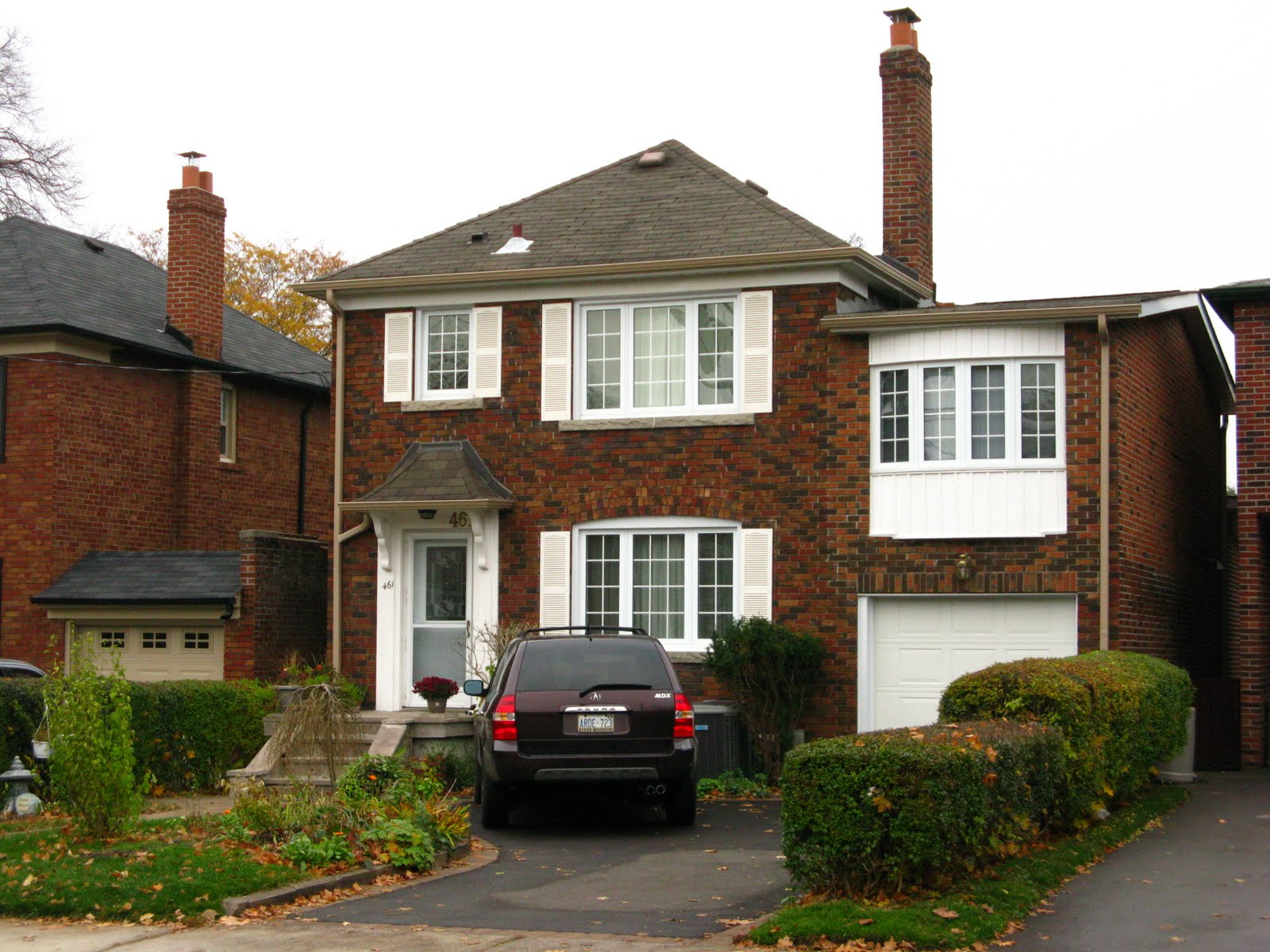
Below is his house, 461 Broadway.


...and the view across the street from his house; 458-464 Broadway, in 1948, 1949, and 2009. You can orient the view with the fire hydrant in the 1948 and 2009 shots. Incidentally... if you look closely, you'll notice an interesting trend. None of these places seems to have a garage or attendant room above it at the time of construction... but they pretty much all seem to have grown one on in the meantime (including, probably, James Salmon's house, above). I wonder when the vogue for doing this hit the neighbourhood. "So, what'll it be, honey... a garage and a family room, or a bomb shelter?" :)


 ...Looking west down Eglinton towards Bayview, 1951 and 2009...


...and east up Eglinton from Bayview, from in front of Sunnybrook Plaza. In the distance on the right is Leaside Secondary School. Again, 1951 and 2009.


I drove along Broadway a few blocks east to Brentcliffe. Brentcliffe was once the street where Eglinton effectively ended west of the Don Valley. When the Salmons first lived in the area, Eglinton didn't cross the Don yet. It more or less dead-ended in the trees above the valley. I know this for sure because one of the photos James Salmon took in the early 50s was just that. Later, he took photos of the work being done building what was called "the Eglinton Extension" between there and Victoria Park Avenue. No one calls it that anymore; I was astounded to find out there'd even been an "Eglinton Extension" when I first read about it four or five years ago. I took photos more or less matching Salmon's, and then just for good measure, walked west to Laird where he had photographed some store fronts at the northwest corner. They still looked kind of the same, in shape, if not in function. Eglinton and Brentcliffe, 1954 and 2009; Eglinton west of Laird, 1955 and 2009.


Something I noticed when I got home and processed the 3D shots into JPG pairs I could work with (geotagging, etc.) was that my camera had a displeasing tendency to shoot the right image with a hazy cast over it that was increasingly visible towards the upper right. There were no strong blacks in the right side images; they were all faintly grey. Colours were muted towards the right side, too. Earlier in the week I wondered if it were a function of the light direction, but by yesterday it was clear to me it was chronic... it had nothing to do with the direction the light was coming from. It was a defect.

I took the camera back to Henry's at lunch time today, with a few printed examples to make the point in case they thought I'd messed up the camera somehow and was just making up an excuse to bring it back. To my relief, they didn't give me any trouble at all. They simply replaced the camera from one they had in stock (I kept all the accessories that came with my original camera). I took a few shots with it in the parking lot and at stop lights, so when I get home I'll see if it has the same problem. If not, great; if so, it's a "feature" of the model I'll have to live with till there's a better one (e.g., the "W2"). Anyway, that's one reason I'm glad I bought it at Henry's and not off eBay or something.

P.S. Below, a "bonus" shot of Eglinton, looking west towards Bayview (intersection out of sight in the dip). Doesn't match up with anything; I just kind of like the look of it.


Saturday, November 14, 2009

New camera, new hero

On a Tuesday not quite two weeks ago, I drove down to the Thornhill branch of Henry's, a Canadian camera chain, at lunch time to buy a Fat Gecko suction cup tripod for my car in anticipation of getting a FujiFilm FinePix 3D W1 camera in the spring. In the process of doing so, I noticed they already had a counter set up for the camera and a price for it ($699). I inquired and found out they'd already received their first shipment and blown through them on the first day. I put in for a pick of the next litter, and was told to expect the arrival in about two weeks. Despite the fact I've been trying to pay down my credit card, I was happy I'd left a few open spots on my dance card. The world's first commercial 3D digital camera doesn't come along every day.

As it turns out, my camera arrived the following Friday. I picked it up that evening.

I've been using it for the past week or so. The image quality is what I'd call passable. It's noisy, even at ISO 100. But I went into this with my eyes open. This is a new technology; basically, two cameras wedded together. For reasons I'll get into in a moment, I felt it was important to adopt this technology as soon as it was feasible, even if the output was marginal.

A couple of years ago, I started mulling over what I've come to call The Millennium Project. I started shooting digital images in February of 1997, well over ten years ago. I have something like 120,000 stills and videos now, even with the stuff I've lost from early on. Since one of my hobbies is comparing old photos of familiar places to what I know now, it's occurred to me that, if I start cataloging my efforts now, the things I've recorded might be of use and value to someone like me in the future. Since I started just before the turn of the century, well... "The Millennium Project".

Think of the advantages we have now. We have colour. We don't have to develop film, or print from negatives. We can adjust, clarify, and enhance our images digitally with an ease that would have astounded people just 20 years ago. Add to that now the ability to easily capture a scene in three dimensions on the fly. Yes, we've arrived at that point, if only just. I have that capacity. And I think in the future, that's going to be very important.

The Toronto Public Library has a many thousands of the Toronto Reference Library's images online, and they're searchable. Lately, they've updated the selection with a whole new raft of images; ones from the 1940s, and 50s, and beyond. These are often images right at the cusp of change in what's now the mid-range areas of town, which were back then the rural fringe. Hard to image now, but it was the case when people who are still working now were children. Some of the images have been truly remarkable to me, and one of the names that kept coming up, over and over and over, was James V. Salmon. His collection speaks to me like no one else's. It seems like nearly every place I've been in the past 15 years, he anticipated and got there first... and took a picture for me, and people like me.

I was interested in Pottery Road when they started building the Bayview Extension that relegated it to a dirt track through encroaching forest... he was there. I went looking at the abutments of lost bridges carrying Lawrence Avenue over the Don and Albion (Flindon) Road over the Humber, trying to imagine what they might have looked like... he was there. What did Eglinton look like at the gap over the Don Valley before they completed it in the late 50s?... he was there. On a map I spotted a long-lost bridge that once carried Bayview Avenue over the Don and went to photograph it in 2003... he was there in 1953. The TPL's online archives are awash with images that mark this man as my spiritual father. Black and white images of the environs of the city I love, wrestled out of film negatives, showing me things I was born too late to see.

James Victor Salmon was born in Toronto May 24, 1911. He lived here all his life. Married in 1942, father to two daughters, a designer for 30 years for Toronto's electrical distribution system, he died, apparently of cancer, on November 18, 1958, at the age of 47. He was an avid collector of photos of the city, and seems to have contributed myriad images of his own to that collection for about the last ten years of his life. That collection was donated to the city, for all of us to see.

I want to follow in this man's footsteps, carrying on the work he was forced to abandon all too soon, and walk the places and see the things he was not privileged to live to see. I also want to see for the people who are not born yet... to see for them the way James Salmon saw for me.

In the fringes of the city, now, as always, things are changing. Fast. I want to record that change. What was, what's becoming, what is to be. Today I can precisely geotag these images. Today I can record these scenes in three dimensions, and give people of the future — whose computational power will dwarf what's available to us today — the ability to precisely map and recreate the spacial relationships of objects. Who knows what they'll be able to do with the meager data we reserve for them today. But even if I just give someone like me, 20, 50, 100 years from now the same unimaginable thrill that James Salmon's work has given me, I'll be able to feel that I've paid him back somehow... the only way I can in a universe where time flows just one way.

So I dedicate The Millennium Project to those like me who follow... and, in gratitude, to James Salmon and the others like him, who came before me, and left me so much. At either ends of my life, I think of you both.

Thursday, August 06, 2009

Where I want to go next...

Jim over at the stellar Down the Road blog has a fascination with photography, and in particular photographic technology, that always rejuvenates my wonder at the science behind the fun. He puts a spin on it that often emphasizes the history of the craft that's important to remember, and often intriguing, completely apart from the products that come out of such contraptions.

My own emphasis seems to be at the other end of the spectrum. :)

I consider myself a true early adopter of digital photography. I bought one of the first digital cameras available to the public, Kodak's DC25, for about $500 back in early 1997. It was awful, and I knew it. The pictures were way under a single megapixel (the word "megapixel" hadn't even entered the language yet), looked like they'd been shot through a Vaseline-smeared lens, and (the camera having no facility for expanding its memory) at best roughly a dozen "high quality" images could be stored at a time. The camera ate up expensive, non-rechargeable "N" batteries and had to be connected to the computer through the serial port to transfer images. I knew all that... but I loved it anyway. It was a digital camera! No more getting film developed, no more waiting around to see what worked and what didnt'! You took a shot and you could review it right away and if it was garbage, you could delete it... it was like getting back a frame of film, instantly. Aside from those bloody N batteries, once you'd paid for the system, taking pictures was essentially free, and the results were instantaneous. For me, that's when photography first became a viable hobby. And I knew the technology would get better over time.

And wow, did it. I honestly hadn't anticipated just how fast the technology would advance. I went through a few different models of Kodak point-and-shoots, none of them really quite a "real" camera in my mind, till we arrived at the 3-megapixel DC4800. To me, that was my first "real" digital camera. It was still a bit too bulky to carry around — still not a camera eligible for digital lomography (shooting from the hip; "don't think, just shoot"; "Kodak moment") — but as far as I could see, it could do anything a film P&S model could and give results every bit as good. I used that camera for years. I moved on to much more sophisiticated Canon models after that, which I still favour.

One of the things I most cherish about photography, though, is its ability to make the past real. In particular, I absolutely love looking at old photos of places familiar to me. I like to imagine what it would have been like to be there. Even better when I can recreate the shot today and compare and contrast them. The one thing I regret about all that is the limitations of the day. Photos taken before about 1965 are nearly always black and white. And the further back you go, the less detail the photos tend to depict. And in most cases, much before about 1890, photographically, you're out of luck. How I wish people back then had had something like the technology available to us now.

But even today I find the technology lacking in one respect: dimensionality. Even after all this time, we're still dealing with two-dimensional images that fail to adequately convey a sense of expanse, volume, placement in a physical space. I've had this idea of spending time just wandering around, shooting this and that around here, with the vague notion of cataloging it all and maybe one day handing it off to some repository where, someday, someone like me in the future will be able to look at what I saw and compare it with what he or she knows "today"... who knows. Digital photography is great for that, especially combined with geotagging, but it still falls flat where giving a sense of place in the world is concerned. For me, the last great hurdle is providing that third dimension... bringing it all together; colour, quality, and visceral depth.

And now it seems like we're at the threshold at last. Last year Fujifilm announced they'd be marketing a system to take and display (and even print) photographs in three dimensions, as well as to shoot 3D video, and to furnish photographers with a host of other interesting abilities that accrue from having two identical lenses in communication with each other in the same camera. And that camera is the FinePix Real 3D W1. Just as the Kodak DC25 was the camera I was waiting for to begin my hobby as a shutterbug, this camera is the one I've been waiting for to really start recording what it's like to be living in this time and place for people who could never see it otherwise.

Followers of this blog (both of you :) ) will know that I've been dabbling in makeshift 3D photography for two or three years now. One version of this attempt was a split lens for my Rebel XT, which gave good results in some aspects but had two drawbacks... one, the effective width of the shots was akin to shooting through an open door, and two, it relied on having the DSLR with me, which I had to plan for. The other version consisted of what P-Doug refers to as the "cha-cha" method; that is, taking one shot, shifting the camera, and taking another. This has been the method I've relied on most of the time and when it works, gives shots of fairly consistent quality. But the drawbacks here are legion: too large a paralax results in strange exaggerations of depth that must be akin to an acid flashback; some pairs, inexplicably, don't seem to "work" in a believable and satisfying way; and, most limiting of all, any movement whatsoever between the shots renders the pair essentially worthless. This has meant that the technique is effectively useless in any urban setting. There's no point trying to use this technique to show someone living in 2110 what the corner of Yonge and Dundas looked like in 2010. But now, with this camera, that's going to be possible. People walking, cars crossing intersections, even water leaping from fountains, will no longer represent impediments to recording a scene in three dimenions. If anything, they will only enhance the experience.

Some people have, not without reason, expressed reservations concerning the technology. The 3D formats are new, proprietary (which means they may not become universally or even widely usable), and technology-dependent (at least for the moment). These are valid objections, but they're not ones that concern me so long as the images and videos the 3D W1 takes can be exported as paired 2D files. It'll be nice having something in the new format (particularly for archival purposes), but so long as I can still combine two images the way I've been doing it for the past couple of years, that's all I'm worried about. I've gotten some pretty satisfying results from the cha-cha with the S80 and G9 (and even the infrared S70)... imagine how much better the results would be if the two images are simultaneously recorded, and exactly the right paralax.

Aside from shooting real 3D, the 3D W1 offers other intriging abilities: shooting colour and B&W at the same time, videoing and shooting still images of the same scene at the same time, and taking two simultaneous images to be stitched together into a single, extreme wide-angle shot. These are all things I've wanted to do in the past, and now they become possible.

The word is that this system (camera, viewer, and send-away printing) will be available in September for something in the neighbourhood of a thousand dollars US, which, at a guess, with the exchange and inevitable mark-up, will probably price it around $1200-1250 Canadian. This is something I'd really like to get my hands on. I haven't really wanted a particular system in this way since back in the days I was waiting for the first DSRL — a real real REAL digital camera — to make its debut. I want to put some money aside and get this thing and start really recording southern Ontario in all its spontaneity and full aspect. This is where I've wanted to go all along, and they've finally built me a road.