
...from Asia Times Online
------------------------
..."Only gradually, over the past two years as Iraq's WMD never materialized but a stubborn insurgency did, the bloody consequences of "patriotic" journalism have begun to dawn on the American people. By not asking tough questions, journalists contributed to a mess that has now cost the lives of nearly 2,000 US soldiers and tens of thousands of Iraqis..."
------------------------
By Robert Parry
Editor's note
September 11, 2001 and subsequent events threw into sharp focus the shortcomings of the media in the United States. In fact, contrary to popular belief, the media had been been in a steep decline for decades prior to the terrorist attacks, as veteran US journalist Robert Parry documents in the article below.
The apex for the "skeptical journalists" came in the mid-1970s when the press followed up exposure of Richard Nixon's Watergate scandal and disclosure of the Vietnam War's Pentagon Papers with revelations of Central Intelligence Agency (CIA) abuses, such as illegal spying on Americans and helping Chile's army oust an elected government.
There were reasons for this new press aggressiveness. After some 57,000 US soldiers had died in Vietnam during a long war fought for murky reasons, many reporters no longer gave the government the benefit of the doubt.
The press corps' new rallying cry was the public's right to know, even when the wrongdoing occurred in the secretive world of national security.
But this journalistic skepticism represented an affront to government officials who had long enjoyed a relatively free hand in the conduct of foreign policy. The Wise Men and the Old Boys - the stewards of the post-World War II era - now faced a harder time lining up public consensus behind any action.
This national security elite, including then-CIA director George H W Bush, viewed the post-Vietnam journalism as a threat to America's ability to strike at its perceived enemies around the world.
Yet, it was from these ruins of distrust - the rubble of suspicion left behind by Watergate and Vietnam - that the conservative-leaning national security elite began its climb back, eventually coming full circle, gaining effective control of what a more "patriotic" press would tell the people, before stumbling into another disastrous war in Iraq.
Pike report
One early turning point in the switch from "skeptical" journalism to "patriotic" journalism occurred in 1976 with the blocking of Otis Pike's congressional report on CIA misdeeds. CIA director Bush had lobbied behind the scenes to convince Congress that suppressing the report was important for national security.
But CBS news correspondent Daniel Schorr got hold of the full document and decided that he couldn't join in keeping the facts from the public. He leaked the report to the Village Voice – and was fired by CBS amid charges of reckless journalism.
"The media's shift in attention from the report's charges to their premature disclosure was skillfully encouraged by the executive branch," wrote Kathryn Olmstead in her book on the media battles of the 1970s, Challenging the Secret Government.
"[Mitchell] Rogovin, the CIA's counsel, later admitted that the executive branch's 'concern' over the report's damage to national security was less than genuine," Olmstead wrote. But the Schorr case had laid down an important marker.
The counterattack against the "skeptical journalists" had begun.
In the late 1970s, conservative leaders began a concerted drive to finance a media infrastructure of their own along with attack groups that would target mainstream reporters who were viewed as too liberal or insufficiently patriotic.
Nixon's former treasury secretary, Bill Simon, took the lead. Simon, who headed the conservative Olin Foundation, rallied like-minded foundations - associated with Lynde and Harry Bradley, Smith Richardson, the Scaife family and the Coors family - to invest their resources in advancing the conservative cause.
Money went to fund conservative magazines taking the fight to the liberals and to finance attack groups, like Accuracy in Media, that hammered away at the supposed "liberal bias" of the national news media.
Reagan-Bush years
This strategy gained momentum in the early 1980s with the arrival of Ronald Reagan's presidency.
Spearheaded by intellectual policymakers now known as the neo-conservatives, the government developed a sophisticated approach - described internally as "perception management" - that included targeting journalists who wouldn't fall into line.
So, when New York Times correspondent Raymond Bonner reported from El Salvador about right-wing death squads, his accounts were criticized and his patriotism challenged. Bonner then infuriated the White House in early 1982 when he disclosed a massacre by the US-backed Salvadoran army around the town of El Mozote. The story appeared just as Reagan was praising the army's human-rights progress.
Like other journalists who were viewed as overly critical of Reagan's foreign policy, Bonner faced both public attacks on his reputation and private lobbying of his editors, seeking his removal. Bonner soon found his career cut short. After being pulled out of Central America, he resigned from the Times.
Bonner's ouster was another powerful message to the national news media about the fate that awaited reporters who challenged Reagan's White House. (Years later, after a forensic investigation confirmed the El Mozote massacre, the Times rehired Bonner.)
Though conservative activists routinely bemoaned what they called the "liberal media" at the big newspapers and TV networks, the Reagan administration actually found many willing collaborators at senior levels of US news organizations.
At the New York Times, executive editor Abe Rosenthal followed a generally neo-conservative line of intense anticommunism and strong support for Israel. Under new owner Martin Peretz, the supposedly leftist New Republic slid into a similar set of positions, including enthusiastic backing for the Nicaraguan Contra rebels.
Where I worked at the Associated Press, its general manager, Keith Fuller, the company's top executive, was considered a staunch supporter of Reagan's foreign policy and a fierce critic of recent social change. In 1982, Fuller gave a speech condemning the 1960s and praising Reagan's election.
"As we look back on the turbulent Sixties, we shudder with the memory of a time that seemed to tear at the very sinews of this country," Fuller said during a speech in Worcester, adding that Reagan's election a year earlier had represented a nation crying "enough" ...
We don't believe that the union of Adam and Bruce is really the same as Adam and Eve in the eyes of Creation. We don't believe that people should cash welfare checks and spend them on booze and narcotics. We don't really believe that a simple prayer or a pledge of allegiance is against the national interest in the classroom. We're sick of your social engineering. We're fed up with your tolerance of crime, drugs and pornography. But most of all, we're sick of your self-perpetuating, burdening bureaucracy weighing ever more heavily on our backs.
Fuller's sentiments were common in the executive suites of major news organizations, where Reagan's reassertion of an aggressive US foreign policy mostly was welcomed. Working journalists who didn't sense the change in the air were headed for danger.
By the time of Reagan's landslide reelection in 1984, the conservatives had come up with catchy slogans for any journalist or politician who still criticized excesses in US foreign policy. They were known as the "blame America firsters" or - in the case of the Nicaragua conflict - "Sandinista sympathizers".
The practical effect of these slurs on the patriotism of journalists was to discourage skeptical reporting on Reagan's foreign policy and to give the administration a freer hand for conducting operations in Central America and the Middle East outside public view.
Gradually, a new generation of journalists began to fill key reporting jobs, bringing with them an understanding that too much skepticism on national security issues could be hazardous to one's career.
Intuitively, these reporters knew there was little or no upside to breaking even important stories that made Reagan's foreign policy look bad. That would just make you a target of the expanding conservative attack machine. You would be "controversialized", another term that Reagan operatives used to describe their anti-reporter strategies.
Iran-Contra
Often I am asked why it took so long for the US news media to uncover the secret operations that later became known as the Iran-Contra affair, clandestine arms sales to the Islamic fundamentalist government of Iran with some of the profits - and other secret funds - funneled into the Contra war against Nicaragua's Sandinista government.
Though the AP was not known as a leading investigative news organization - and my superiors weren't eager supporters - we were able to get ahead on the story in 1984, 1985 and 1986 because the New York Times, the Washington Post and other top news outlets mostly looked the other way.
It took two external events - the shooting down of a supply plane over Nicaragua in October 1986 and the disclosure of the Iran initiative by a Lebanese newspaper in November 1986 - to bring the scandal into focus.
In late 1986 and early 1987 there was a flurry of Iran-Contra coverage, but the Reagan administration largely succeeded in protecting top officials, including Reagan and George H W Bush.
The growing conservative news media, led by Reverend Sun Myung Moon's Washington Times, lashed out at journalists and government investigators who dared push the edges of the envelope or closed in on Reagan and Bush.
But resistance to the Iran-Contra scandal also penetrated mainstream news outlets. At Newsweek, where I went to work in early 1987, editor Maynard Parker was hostile to the possibility that Reagan might be implicated.
During one Newsweek dinner/interview with retired General Brent Scowcroft and then-Representative Dick Cheney, Parker expressed support for the notion that Reagan's role should be protected, even if that required perjury. "Sometimes you have to do what's good the country," Parker said.
When Iran-Contra conspirator Oliver North went on trial in 1989, Parker and other news executives ordered that Newsweek's Washington bureau not even cover the trial, presumably because Parker just wanted the scandal to go away.
(When the North trial became a major story anyway, I was left scrambling to arrange daily transcripts so we could keep abreast of the trial's developments. Because of these and other differences over the Iran-Contra scandal, I left Newsweek in 1990.)
Iran-Contra special prosecutor, Lawrence Walsh, a Republican, also encountered press hostility when his investigation finally broke through the White House cover-up in 1991. Moon's Washington Times routinely lambasted Walsh and his staff over minor issues, such as the elderly Walsh flying first class on airplanes or ordering room-service meals.
But the attacks on Walsh were not coming only from the conservative news media. Toward the end of 12 years of Republican rule, mainstream journalists also realized their careers were far better served by staying on the good side of the Reagan-Bush crowd.
So, when George H W Bush sabotaged Walsh's probe by issuing six Iran-Contra pardons on Christmas Eve 1992, prominent journalists praised Bush's actions. They brushed aside Walsh's complaint that the move was the final act in a long-running cover-up that protected a secret history of criminal behavior and Bush's personal role.
"Liberal" Washington Post columnist Richard Cohen spoke for many of his colleagues when he defended Bush's fatal blow against the Iran-Contra investigation. Cohen especially liked Bush's pardon of former defense secretary Caspar Weinberger, who had been indicted for obstruction of justice but was popular around Washington.
In a December 30, 1992, column, Cohen said his view was colored by how impressed he was when he would see Weinberger in the Georgetown Safeway store, pushing his own shopping cart. "Based on my Safeway encounters, I came to think of Weinberger as a basic sort of guy, candid and no nonsense - which is the way much of official Washington saw him," Cohen wrote. "Cap, my Safeway buddy, walks, and that's all right with me."
For fighting too hard for the truth, Walsh drew derision as a kind of Captain Ahab obsessively pursuing the White Whale. Writer Marjorie Williams delivered this damning judgment against Walsh in a Washington Post magazine article, which read:
In the utilitarian political universe of Washington, consistency like Walsh's is distinctly suspect. It began to seem ... rigid of him to care so much. So un-Washington. Hence the gathering critique of his efforts as vindictive, extreme. Ideological. ... But the truth is that when Walsh finally goes home, he will leave a perceived loser.
By the time the Reagan-Bush era ended in January 1993, the era of the "skeptical journalist" was dead, at least on issues of national security.
The Webb case
Even years later, when historical facts surfaced suggesting that serious abuses had been missed around the Iran-Contra affair, mainstream news outlets took the lead in rallying to the Reagan-Bush defense.
When a controversy over Contra-drug trafficking reemerged in 1996, the Washington Post, the New York Times and the Los Angeles Times went on the attack - against Gary Webb, the reporter who revived interest in the scandal. Even admissions of guilt by the CIA's inspector general in 1998 didn't shake the largely dismissive treatment of the issue by the major newspapers.
(For Webb's courageous reporting, he was pushed out of his job at the San Jose Mercury News, his career was ruined, his marriage collapsed and - in December 2004 - he killed himself with his father's revolver.)
When Republican rule was restored in 2001 with George W Bush's controversial "victory", major news executives and many rank-and-file journalists understood that their careers could best be protected by wrapping themselves in the old red-white-and-blue. "Patriotic" journalism was in; "skeptical" journalism was definitely out.
That tendency deepened even more after the September 11, 2001 terror attacks as many journalists took to wearing American flag lapels and avoided critical reporting about Bush's sometimes shaky handling of the crisis.
For instance, Bush's seven-minute freeze in a second-grade classroom - after being told "the nation is under attack" - was hidden from the public, even though it was filmed and witnessed by White House pool reporters. (Millions of Americans were shocked when they finally saw the footage two years later in Michael Moore's Fahrenheit 9/11.)
In November 2001, to avoid other questions about Bush's legitimacy, the results of a media recount of the Florida vote were misrepresented to obscure the finding that Al Gore would have carried the state - and thus the White House - if all legally cast votes were counted.
Iraq War
In 2002, as Bush shifted focus from Osama bin Laden and Afghanistan to Saddam Hussein and Iraq, the "patriotic" journalists moved with him.
Some of the few remaining "skeptical" media personalities were silenced, such as MSNBC's host Phil Donahue, whose show was canceled because he invited on too many war opponents.
In most newspapers, the occasional critical articles were buried deep inside, while credulous stories accepting the administration's claims about Iraq's alleged weapons of mass destruction were bannered on page one.
New York Times reporter Judith Miller was in her element as she tapped into her friendly administration sources to produce weapons of mass destruction (WMD)stories, like the one about how Iraq's purchase of aluminum tubes was proof that it was building a nuclear bomb. The article gave rise to the White House warning that Americans couldn't risk the "smoking gun" on Iraq's WMD being "a mushroom cloud".
In February 2003, when then secretary of state Colin Powell made his United Nations speech accusing Iraq of possessing WMD stockpiles, the national news media swooned at his feet. The Washington Post's op-ed page was filled with glowing tributes to his supposedly air-tight case, which would later be exposed as a mix of exaggerations and outright lies.
The rout of "skeptical" journalism was so complete - driven to the fringes of the Internet and to a few brave souls in Knight-Ridder's Washington bureau - that the "patriotic" reporters often saw no problem casting aside even the pretense of objectivity.
In the rush to war, news organizations joined in ridiculing the French and other longtime allies who urged caution. Those countries became the "axis of weasels" and cable TV devoted hours of coverage to diners that renamed "French fries" as "Freedom fries".
Once the invasion began, the coverage on MSNBC, CNN and the major networks was barely discernable from the patriotic fervor on Fox. Like Fox News, MSNBC produced promotional segments, packaging heroic footage of American soldiers, often surrounded by thankful Iraqis and underscored with stirring music.
"Embedded" reporters often behaved like excited advocates for the American side of the war. But objectivity also was missing back at the studios where anchors voiced outrage about Geneva Convention violations when Iraqi TV aired pictures of captured American soldiers, but the US media saw nothing wrong with broadcasting images of captured Iraqis.
As Judith Miller would later remark unabashedly, she saw her beat as "what I've always covered - threats to our country". Referring to her time "embedded" with a US military unit searching for WMD, she claimed that she had received a government "security clearance".
While the 57-year-old Miller may be an extreme case of mixing patriotism and journalism, she is far from alone as a member of her generation who absorbed the lessons of the 1980s, that skeptical journalism on national security issues was a fast way to put yourself in the unemployment line.
Only gradually, over the past two years as Iraq's WMD never materialized but a stubborn insurgency did, the bloody consequences of "patriotic" journalism have begun to dawn on the American people. By not asking tough questions, journalists contributed to a mess that has now cost the lives of nearly 2,000 US soldiers and tens of thousands of Iraqis.
Retired Army Lieutenant General William Odom, a top military intelligence official under Reagan, has predicted that the Iraq invasion "will turn out to be the greatest strategic disaster in US history".
Plame case
At the core of this disaster were the cozy relationships between the "patriotic" journalists and their sources.
In her October 16 account of her interviews with Vice President Dick Cheney's chief of staff, I Lewis "Scooter" Libby, Miller gave the public an inadvertent look into that closed world of shared secrets and mutual trust.
Libby talked with Miller in two face-to-face meetings and one phone call in 2003, as the Bush administration tried to beat back post-invasion questions about how the president made his case for war, according to Miller's story.
As Miller agreed to let Libby hide behind a misleading identification as a "former Hill staffer", Libby unleashed a harsh attack on one whistleblower, former ambassador Joseph Wilson, who was challenging Bush's claims that Iraq had sought enriched uranium from the African nation of Niger.
The Miller/Libby interviews included Libby's references to Wilson's wife, Valerie Plame, who was an undercover CIA officer working on proliferation issues.
On July 14, 2003, right-wing columnist Robert Novak, claiming to have been briefed by two administration officials, outed Plame in a column that denigrated Wilson with the suggestion that Plame may have arranged the trip to Niger for her husband.
Eventually, this outing of a covert CIA agent prompted a criminal investigation headed by special prosecutor Patrick Fitzgerald, who is examining a possible administration conspiracy to punish Wilson for his criticism. When Miller refused to testify about her meetings with Libby, Fitzgerald had her jailed for 85 days.
Miller finally relented after Libby encouraged her to do so. "Out West, where you vacation, the aspens will already be turning," Libby wrote in a folksy letter. "They turn in clusters because their roots are connected."
While the Plame case has become a major embarrassment for the Bush administration - and now for the New York Times - it has not stopped many of Miller's colleagues from continuing their old roles as "patriotic" journalists opposing the disclosure of too many secrets to the American people.
For instance, Washington Post columnist Richard Cohen - who hailed George H W Bush's pardons that destroyed the Iran-Contra investigation in 1992 - adopted a similar stance against Fitzgerald's investigation.
"The best thing Patrick Fitzgerald could do for his country is get out of Washington, return to Chicago and prosecute some real criminals," Cohen wrote in a column entitled "Let This Leak Go".
"As it is, all he has done so far is send Judith Miller of the New York Times to jail and repeatedly haul this or that administration high official before a grand jury, investigating a crime that probably wasn't one in the first place but that now, as is often the case, might have metastasized into some sort of cover-up - but again, of nothing much," Cohen wrote. "Go home, Pat."
If Fitzgerald does as Cohen wishes and closes down the investigation without indictments, the result could well be the continuation of the status quo in Washington. The Bush administration would get to keep control of the secrets and reward friendly "patriotic" journalists with selective leaks - and protected careers.
It is that cozy status quo that is now endangered by the Plame case. But the stakes of the case are even bigger than that, going to the future of American democracy and to two questions in particular:
Will journalists return to the standard of an earlier time when disclosing important facts to the electorate was the goal, rather than Cohen's notion of putting the comfortable relationships between Washington journalists and government officials first?
Put differently, will journalists decide that confronting the powerful with tough questions is the true patriotic test of a journalist?
Robert Parry broke many of the Iran-Contra stories in the 1980s for the Associated Press and Newsweek. His latest book, Secrecy & Privilege: Rise of the Bush Dynasty from Watergate to Iraq, can be ordered at secrecyandprivilege.com. It's also available at Amazon.com, as is his 1999 book, Lost History: Contras, Cocaine, the Press & 'Project Truth.'
Friday, November 18, 2005

Monday, November 14, 2005
Blame the mirror
I just read a very interesting article at the Asia Times Online. Basically, it suggests what we all so vehemently love to deny... that what our governments do in the West is our fault, because we — as a society — place the people in power who express our national characters. By this I don't mean every single one of us... but overall, as societies. Here are a few telling points from the article...
...American immigration laws, to be sure, favor the rich, the talented and educated. But that sheds some light on the character of the United States, which absorbs immigrants directly into its elite. Europe, which allows barely one in eight of its school leavers into university, does not want immigrants who might displace the local talent. It has recruited an immigrant population of dustmen, whose children burn cars out of frustration. As their numbers diminish, the Europeans confront an army of 30 million unemployed young Arabs, which they neither can absorb nor expel. The reason that the leaders of France can offer no solution to the present crisis is that no solution exists, given the present demography and predilections of the population of France.
The tragedy of the Americans, I have argued in the past, is that they cannot understand the tragedy of other peoples. With force as deadly as the mounted hordes of the past, America's influence has swept through the world and overturned the traditional order, leaving ill-prepared peoples to fend for themselves in the chaos...
...Tragedy entertains us on the stage because tragic protagonists do not know that they are tragic, even after the chorus admonishes them that this is the case. Bush will go into retirement wondering what he did wrong. The trouble is not what he did, but what he is, and what Americans are.
In the classic tragedy of Greek religious festivals, the tragedy of the individual is the tragedy of a culture; the case of Orestes can be resolved only by a cultural change, in this case trial by jury at Athens. Bush, whose second administration has failed on all fronts after 10 months in office, may be less articulate than Pericles, but he is no less tragic, and his tragedy is that of the Americans as a people, just as Chirac's tragedy is that of the French.
...American immigration laws, to be sure, favor the rich, the talented and educated. But that sheds some light on the character of the United States, which absorbs immigrants directly into its elite. Europe, which allows barely one in eight of its school leavers into university, does not want immigrants who might displace the local talent. It has recruited an immigrant population of dustmen, whose children burn cars out of frustration. As their numbers diminish, the Europeans confront an army of 30 million unemployed young Arabs, which they neither can absorb nor expel. The reason that the leaders of France can offer no solution to the present crisis is that no solution exists, given the present demography and predilections of the population of France.
The tragedy of the Americans, I have argued in the past, is that they cannot understand the tragedy of other peoples. With force as deadly as the mounted hordes of the past, America's influence has swept through the world and overturned the traditional order, leaving ill-prepared peoples to fend for themselves in the chaos...
...Tragedy entertains us on the stage because tragic protagonists do not know that they are tragic, even after the chorus admonishes them that this is the case. Bush will go into retirement wondering what he did wrong. The trouble is not what he did, but what he is, and what Americans are.
In the classic tragedy of Greek religious festivals, the tragedy of the individual is the tragedy of a culture; the case of Orestes can be resolved only by a cultural change, in this case trial by jury at Athens. Bush, whose second administration has failed on all fronts after 10 months in office, may be less articulate than Pericles, but he is no less tragic, and his tragedy is that of the Americans as a people, just as Chirac's tragedy is that of the French.
Saturday, November 12, 2005
Driving in the Trees
Rule of Proportions #318
The likelihood that a driver will use his turn signals to indicate a lane change is in inverse proportion to the value of his automobile.
The likelihood that a driver will use his turn signals to indicate a lane change is in inverse proportion to the value of his automobile.
Capote
Last night I went with P-Doug to see Capote. It's not really a plot-driven movie, so it's not like I can give away the ending in discussing it... but if you're one of those people who has to walk into a movie utterly blind, better skip this posting.
This is an amazing movie. I figured it would be, but it didn't disappoint. The movie captures the period in Truman Capote's life during the writing of In Cold Blood, one of the most important journalistic works of the 20th century. It spares time for nothing else. Capote (played by Philip Seymour Hoffman) is cutting the clippling out of the New York Times within minutes of the start of the movie; it ends with him still reeling from watching Perry Smith being hanged.
I don't know that much about Truman Capote as an historical figure, so I'm in no position to judge how accurate Hoffman's portrayal actually is. But all the same, the persona into which he slips so seamlessly is so strange, so unlike any other character I've seen him portray, that he would deserve the Oscar just for the ability to summon up a character so different from himself and make him believable, even if the mark he hit were miles away from Truman Capote's real character. I have no reason to doubt, though, that his portrayal is a reasonably accurate approximation of what Capote must have been like at that point in his life.
The movie depicts Capote as a bon vivant verging on 40, living a quiet life during the day but moving in bright, noisy circles at night. Alcohol, though a constant companion, is at this point still a gentle one. Inexplicably fascinated with the report of the slaying of an entire family of four at a remote farmhouse in Kansas, Capote sets out with lifelong friend Nelle Harper Lee (of To Kill a Mockingbird fame) to write what he is firmly convinced from the outset is the book he was born to write. As history turns out, he was entirely correct.
In fairly short order the murderers are apprehended, and Capote bribes his way into their presence. He is portrayed as being particularly taken with Perry Smith. The movie believably implies, overtly but without grinding it into the dirt, that Truman identified with Perry because they both led childhoods where they were essentially abandoned. In one scene, Truman muses to Nelle that he feels as though he lived in the same house with Perry, only that Perry went out the back door and he went out the front. The unstated implication is that Truman felt a "there, but for the grace of God, go I" shiver in dealing with Perry.
Plenty of cold blood to go around
The murders were committed in 1959, and it took Capote till 1965 to finish his book. In the course of it, he finally settled on a title: In Cold Blood. There's plenty of that in this movie. Aside from the brutality of the murders of the Clutter family themselves, there are the dark forces that trail afterwards, even in good people. Capote essentially bribes a prison warden who has his eye on taking a seat in Congress. He manipulates Perry Smith into parting with his diaries, and in a scene of masterful ambiguity, reads a passage from them over the phone to Nelle. The passage deals with Smith's craving for recognition — again, a touchstone with Truman — and Truman's intentions in sharing it with Nelle are unclear. Nelle's reaction is anything but; when her dreadful silence prompts Truman to ask if she's still there, she acidly suggests he is wallowing in ridiculing this man. Whether her reaction is right or wrong, her disgust with his behaviour is powerful. When, later, Perry Smith eventually learns of the title Capote has chosen for his work in progress and confronts Truman with it, he unblushingly lies to Smith, instantly and convincingly telling him it was the publisher's choice to draw the hoi poloi, implying it will be changed before publication. The audience is left in jaw-dropping horror at the duplicity — or at least I was.
Capote took it upon himself to find representation for Smith and Hickock, beginning a long, drawn-out series of legal procedures. At one point, investigating officer Alvin Dewey, rising from breakfast with Capote at the local diner, promises that if Capote's counsel springs the murders, that he himself intends to go to New York and kill Truman. The promise is delivered with such froideur, resignation, and matter-of-factness that it is impossible to disbelieve it.
But the coldest blood of all may be Truman's. In an unforgetable scene four years after the murder, he devastatingly belittles Smith's attempts at erudition (which, frankly, verge on insulting as he explains 'big' words to Truman), admits to Smith that all he's interested in is hearing about the details of the murder, which have not been forthcoming, and suggests that he wants nothing more to do with the men until they are. (That the relationship can, and does, recover from this sub-zero free-out is astonishing.) But most remarkable of all is Truman's attitude towards the men. Regardless of his feelings towards them, they are first and foremost his tools — resources in his writing. Initially a "gold mine", they later become a liability as he finds himself unable to finish the book until the closure of their executions is a fait accompli. In a horrific comedy of errors, Truman's own legal efforts on their behalf take on a life of their own, lumbering on in appeal after appeal and stay after stay, until the audience is treated to the macabre spectacle of Truman whining on the phone that he is being "tortured", seeming to utterly fail to realize that what he is talking about is the continued existence of two human beings, however monstrous. Eventually, he withdraws his support, his aid, and his friendship, and waits for them to serve his purpose by dying, which finally they do, but not before shaming him in an eleventh-hour confrontation in which the vicious killers forgive and absolve their so-called friend, whose penance is to stand by and watch them take the drop. In the final scene, Truman is again on the phone to Nelle, again inwardly focused, speaking his own ordeal, and trying to convince both her and himself that he did all his could to save Smith and Hickock. Nelle is having none of it, and condemns his efforts as cynical. Anyone vaguely familiar with the tatty details of the last two decades of Capote's life (like me) sees in this the seeds of what followed: alcoholism, drug abuse, alienation, and the inability to ever complete another book. In Cold Blood used up so much of Capote's emotional resources that he too became a willing victim of the Clutter killers.
I don't ordinarily invest myself emotionally in the Academy Awards, but I really will be cheering for this one next spring. The movie, the writer, Hoffman, and Clifton Collins Jr. (Perry Smith), at least, all deserve the nomination nod, if not the golden statue itself. Don't miss this one. This is as human as it gets.
This is an amazing movie. I figured it would be, but it didn't disappoint. The movie captures the period in Truman Capote's life during the writing of In Cold Blood, one of the most important journalistic works of the 20th century. It spares time for nothing else. Capote (played by Philip Seymour Hoffman) is cutting the clippling out of the New York Times within minutes of the start of the movie; it ends with him still reeling from watching Perry Smith being hanged.
I don't know that much about Truman Capote as an historical figure, so I'm in no position to judge how accurate Hoffman's portrayal actually is. But all the same, the persona into which he slips so seamlessly is so strange, so unlike any other character I've seen him portray, that he would deserve the Oscar just for the ability to summon up a character so different from himself and make him believable, even if the mark he hit were miles away from Truman Capote's real character. I have no reason to doubt, though, that his portrayal is a reasonably accurate approximation of what Capote must have been like at that point in his life.
The movie depicts Capote as a bon vivant verging on 40, living a quiet life during the day but moving in bright, noisy circles at night. Alcohol, though a constant companion, is at this point still a gentle one. Inexplicably fascinated with the report of the slaying of an entire family of four at a remote farmhouse in Kansas, Capote sets out with lifelong friend Nelle Harper Lee (of To Kill a Mockingbird fame) to write what he is firmly convinced from the outset is the book he was born to write. As history turns out, he was entirely correct.
In fairly short order the murderers are apprehended, and Capote bribes his way into their presence. He is portrayed as being particularly taken with Perry Smith. The movie believably implies, overtly but without grinding it into the dirt, that Truman identified with Perry because they both led childhoods where they were essentially abandoned. In one scene, Truman muses to Nelle that he feels as though he lived in the same house with Perry, only that Perry went out the back door and he went out the front. The unstated implication is that Truman felt a "there, but for the grace of God, go I" shiver in dealing with Perry.
Plenty of cold blood to go around
The murders were committed in 1959, and it took Capote till 1965 to finish his book. In the course of it, he finally settled on a title: In Cold Blood. There's plenty of that in this movie. Aside from the brutality of the murders of the Clutter family themselves, there are the dark forces that trail afterwards, even in good people. Capote essentially bribes a prison warden who has his eye on taking a seat in Congress. He manipulates Perry Smith into parting with his diaries, and in a scene of masterful ambiguity, reads a passage from them over the phone to Nelle. The passage deals with Smith's craving for recognition — again, a touchstone with Truman — and Truman's intentions in sharing it with Nelle are unclear. Nelle's reaction is anything but; when her dreadful silence prompts Truman to ask if she's still there, she acidly suggests he is wallowing in ridiculing this man. Whether her reaction is right or wrong, her disgust with his behaviour is powerful. When, later, Perry Smith eventually learns of the title Capote has chosen for his work in progress and confronts Truman with it, he unblushingly lies to Smith, instantly and convincingly telling him it was the publisher's choice to draw the hoi poloi, implying it will be changed before publication. The audience is left in jaw-dropping horror at the duplicity — or at least I was.
Capote took it upon himself to find representation for Smith and Hickock, beginning a long, drawn-out series of legal procedures. At one point, investigating officer Alvin Dewey, rising from breakfast with Capote at the local diner, promises that if Capote's counsel springs the murders, that he himself intends to go to New York and kill Truman. The promise is delivered with such froideur, resignation, and matter-of-factness that it is impossible to disbelieve it.
But the coldest blood of all may be Truman's. In an unforgetable scene four years after the murder, he devastatingly belittles Smith's attempts at erudition (which, frankly, verge on insulting as he explains 'big' words to Truman), admits to Smith that all he's interested in is hearing about the details of the murder, which have not been forthcoming, and suggests that he wants nothing more to do with the men until they are. (That the relationship can, and does, recover from this sub-zero free-out is astonishing.) But most remarkable of all is Truman's attitude towards the men. Regardless of his feelings towards them, they are first and foremost his tools — resources in his writing. Initially a "gold mine", they later become a liability as he finds himself unable to finish the book until the closure of their executions is a fait accompli. In a horrific comedy of errors, Truman's own legal efforts on their behalf take on a life of their own, lumbering on in appeal after appeal and stay after stay, until the audience is treated to the macabre spectacle of Truman whining on the phone that he is being "tortured", seeming to utterly fail to realize that what he is talking about is the continued existence of two human beings, however monstrous. Eventually, he withdraws his support, his aid, and his friendship, and waits for them to serve his purpose by dying, which finally they do, but not before shaming him in an eleventh-hour confrontation in which the vicious killers forgive and absolve their so-called friend, whose penance is to stand by and watch them take the drop. In the final scene, Truman is again on the phone to Nelle, again inwardly focused, speaking his own ordeal, and trying to convince both her and himself that he did all his could to save Smith and Hickock. Nelle is having none of it, and condemns his efforts as cynical. Anyone vaguely familiar with the tatty details of the last two decades of Capote's life (like me) sees in this the seeds of what followed: alcoholism, drug abuse, alienation, and the inability to ever complete another book. In Cold Blood used up so much of Capote's emotional resources that he too became a willing victim of the Clutter killers.
I don't ordinarily invest myself emotionally in the Academy Awards, but I really will be cheering for this one next spring. The movie, the writer, Hoffman, and Clifton Collins Jr. (Perry Smith), at least, all deserve the nomination nod, if not the golden statue itself. Don't miss this one. This is as human as it gets.
Friday, November 11, 2005
End of an era
I heard this morning that for the first time in our history, no World War One veterans will be in attendence at the Remembrance Day ceremonies at the Cenotaph in Ottawa. I read an estimate a few moments ago — with no idea how old a reference it is — that ten or fewer of them are left alive across the country. When I was a kid, they were not yet entirely rare. Old men in their late 70s, mostly. But now, the youngest of them is in the vicinity of 100. We're at the very cusp of the passing of a war from living memory, the way the US Civil War did in the 1950s. Already none are in sufficient health to attend. In just a few years at most, there will be no one left alive who can remember that time first-hand. It's a sobering thought. But it brings into sharp focus the way that we are all woven into the past, and the future.
"War brings out the beast in every man"...
Last night I was introduced to one of those sleeper movies that just pop up in your life from time to time right out of nowhere. The movie was called The Beast, shortened from The Beast of War.
Released in 1988 — when the Cold War was nearly, but not just quite yet, over — the picture is set in 1981 during the Soviet invasion of Afghanistan. It follows two threads that are quickly braided: the story of a Russian tank crew lost in the Afghani desert, and the resistence fighters of the small village the tank crew assaults in their absence. The central figures are the young tank driver, Koverchenko, and the new "Khan" of the tribe, Taj — unwittingly 'elected' by the tank crew when they execute Taj's brother, the previous Khan. Koverchenko is a free-thinker, a trait which has seen him demoted several times, as he is reminded by his overzealous commander, Daskal. As a result of several moral clashes, Koverchenko finds himself increasingly at odds with Daskal, who feels justified in doing whatever occurs to him to further the aims of the war. The scene in which Daskal recounts his role as an eight-year-old tank-killer in the Battle of Stalingrad, earning him the nickname "Tank Boy" from the soldiers, adds a note of needed humanity to the character, who might otherwise be discountable as a cardboard villain. Koverchenko, on the other hand, is a man who thinks highly of his country, but for whom that means expecting his country to do the right thing, and lead by example. When the two men finally clash, Koverchenko is faced with a hard choice, not unlike that, it seems to me, of a surgeon having to excise a cancer from his own body.
I think what impresses me most about the movie is the intellectual risk it takes. The Russians in this movie are played by Americans. But they're not played "as Russians"; no one is strutting around spouting slogans in a rubbery Mr. Chekov-style Russian accent. The actors speak in normal, unaccented (to my ears) North American English. This has the powerful effect of making the Russians "us" for an American or other English-speaking audience. It becomes virtually impossible not to identify with these men: the distance of their foreignness is eliminated, its insulation stripped away. Suddenly the Russians invading Afghanistan cease to be just an evil faceless mob, the stormtroopers of the Evil Empire. We're put in the disquieting psychological space of being "the enemy". Interestingly, the Afghanis (supposedly "our" side at the time) speak an Afghan language (either Dari or Pashtu), subtitled in English. The strangeness of their ways and mode of speech is preserved. We are invited to sympathize with them, but not to be them. In this movie, we are the Russians.
In the context of the time, 1988, this movie must have been about putting smug Westerners in the the place of the average Russian and suggesting that they had the same range of emotional responses and moral conflicts as anyone else. In the context of 2005, though, it takes on a new life, and a highly ironic one at that. No one in 1988 could have imagined that in the opening years of the next century, the voices of tank crews in Afghanistan would be those speaking North American English (among other varieties). Today Americans and, yes, even Canadians are serving in very much the same capacities as the Russians were in that land twenty years ago. Even more imporantly, I think only the thickest or most willfully callous American or Briton could watch the opening scenes of absolute power corrupting absolutely without squirming and knowing that, deep down, "our" side is now behaving the same way on a daily basis in Iraq. Only the most credulous patriot could possibly imagine that "we" would never do the things that others do, or have done before. The Beast is what it always was: a movie about human morality rising above a reptilian sense of duty. In 1988, it was about the Russians. Now, it's about us. Everyone who ever voted Republican or Conservative out of a sense that the West has a moral superiority and thus the right to impose its will on outsiders ought to be forced to watch this movie... again and again, if necessary, till the message sinks in.
Released in 1988 — when the Cold War was nearly, but not just quite yet, over — the picture is set in 1981 during the Soviet invasion of Afghanistan. It follows two threads that are quickly braided: the story of a Russian tank crew lost in the Afghani desert, and the resistence fighters of the small village the tank crew assaults in their absence. The central figures are the young tank driver, Koverchenko, and the new "Khan" of the tribe, Taj — unwittingly 'elected' by the tank crew when they execute Taj's brother, the previous Khan. Koverchenko is a free-thinker, a trait which has seen him demoted several times, as he is reminded by his overzealous commander, Daskal. As a result of several moral clashes, Koverchenko finds himself increasingly at odds with Daskal, who feels justified in doing whatever occurs to him to further the aims of the war. The scene in which Daskal recounts his role as an eight-year-old tank-killer in the Battle of Stalingrad, earning him the nickname "Tank Boy" from the soldiers, adds a note of needed humanity to the character, who might otherwise be discountable as a cardboard villain. Koverchenko, on the other hand, is a man who thinks highly of his country, but for whom that means expecting his country to do the right thing, and lead by example. When the two men finally clash, Koverchenko is faced with a hard choice, not unlike that, it seems to me, of a surgeon having to excise a cancer from his own body.
I think what impresses me most about the movie is the intellectual risk it takes. The Russians in this movie are played by Americans. But they're not played "as Russians"; no one is strutting around spouting slogans in a rubbery Mr. Chekov-style Russian accent. The actors speak in normal, unaccented (to my ears) North American English. This has the powerful effect of making the Russians "us" for an American or other English-speaking audience. It becomes virtually impossible not to identify with these men: the distance of their foreignness is eliminated, its insulation stripped away. Suddenly the Russians invading Afghanistan cease to be just an evil faceless mob, the stormtroopers of the Evil Empire. We're put in the disquieting psychological space of being "the enemy". Interestingly, the Afghanis (supposedly "our" side at the time) speak an Afghan language (either Dari or Pashtu), subtitled in English. The strangeness of their ways and mode of speech is preserved. We are invited to sympathize with them, but not to be them. In this movie, we are the Russians.
In the context of the time, 1988, this movie must have been about putting smug Westerners in the the place of the average Russian and suggesting that they had the same range of emotional responses and moral conflicts as anyone else. In the context of 2005, though, it takes on a new life, and a highly ironic one at that. No one in 1988 could have imagined that in the opening years of the next century, the voices of tank crews in Afghanistan would be those speaking North American English (among other varieties). Today Americans and, yes, even Canadians are serving in very much the same capacities as the Russians were in that land twenty years ago. Even more imporantly, I think only the thickest or most willfully callous American or Briton could watch the opening scenes of absolute power corrupting absolutely without squirming and knowing that, deep down, "our" side is now behaving the same way on a daily basis in Iraq. Only the most credulous patriot could possibly imagine that "we" would never do the things that others do, or have done before. The Beast is what it always was: a movie about human morality rising above a reptilian sense of duty. In 1988, it was about the Russians. Now, it's about us. Everyone who ever voted Republican or Conservative out of a sense that the West has a moral superiority and thus the right to impose its will on outsiders ought to be forced to watch this movie... again and again, if necessary, till the message sinks in.
Sunday, November 06, 2005
A Ripple, In Passing
Driveways treelined, neighbours sparce,
plain houses hug the country road
embraced by family fields,
and garbed in ancient thickets
Bright and hopeful, porch lights glow
But not for me.
Oh, to belong
To a warm kitchen with
its welcoming smiles,
soft background AM-borne,
and the presence of others,
unseen but felt,
awaiting the call to a shared moment...
I push on
into falling dusk;
The orphaned leaves run wild.
plain houses hug the country road
embraced by family fields,
and garbed in ancient thickets
Bright and hopeful, porch lights glow
But not for me.
Oh, to belong
To a warm kitchen with
its welcoming smiles,
soft background AM-borne,
and the presence of others,
unseen but felt,
awaiting the call to a shared moment...
I push on
into falling dusk;
The orphaned leaves run wild.
Wednesday, November 02, 2005
Eros Corsicana
Sat on a curb at the edge of the street
Sat on a street at the edge of the summer
All freckles and eloquence,
She took a deep breath
And in her hands held out her heart to me
"I love you," she whispered
I plunged the dagger with every barking laugh
It was years before I understood
My heart was Corsican twin to hers
When I saw the boy who didn't laugh
And felt the stabbing pains of wounds
Unsuspected
Ancient
Self-inflicted.
Sat on a street at the edge of the summer
All freckles and eloquence,
She took a deep breath
And in her hands held out her heart to me
"I love you," she whispered
I plunged the dagger with every barking laugh
It was years before I understood
My heart was Corsican twin to hers
When I saw the boy who didn't laugh
And felt the stabbing pains of wounds
Unsuspected
Ancient
Self-inflicted.
Tuesday, November 01, 2005
Worst... president... ever...! -- or thereabouts...
From Environics...
------------------------------------------------
10/20/2005 5:05:31 PM
Bash Thy Neighbour
The last time Canadians so disliked a U.S. president, the Americans were shooting at us, says pollster-author MICHAEL ADAMS.
by: Micheal Adams
Globe and Mail, October 19, 2005
The last time Canadians so disliked a U.S. president, the Americans were shooting at us, says pollster-author MICHAEL ADAMS. But we feel antagonism at our own peril.
Canada and its best friend and ally are going through a rough patch. This patch could get rougher - a lot rougher.
Our Prime Minister, in a speech at the Economic Club of New York on Oct. 6, told the American business community that in not adhering to the North American free-trade agreement's dispute settlement process on softwood lumber, America was jeopardizing the treaty that guarantees the United States unfettered access to Canadian energy resources. He did not threaten to tax Canadian oil and gas exports going into the U.S. and to divert those tax revenues to the softwood lumber industry in response to parallel U.S. measures, but certainly Paul Martin raised the temperature in our most pressing trade dispute. Then he dispatched Natural Resources Minister John McCallum to Beijing to say that we were keen to boost trade with the Chinese.
To many, this flexing of Canadian muscle would be laughable if it weren't so dangerous. That Canada could reduce its dependence on the U.S. market, which currently takes in 87 per cent of our exports, by diverting its output to other countries in the near future seems fanciful at best. So why is the Prime Minister acting in this way?
As former U.S. Speaker of the House Tip O'Neill used to say, "All politics is local" - and here in Canada, we have a minority Liberal government just three points (in our latest poll) ahead of the Conservative opposition, and probably just months away from a promised federal election.
The Liberals cannot easily play their traditional role of uniting the country by appealing to French Quebec and building out from this base to Ontario and urban Canada. Nor can they play the health-care card. The polls say it's the No. 1 issue in Canadians' minds, but this is hard for the Liberals to leverage as Stephen Harper has promised to spend as much in this area as the Liberals - astutely leaving any talk of private-sector alternatives (that second tier/third rail issue) to Ralph Klein.
So what cards are left in the Liberals' hands? Canadian nationalism, which has always been bound up in wariness of the United States.
America and the U.S. government are less popular in Canada today than any time since polls were first conducted in this country in the 1930s. To find similar anti-American sentiment, you'd probably have to go back to the federal election of 1911, when Wilfrid Laurier's espousal of trade reciprocity with the United States cost him re-election.
The public-opinion trends do not augur well. In 1981, the year Ronald Reagan was inaugurated, seven per cent of Canadians told us they had an unfavourable opinion of the U.S., while 10 times that proportion (72 per cent) reported a favourable impression of our southern neighbour. Today the proportion reporting an unfavourable impression is 48 per cent, and the proportion reporting a favourable opinion is down to 50 per cent.
We are talking here of America as a country, not the administration of George W. Bush. Favourable opinion of the United States has been eroding gradually over the years, but its decline accelerated sharply when W. was first elected in the fall of 2000. And if his Republican administration was unpopular in 2000, it was anathema in 2004.In 2000, 29 per cent of Canadians would have voted for Mr. Bush had they had the opportunity. Forty-eight per cent would have voted for Democratic candidate Al Gore. By 2004, Mr. Bush was down to 15 per cent in Canada, and John Kerry would have garnered 70 per cent of the Canadian vote. George W. Bush is probably the least popular president of the United States in Canada since James Madison led his country in the War of 1812.
(In 1992, George W.'s father George H.W. was actually preferred over Bill Clinton by a margin of 39 per cent to 31 per cent; we liked the kinder, gentler Mr. Bush better than his more religious, neo-conservative son.)
As for co-operation, only 10 per cent of Canadians want their government to do everything it can to get along with the United States; 70 per cent want the government to try to get along but hold the line on issues where there is no clear agreement. Another 19 per cent (twice the proportion of the devout continentalists) say Canada should actively oppose those U.S. government policies at odds with Canadian policies. More than 80 per cent of Canadians believe former prime minister Jean Chrétien did the right thing to stay out of the Iraq war.
Canadians also opposed Canada's participation in the U.S.-led North American missile-defence system by a margin of 59 per cent to 38 per cent. On softwood lumber, Canadians are feeling similarly standoffish: A September poll by The Strategic Counsel found that 76 per cent of Canadians said Ottawa had not been tough enough in the dispute.
This is fertile ground for politicians in search of votes, but it is crucial for Canada that Paul Martin the Prime Minister temper Paul Martin the Leader of the Liberal Party. To capitalize on anti-American sentiment may be rewarding for the Liberal Leader when it comes to votes - and it might even do double-duty in efforts toward national unity, as Quebeckers' distaste for America these days is the highest in the country - but such a strategy would be playing with fire: the negative consequences for Canada's Prime Minister (to say nothing of his fellow citizens) could last far beyond the next election. How the two Paul Martins play their cards over the coming months will be important - for the fate of the Liberal Party and for the fate of Canada.
* Michael Adams, president of the Environics group, is author of American Backlash: The Untold Story of Social Change in the United States, to be published next month by Penguin.
------------------------------------------------
10/20/2005 5:05:31 PM
Bash Thy Neighbour
The last time Canadians so disliked a U.S. president, the Americans were shooting at us, says pollster-author MICHAEL ADAMS.
by: Micheal Adams
Globe and Mail, October 19, 2005
The last time Canadians so disliked a U.S. president, the Americans were shooting at us, says pollster-author MICHAEL ADAMS. But we feel antagonism at our own peril.
Canada and its best friend and ally are going through a rough patch. This patch could get rougher - a lot rougher.
Our Prime Minister, in a speech at the Economic Club of New York on Oct. 6, told the American business community that in not adhering to the North American free-trade agreement's dispute settlement process on softwood lumber, America was jeopardizing the treaty that guarantees the United States unfettered access to Canadian energy resources. He did not threaten to tax Canadian oil and gas exports going into the U.S. and to divert those tax revenues to the softwood lumber industry in response to parallel U.S. measures, but certainly Paul Martin raised the temperature in our most pressing trade dispute. Then he dispatched Natural Resources Minister John McCallum to Beijing to say that we were keen to boost trade with the Chinese.
To many, this flexing of Canadian muscle would be laughable if it weren't so dangerous. That Canada could reduce its dependence on the U.S. market, which currently takes in 87 per cent of our exports, by diverting its output to other countries in the near future seems fanciful at best. So why is the Prime Minister acting in this way?
As former U.S. Speaker of the House Tip O'Neill used to say, "All politics is local" - and here in Canada, we have a minority Liberal government just three points (in our latest poll) ahead of the Conservative opposition, and probably just months away from a promised federal election.
The Liberals cannot easily play their traditional role of uniting the country by appealing to French Quebec and building out from this base to Ontario and urban Canada. Nor can they play the health-care card. The polls say it's the No. 1 issue in Canadians' minds, but this is hard for the Liberals to leverage as Stephen Harper has promised to spend as much in this area as the Liberals - astutely leaving any talk of private-sector alternatives (that second tier/third rail issue) to Ralph Klein.
So what cards are left in the Liberals' hands? Canadian nationalism, which has always been bound up in wariness of the United States.
America and the U.S. government are less popular in Canada today than any time since polls were first conducted in this country in the 1930s. To find similar anti-American sentiment, you'd probably have to go back to the federal election of 1911, when Wilfrid Laurier's espousal of trade reciprocity with the United States cost him re-election.
The public-opinion trends do not augur well. In 1981, the year Ronald Reagan was inaugurated, seven per cent of Canadians told us they had an unfavourable opinion of the U.S., while 10 times that proportion (72 per cent) reported a favourable impression of our southern neighbour. Today the proportion reporting an unfavourable impression is 48 per cent, and the proportion reporting a favourable opinion is down to 50 per cent.
We are talking here of America as a country, not the administration of George W. Bush. Favourable opinion of the United States has been eroding gradually over the years, but its decline accelerated sharply when W. was first elected in the fall of 2000. And if his Republican administration was unpopular in 2000, it was anathema in 2004.In 2000, 29 per cent of Canadians would have voted for Mr. Bush had they had the opportunity. Forty-eight per cent would have voted for Democratic candidate Al Gore. By 2004, Mr. Bush was down to 15 per cent in Canada, and John Kerry would have garnered 70 per cent of the Canadian vote. George W. Bush is probably the least popular president of the United States in Canada since James Madison led his country in the War of 1812.
(In 1992, George W.'s father George H.W. was actually preferred over Bill Clinton by a margin of 39 per cent to 31 per cent; we liked the kinder, gentler Mr. Bush better than his more religious, neo-conservative son.)
As for co-operation, only 10 per cent of Canadians want their government to do everything it can to get along with the United States; 70 per cent want the government to try to get along but hold the line on issues where there is no clear agreement. Another 19 per cent (twice the proportion of the devout continentalists) say Canada should actively oppose those U.S. government policies at odds with Canadian policies. More than 80 per cent of Canadians believe former prime minister Jean Chrétien did the right thing to stay out of the Iraq war.
Canadians also opposed Canada's participation in the U.S.-led North American missile-defence system by a margin of 59 per cent to 38 per cent. On softwood lumber, Canadians are feeling similarly standoffish: A September poll by The Strategic Counsel found that 76 per cent of Canadians said Ottawa had not been tough enough in the dispute.
This is fertile ground for politicians in search of votes, but it is crucial for Canada that Paul Martin the Prime Minister temper Paul Martin the Leader of the Liberal Party. To capitalize on anti-American sentiment may be rewarding for the Liberal Leader when it comes to votes - and it might even do double-duty in efforts toward national unity, as Quebeckers' distaste for America these days is the highest in the country - but such a strategy would be playing with fire: the negative consequences for Canada's Prime Minister (to say nothing of his fellow citizens) could last far beyond the next election. How the two Paul Martins play their cards over the coming months will be important - for the fate of the Liberal Party and for the fate of Canada.
* Michael Adams, president of the Environics group, is author of American Backlash: The Untold Story of Social Change in the United States, to be published next month by Penguin.
Saturday, October 29, 2005



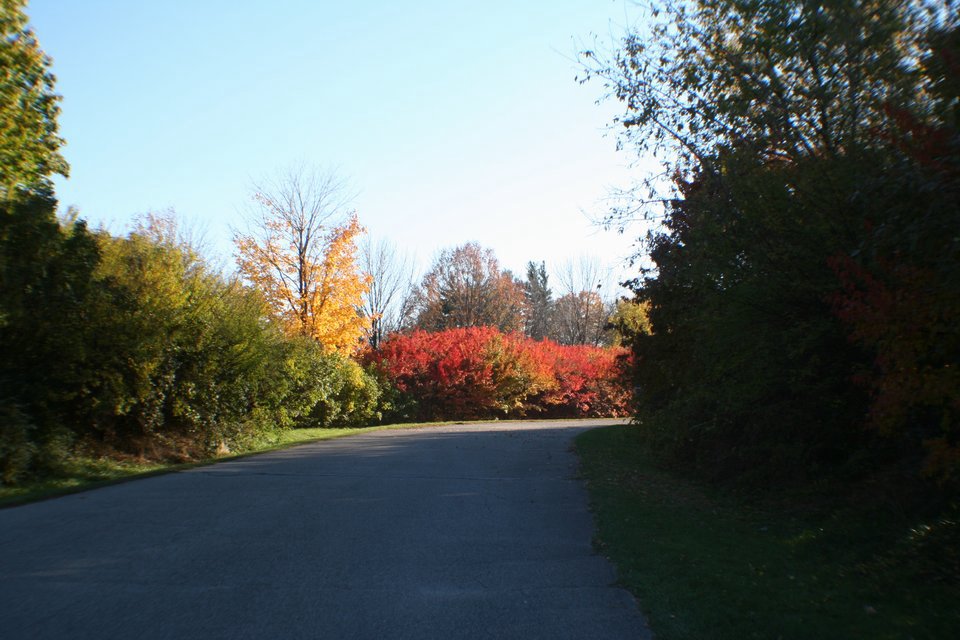
Friday, October 28, 2005
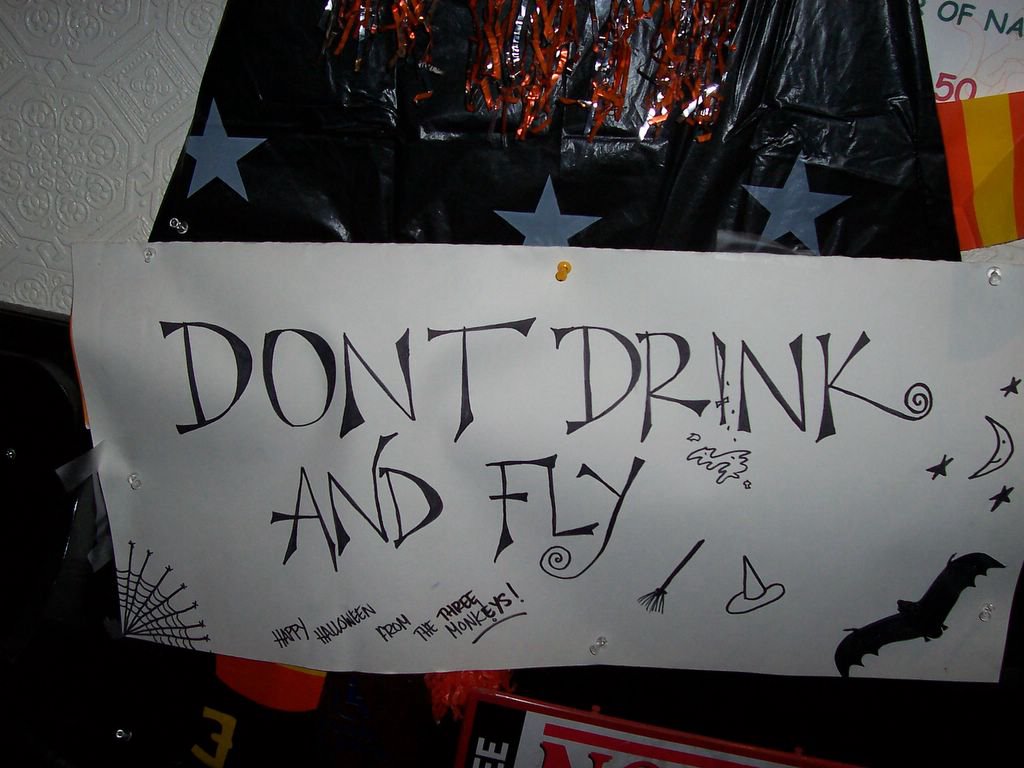
Thursday, October 27, 2005
Derry Road and Creditview Road
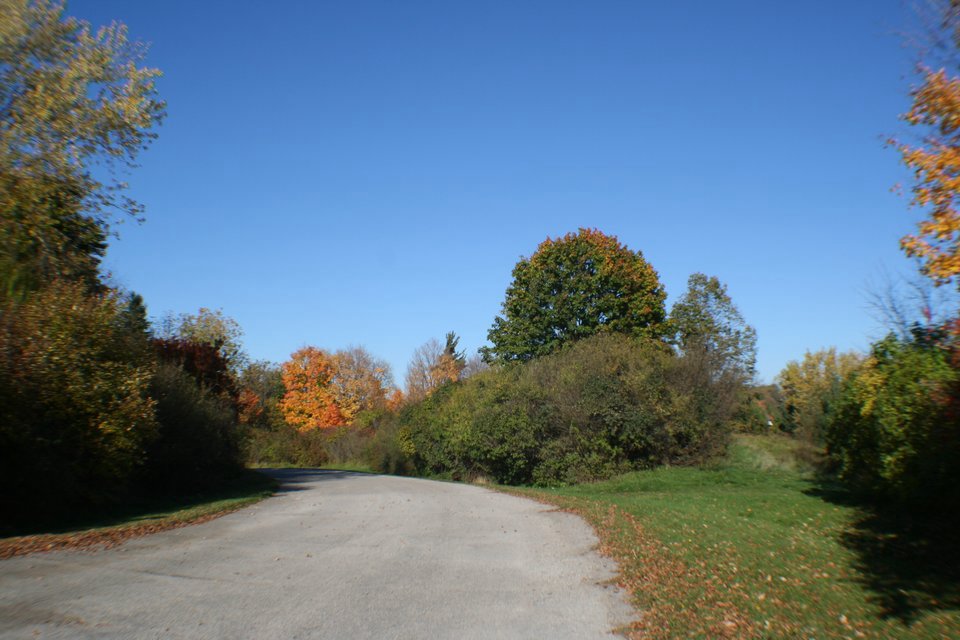
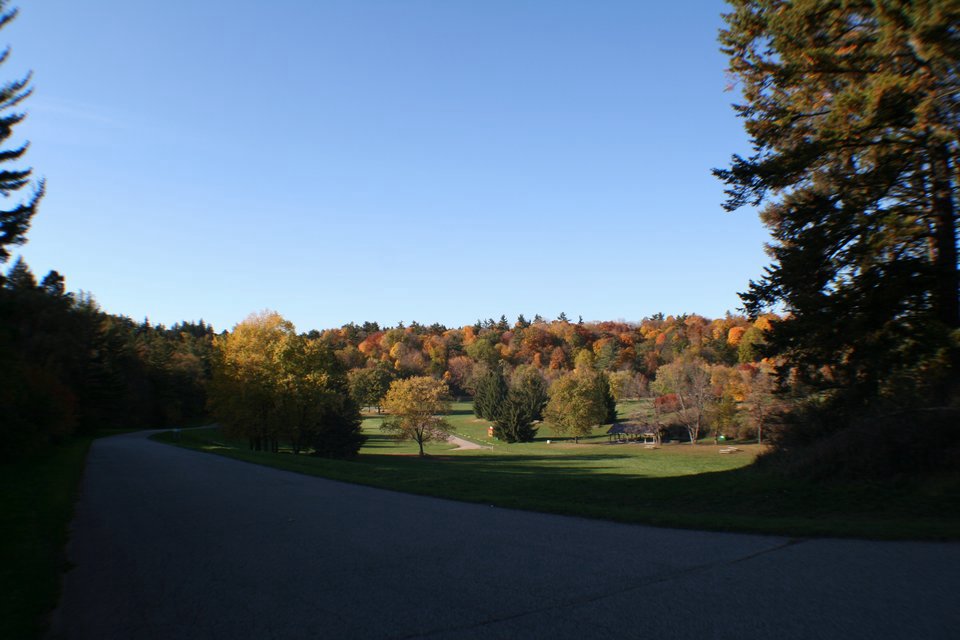
Mississauga's changed a lot over the years. I saw a lot of changes while I was there. In the last couple of days, a newcomer to the blog has been commenting on such in an early post of mine from last June. It got me thinking about some of the changes I recorded over the years with the various cameras I've had.
In May of 1999, I went with a friend to look over the changes they were making at the intersection of Derry Road and Creditview Road. It was pretty much exactly the time they closed off the old road allowance of Derry between Mississauga Road and Creditview, a stretch leading to the Credit River and Meadowvale Village beyond that must have been travelled for a century and a half when they closed it. Creditview itself, between Derry and the newly-constructed 407, was also closed at this time... a stretch I drove many a time on my way to the glorious parks in Churchville.
These pictures were taken with my third digital camera, a Kodak DC-50.
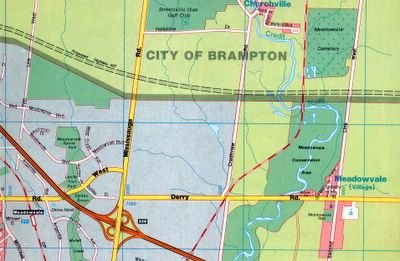
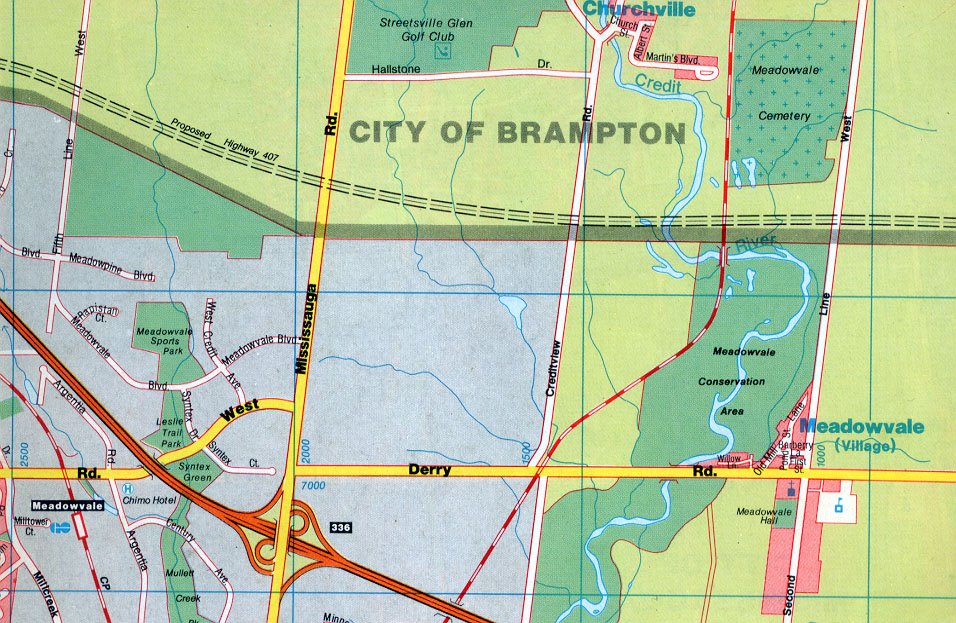
Derry Road and Creditview Road, 1990, MapArt
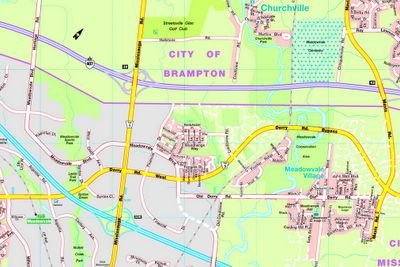
Derry Road and Creditview Road, 1999, MapArt
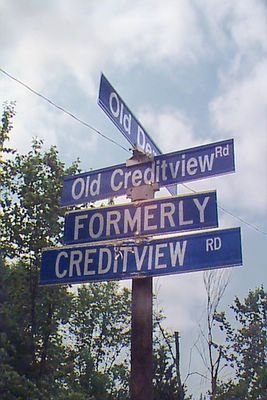
Signposts, 1999
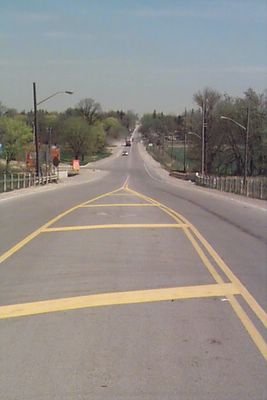
Looking east along Derry Road, now Old Derry Road, towards the Credit River, and Meadowvale Village beyond.
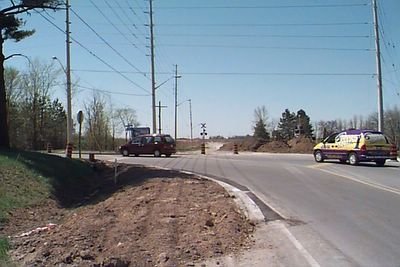
Looking west along Derry as cars turn south onto Creditview...

Close-up shot from same location... the sign says "Old Derry Road Closed Permanently Creditview Road to Meadowvale Blvd." In the distance, just before the building on the right, is Mississauga Road, which runs parallel to Creditview.
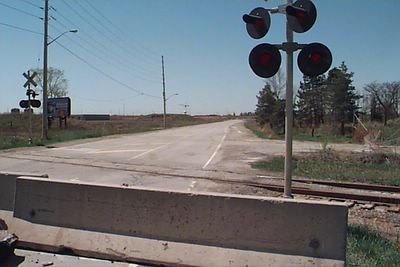
The level crossing in the middle of the intersection of Derry and Creditview, now the exclusive province of the trains.

The level crossing, looking south across Derry towards the 401 in the distance.

Beyond the train tracks, looking west along Derry. The former northbound course of Creditview is on the right.
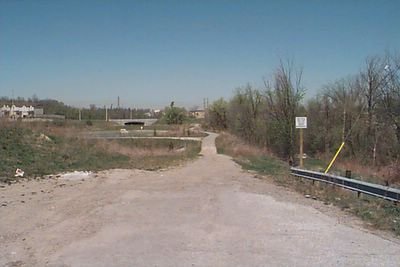
This was the way north along Creditview (to my back is Derry). At the time that it was open to traffic, it headed down into a thicket of trees. There were no houses, nor did the bridge in the distance exist. That bridge carries the new course of Derry Road over the creek, which runs just off to the right of the guard rail.

This was an even older entrance to Creditview! I never got to drive this stretch, but I have friends old enough to remember riding on it. It was just a few yards to the east (right, in this view) of the course shown above (off to the left in this view). The creek is just off to the right.

Looking west along the closed section of Derry Road, towards Mississauga Road in the distance.

Further westward along the closed section of Derry.
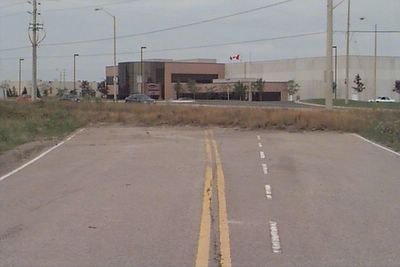
This is a slightly older shot, from the summer of 1998. I don't have a map showing it, but briefly in the mid-90s, Derry Road was "corrected" to cross straight across Mississauga Road (notice the dogleg in the 1990 map) to rejoin the main course of Derry eastward, through Meadowvale Village, via the portion that's now closed, and the section east of Creditview now called Old Derry Road. When I took this picture, the new course, up through the conservation area and bypassing the village, was already in use. This is the old detour, used for perhaps five or six years, shown in disuse by 1998. By now, this stretch is very likely under buildings.
In May of 1999, I went with a friend to look over the changes they were making at the intersection of Derry Road and Creditview Road. It was pretty much exactly the time they closed off the old road allowance of Derry between Mississauga Road and Creditview, a stretch leading to the Credit River and Meadowvale Village beyond that must have been travelled for a century and a half when they closed it. Creditview itself, between Derry and the newly-constructed 407, was also closed at this time... a stretch I drove many a time on my way to the glorious parks in Churchville.
These pictures were taken with my third digital camera, a Kodak DC-50.
Derry Road and Creditview Road, 1990, MapArt

Derry Road and Creditview Road, 1999, MapArt
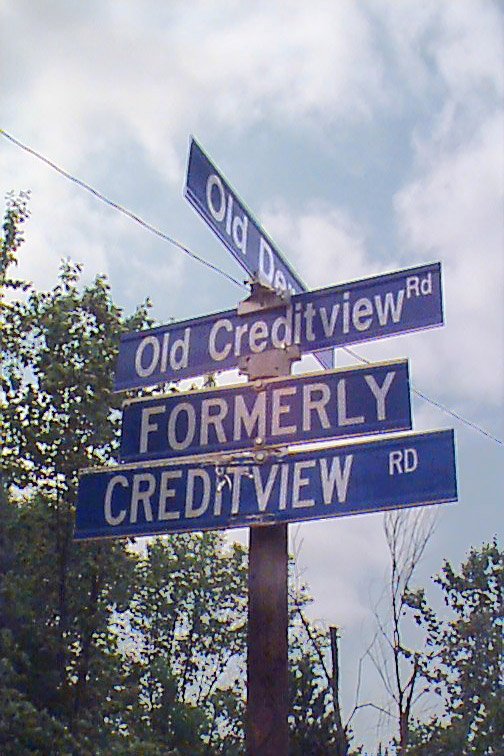
Signposts, 1999
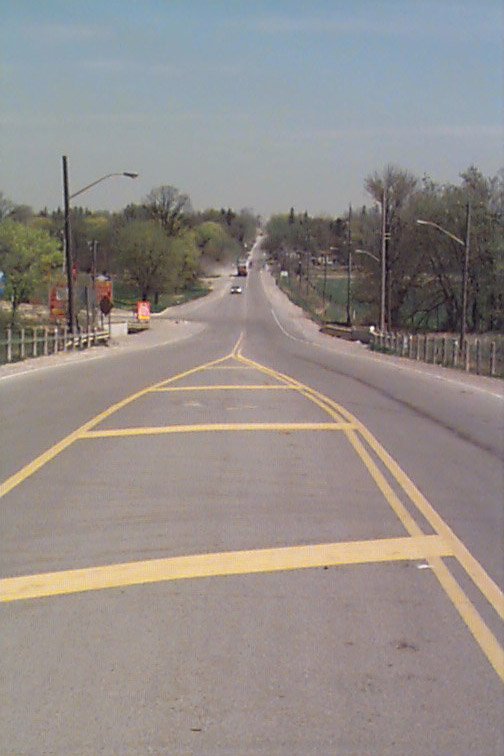
Looking east along Derry Road, now Old Derry Road, towards the Credit River, and Meadowvale Village beyond.
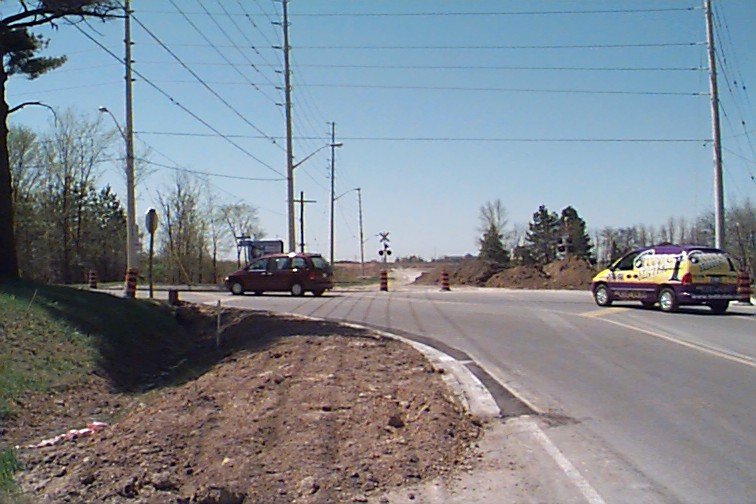
Looking west along Derry as cars turn south onto Creditview...

Close-up shot from same location... the sign says "Old Derry Road Closed Permanently Creditview Road to Meadowvale Blvd." In the distance, just before the building on the right, is Mississauga Road, which runs parallel to Creditview.

The level crossing in the middle of the intersection of Derry and Creditview, now the exclusive province of the trains.

The level crossing, looking south across Derry towards the 401 in the distance.
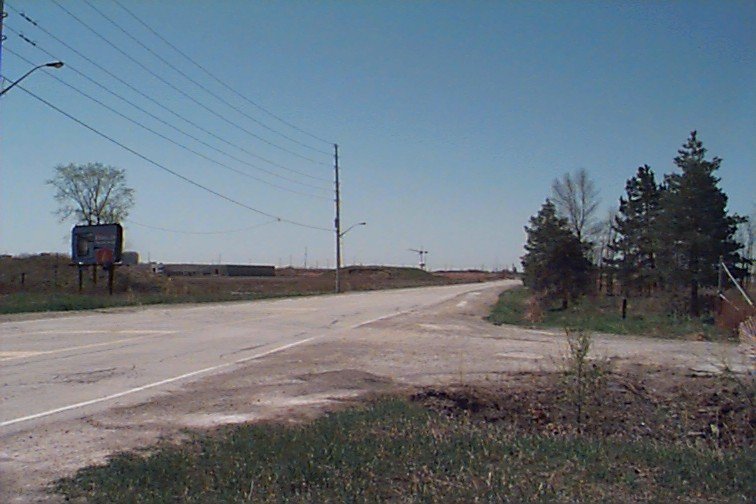
Beyond the train tracks, looking west along Derry. The former northbound course of Creditview is on the right.

This was the way north along Creditview (to my back is Derry). At the time that it was open to traffic, it headed down into a thicket of trees. There were no houses, nor did the bridge in the distance exist. That bridge carries the new course of Derry Road over the creek, which runs just off to the right of the guard rail.

This was an even older entrance to Creditview! I never got to drive this stretch, but I have friends old enough to remember riding on it. It was just a few yards to the east (right, in this view) of the course shown above (off to the left in this view). The creek is just off to the right.
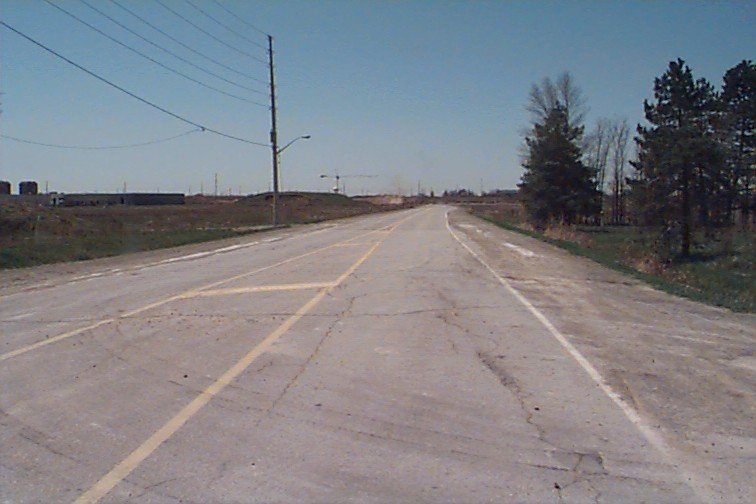
Looking west along the closed section of Derry Road, towards Mississauga Road in the distance.
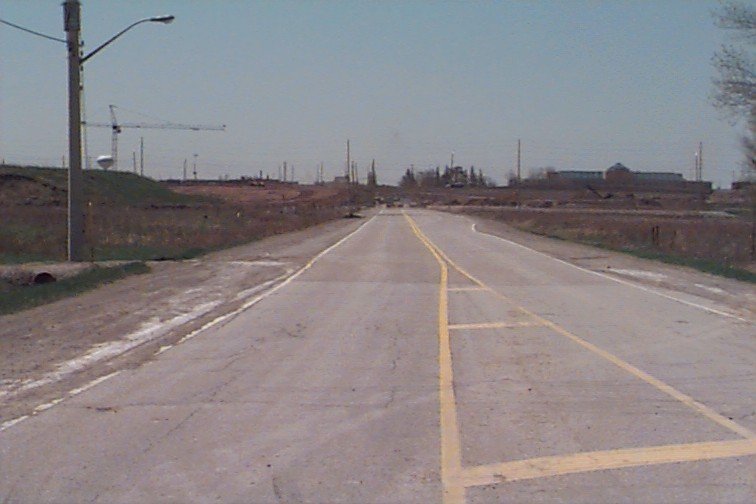
Further westward along the closed section of Derry.
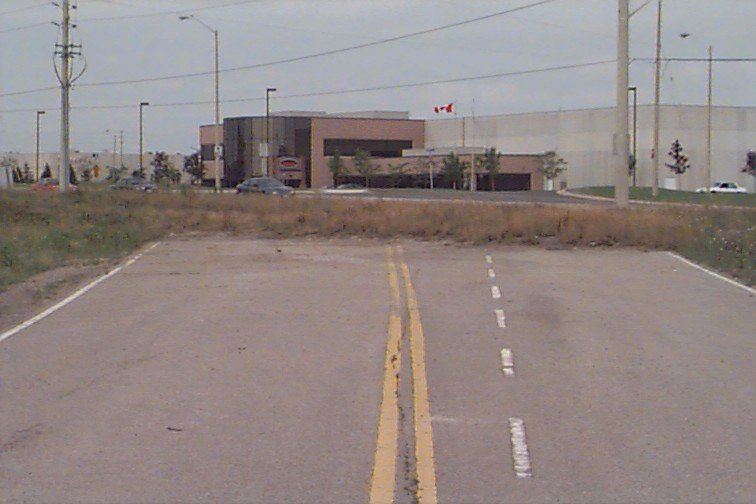
This is a slightly older shot, from the summer of 1998. I don't have a map showing it, but briefly in the mid-90s, Derry Road was "corrected" to cross straight across Mississauga Road (notice the dogleg in the 1990 map) to rejoin the main course of Derry eastward, through Meadowvale Village, via the portion that's now closed, and the section east of Creditview now called Old Derry Road. When I took this picture, the new course, up through the conservation area and bypassing the village, was already in use. This is the old detour, used for perhaps five or six years, shown in disuse by 1998. By now, this stretch is very likely under buildings.
JRR Tolkien and Dr. Seuss -- separated at birth?
Someone at work brought up the subject of the Lord of the Rings trilogy today... not the movies, but the books. Twice in my life now — once as a 16-year-old boy and later as a man in his early 30s — I've tried to wade through the thing. I barely made it a hundred pages as a youth, but I thought that by the time I'd doubled my age, my chops would be up to the task.
Uh uh.
I praise myself for having made it all the way through The Hobbit... it took a while, but I made it. But once I got into the trilogy proper, it... just... ground... me... down. I surrendered. The fellow who lent me the books made the mistake of asking me what I found so difficult about it. The discussion today reminded me of my reply to him, captured in e-mail archives from several years ago. I now present that reply to you, in hopes that it will resonate with some reader, sometime, and provoke a smile of recognition. :) Please enjoy. Or... at least, don't be too offended. :)
----------------------------------------------------
Frodo, Sam, Pippin and Merry were anything but merry as they trundled along the forest path towards certain doom and likely dismemberment. But they knew how to keep their spirits up, and were soon chattering away like great fat chipmunks on an acorn ale bender:
Ping, bling, follow the ring
Schwing, gling, swallow the thing
Hurdely burdely bow!
Skeedly weedly woe!
Needly pop! Tweedly drop!
Ow I stubbed my toe.
Tom Bombadil seemed to jump down on them from out of the sky, like rain, which was appropriate because as a result their trousers were all sodden. “What’s this, then?” Tom boomed. “Wee hobbits belting out the most glorious tune I ever heard, save one of my own? Try this one on for size, my small adventurers!”
Eat a bean, start a fart,
Eat a green, head a-smart,
Oh I love to wander ‘round,
Piss and wind and smoke and sound,
Marching through the forest cool,
Comb my beard with mining tools,
Peering in the silv’ry pool, hey!
Ho! Hee! Huh! Hum! Hi! Hic!
But all this talk of food had a bad effect, for didn’t it summon old Smaug onto the scene! He slithered over the tree tops like an evil wind, and appeared before them with a serviette tied around his neck, a hobbit-sized pitchfork in one claw and a toothpick in the other.
“We’re doomed!” cried Sam, wringing out his pants.
“Yes, yes, most assuredly,” agreed the dragon. “But before I eat you all, a song to soften you up…”
Eat, meat, heat, feet,
Seat, teat, wheat, cheat
Now I’m going to chew
Turn you into poo
That’s what I will do
Say ‘bye’ not ‘haloo’!
“We’ll see about that,” said Tom. The dragon decided he would be the first to go, and had just begun to move when, as luck would have it, Gandalf appeared from behind a tree, to the great relief of the hobbits! “Oh, I think not,” he told Smaug, and there was a great battle in which the forests burned and mountains fell and cities were laid waste and unicorns wept big tears that turned to crystals that trapped tiny pixies for a thousand years, but finally Smaug was put down, so at last Gandalf could sing:
I have smote the dragon, hey!
Pass me now the flagon, ho!
I’m not on the wagon, hi!
Surely we—
“For fuck’s sake!” cried the reader. “Can we please just get on with the story without having to suffer through this shitty, masturbatory poetry every other page? And it’s not bad enough it comes thick as oatmeal, it has to be the worst poetry I’ve read since grade eight! I mean, is every character in this story an artless drunk who fancies himself a slightly effeminate Elvis Presley, or what? Will you please just for God’s sake tell the fucking story?…”
Yes. Well. Erm. So Gandalf, Tom, and the hobbits feasted on Smaug steaks and Smaug lager for a fortnight, while they sat around the fire, swapping great tales and singing heroic tunes li— Oh, wait, I can’t, can I. Well, they started off towards Mordor again, singing a—oh, shit. And when they arrived, they called Sauron out to battle with a—oh, damn…
Uh uh.
I praise myself for having made it all the way through The Hobbit... it took a while, but I made it. But once I got into the trilogy proper, it... just... ground... me... down. I surrendered. The fellow who lent me the books made the mistake of asking me what I found so difficult about it. The discussion today reminded me of my reply to him, captured in e-mail archives from several years ago. I now present that reply to you, in hopes that it will resonate with some reader, sometime, and provoke a smile of recognition. :) Please enjoy. Or... at least, don't be too offended. :)
----------------------------------------------------
Frodo, Sam, Pippin and Merry were anything but merry as they trundled along the forest path towards certain doom and likely dismemberment. But they knew how to keep their spirits up, and were soon chattering away like great fat chipmunks on an acorn ale bender:
Ping, bling, follow the ring
Schwing, gling, swallow the thing
Hurdely burdely bow!
Skeedly weedly woe!
Needly pop! Tweedly drop!
Ow I stubbed my toe.
Tom Bombadil seemed to jump down on them from out of the sky, like rain, which was appropriate because as a result their trousers were all sodden. “What’s this, then?” Tom boomed. “Wee hobbits belting out the most glorious tune I ever heard, save one of my own? Try this one on for size, my small adventurers!”
Eat a bean, start a fart,
Eat a green, head a-smart,
Oh I love to wander ‘round,
Piss and wind and smoke and sound,
Marching through the forest cool,
Comb my beard with mining tools,
Peering in the silv’ry pool, hey!
Ho! Hee! Huh! Hum! Hi! Hic!
But all this talk of food had a bad effect, for didn’t it summon old Smaug onto the scene! He slithered over the tree tops like an evil wind, and appeared before them with a serviette tied around his neck, a hobbit-sized pitchfork in one claw and a toothpick in the other.
“We’re doomed!” cried Sam, wringing out his pants.
“Yes, yes, most assuredly,” agreed the dragon. “But before I eat you all, a song to soften you up…”
Eat, meat, heat, feet,
Seat, teat, wheat, cheat
Now I’m going to chew
Turn you into poo
That’s what I will do
Say ‘bye’ not ‘haloo’!
“We’ll see about that,” said Tom. The dragon decided he would be the first to go, and had just begun to move when, as luck would have it, Gandalf appeared from behind a tree, to the great relief of the hobbits! “Oh, I think not,” he told Smaug, and there was a great battle in which the forests burned and mountains fell and cities were laid waste and unicorns wept big tears that turned to crystals that trapped tiny pixies for a thousand years, but finally Smaug was put down, so at last Gandalf could sing:
I have smote the dragon, hey!
Pass me now the flagon, ho!
I’m not on the wagon, hi!
Surely we—
“For fuck’s sake!” cried the reader. “Can we please just get on with the story without having to suffer through this shitty, masturbatory poetry every other page? And it’s not bad enough it comes thick as oatmeal, it has to be the worst poetry I’ve read since grade eight! I mean, is every character in this story an artless drunk who fancies himself a slightly effeminate Elvis Presley, or what? Will you please just for God’s sake tell the fucking story?…”
Yes. Well. Erm. So Gandalf, Tom, and the hobbits feasted on Smaug steaks and Smaug lager for a fortnight, while they sat around the fire, swapping great tales and singing heroic tunes li— Oh, wait, I can’t, can I. Well, they started off towards Mordor again, singing a—oh, shit. And when they arrived, they called Sauron out to battle with a—oh, damn…
Wednesday, October 26, 2005
Is this ever me :)

A bookmark I found at a dollar store yesterday. I really needed one, and man... did this one speak to me. :)
The wide wilderness
It's getting a little cold for barefoot hiking this time of year... I admit I'm not a rugged as I might like, but I still like to get out and experience nature. Took some time to do that around noon hour today.
As it turns out, I forgot the CX7330 at home today, but I happened to have the Rebel XT in the trunk. Much better choice for this assignment anyway. That camera cost a lot of money, and I admit, with some of the shots I've taken lately with the Kodak point and shoot, I started wondering if I'd spent more than my own abilities justified...
Now let's make mention of that cheap little 0.42x wide angle attachment I picked up recently. The reviews I read about it after I ordered it didn't fill me with great expectations, but I thought, well, it's $70. So what if the shots aren't great; it'll be fun. How great do they have to be? I'm only an amateur — though I flatter myself a reasonably dedicated one — not a professional. So I was prepared for quirky, if technically flawed, shots...
Some of the shots I took today amazed me, though I say it myself. That 0.42x attachment lets me photgraph things literally at the end of the lens assembly. Maybe that's where the focal length of the original lens is anyway, but still... the realization I've bumped a leaf I'm focusing on was a shocker. So let me share a handful of what I consider the better of the 160-some shots I took over about half an hour today at Bruce's Mill Conservation Area...
Down in the valley... (a.k.a. nature's cathedral)
...and back up again...
Now look up... look WAA-AA-AA-AAY up...
Leaves, undershot

Out of nowhere, a leaf laden with dew, or holding the rain...
...and its nearby twin.
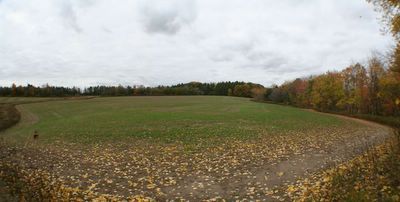
The field at the edge of Bruce's Mill Conservation Area
I'll take a moment to comment on this one. This is actually a composite of two photographs. But only two. I photographed this field in panorama in late spring with my DC4800. As I recall, it took me about six or seven shots to accomplish this, and the results were nowhere near as consistent or satisfying.

Tight focus...

Same view, focus slightly relaxed...
Shots like this pair are what I bought the Rebel XT for. I always wanted this kind of control. This sort of thing verges on 3D. I'm quietly proud of this pair of shots; I took them from only three or four inches away from the branches, and they came out just great.

Looking up on the way back out of the valley

Ladybug in repose #1
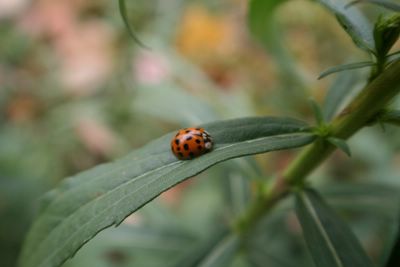
Ladybug in repose #2
I particularly like how the razor-thin shadowed edge of the leaf is defined in this shot. The focal control I managed here just about takes my breath away. Most of the shots of this calibre I've attempted till now have not come out, but these ones really worked. I'm especially pleased because these were all manual focus (as were most of the close-up shots you see in this posting), and not automatic.

Ladybug in repose #3

Ladybug in repose #4
This one is actually a detail of another shot, but it's not enlarged (in fact, in posting it here, it's significantly reduced). This might be the best macro shot I've ever taken, and it — as with everything else in this post — was achieved using that cheap 0.42x wide angle attachment. I imagine better shots are possible with more expensive versions, but only to the trained eye. I think these ones are just fantastic. I mean, yes, I had the vision to capture them, but I've had that before and blown it. So I credit the tools... they really made this possible, rather than simply desirable, as it's always been till now.
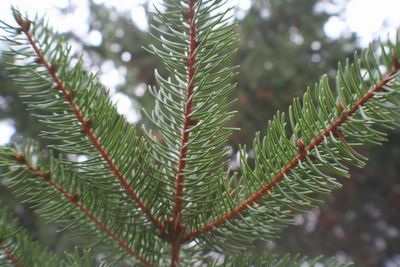
Backlit pine needles
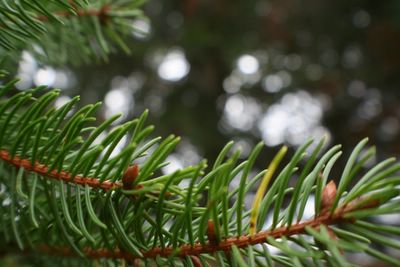
Evergreen.
As it turns out, I forgot the CX7330 at home today, but I happened to have the Rebel XT in the trunk. Much better choice for this assignment anyway. That camera cost a lot of money, and I admit, with some of the shots I've taken lately with the Kodak point and shoot, I started wondering if I'd spent more than my own abilities justified...
Now let's make mention of that cheap little 0.42x wide angle attachment I picked up recently. The reviews I read about it after I ordered it didn't fill me with great expectations, but I thought, well, it's $70. So what if the shots aren't great; it'll be fun. How great do they have to be? I'm only an amateur — though I flatter myself a reasonably dedicated one — not a professional. So I was prepared for quirky, if technically flawed, shots...
Some of the shots I took today amazed me, though I say it myself. That 0.42x attachment lets me photgraph things literally at the end of the lens assembly. Maybe that's where the focal length of the original lens is anyway, but still... the realization I've bumped a leaf I'm focusing on was a shocker. So let me share a handful of what I consider the better of the 160-some shots I took over about half an hour today at Bruce's Mill Conservation Area...

Down in the valley... (a.k.a. nature's cathedral)
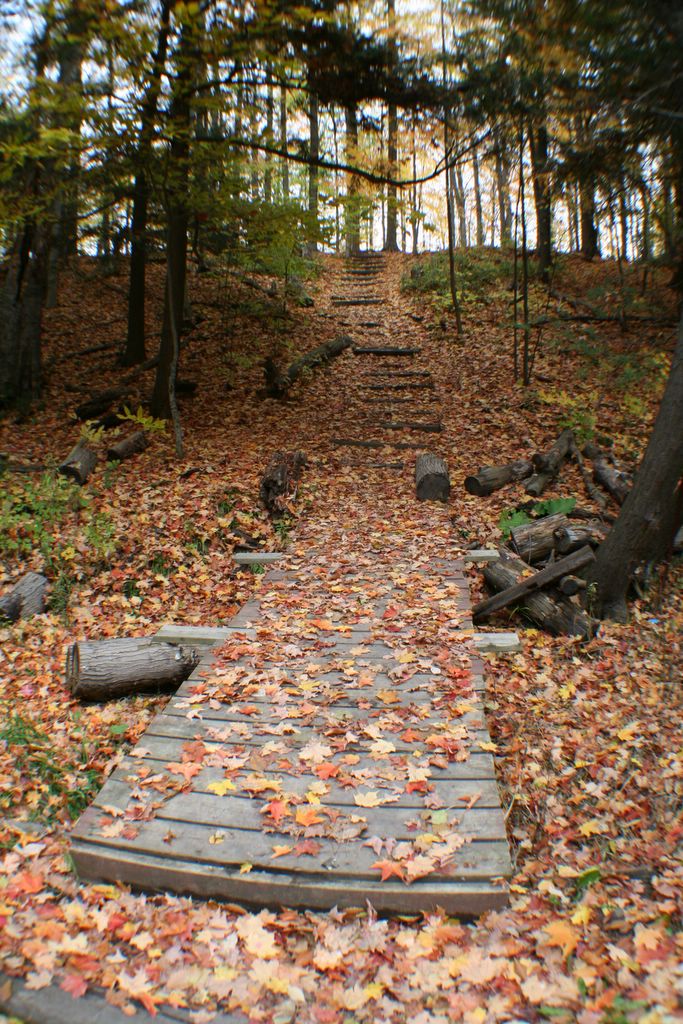
...and back up again...

Now look up... look WAA-AA-AA-AAY up...

Leaves, undershot
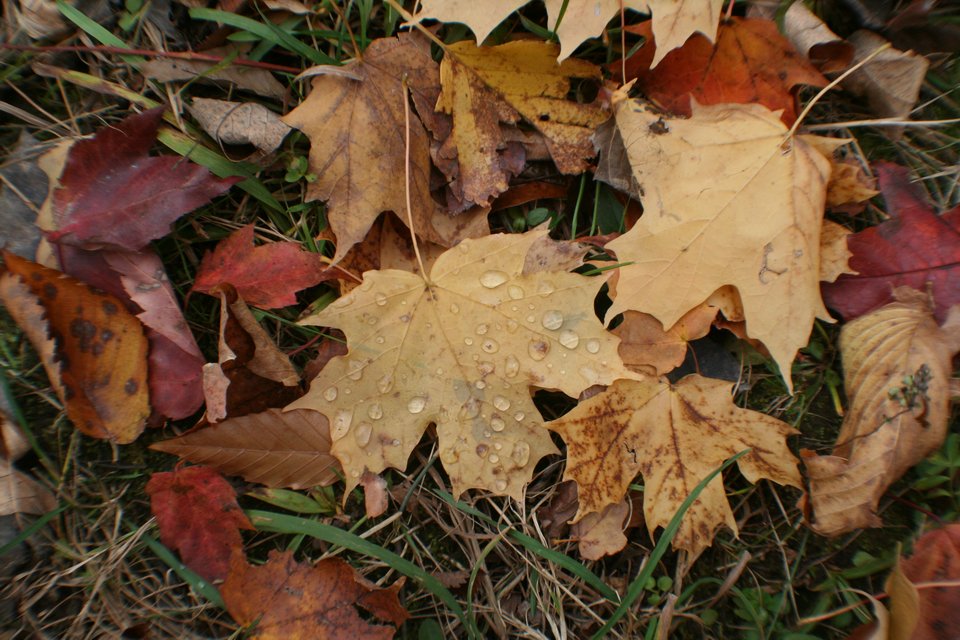
Out of nowhere, a leaf laden with dew, or holding the rain...
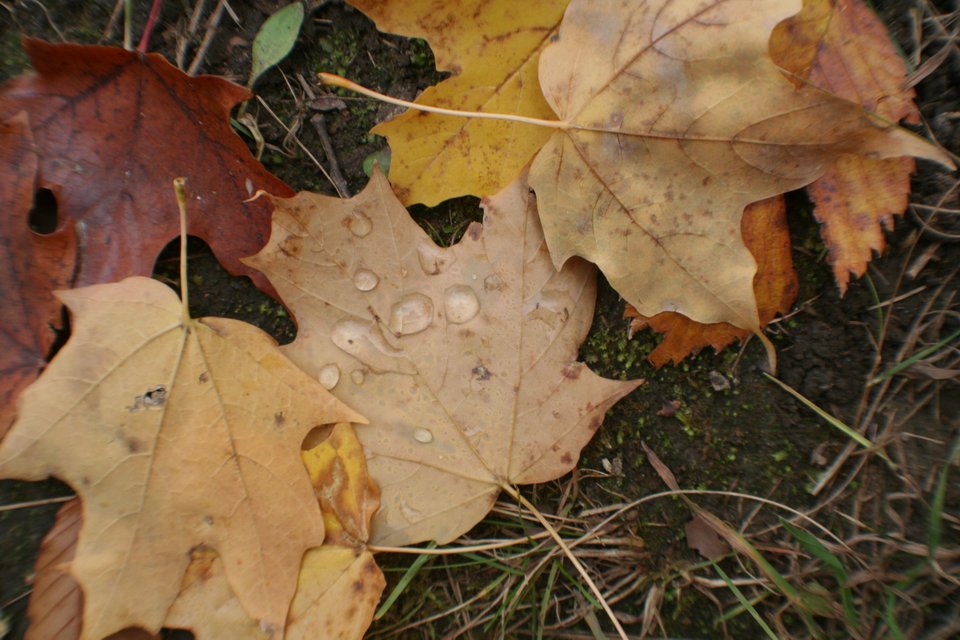
...and its nearby twin.
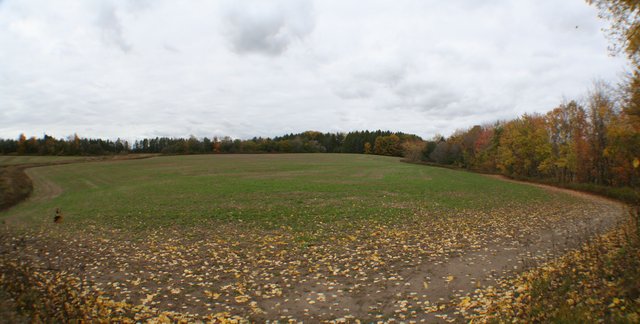
The field at the edge of Bruce's Mill Conservation Area
I'll take a moment to comment on this one. This is actually a composite of two photographs. But only two. I photographed this field in panorama in late spring with my DC4800. As I recall, it took me about six or seven shots to accomplish this, and the results were nowhere near as consistent or satisfying.

Tight focus...

Same view, focus slightly relaxed...
Shots like this pair are what I bought the Rebel XT for. I always wanted this kind of control. This sort of thing verges on 3D. I'm quietly proud of this pair of shots; I took them from only three or four inches away from the branches, and they came out just great.
Looking up on the way back out of the valley

Ladybug in repose #1

Ladybug in repose #2
I particularly like how the razor-thin shadowed edge of the leaf is defined in this shot. The focal control I managed here just about takes my breath away. Most of the shots of this calibre I've attempted till now have not come out, but these ones really worked. I'm especially pleased because these were all manual focus (as were most of the close-up shots you see in this posting), and not automatic.

Ladybug in repose #3

Ladybug in repose #4
This one is actually a detail of another shot, but it's not enlarged (in fact, in posting it here, it's significantly reduced). This might be the best macro shot I've ever taken, and it — as with everything else in this post — was achieved using that cheap 0.42x wide angle attachment. I imagine better shots are possible with more expensive versions, but only to the trained eye. I think these ones are just fantastic. I mean, yes, I had the vision to capture them, but I've had that before and blown it. So I credit the tools... they really made this possible, rather than simply desirable, as it's always been till now.

Backlit pine needles
Evergreen.
Sunday, October 23, 2005
Postin' old school
Well, I guess the only way I can accomplish this is to post the old-fashioned way. :)
First glimpse of Heaven...
A blast from the past...
 Anybody remember Toronto's bid for the 1996 Summer Olympics? You might recall we didn't get it. Atlanta did. Their revenge on us for the 1992 World Series, I guess. ;) But these stickers were common back in the early 1990s. I suppose this one has been on this box for twelve or thirteen years now. God... 1996 used to seem so far into the future. It's hard to believe it was nearly ten years ago now.
Come look through my window...

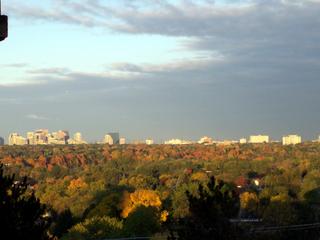
First glimpse of Heaven...
A blast from the past...
 Anybody remember Toronto's bid for the 1996 Summer Olympics? You might recall we didn't get it. Atlanta did. Their revenge on us for the 1992 World Series, I guess. ;) But these stickers were common back in the early 1990s. I suppose this one has been on this box for twelve or thirteen years now. God... 1996 used to seem so far into the future. It's hard to believe it was nearly ten years ago now.
Come look through my window...
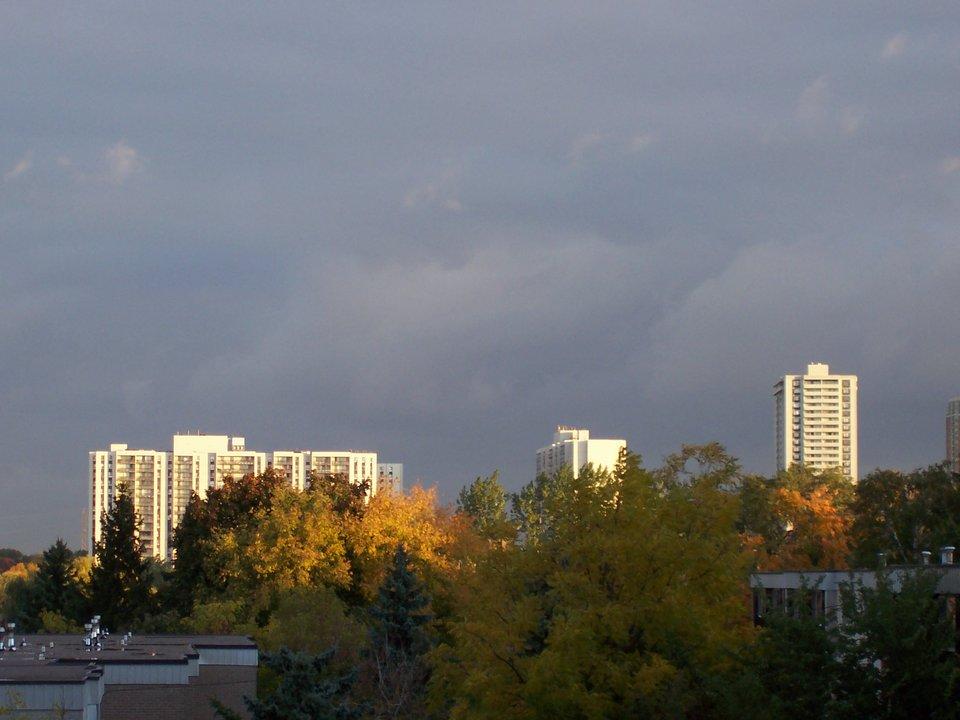
Or more precisely, off my balcony. A few days ago just before I left for work I happened to glance out just as the sun was catching the buildings, but leaving the east lip of the valley in shadow. I found the contrast striking, and in the five minutes or so while the effect persisted, I took about two dozen shots. These were the two I liked the best.
The drunk of the Irish...
Atmosphere at the Irish pub I recently attended with a friend.
 I'd like to win one in County Wexford, please. :) A humourous, and I'm sure entirely unintentional, juxtapositioning of pressure marketing and schmaltzy kitsch.
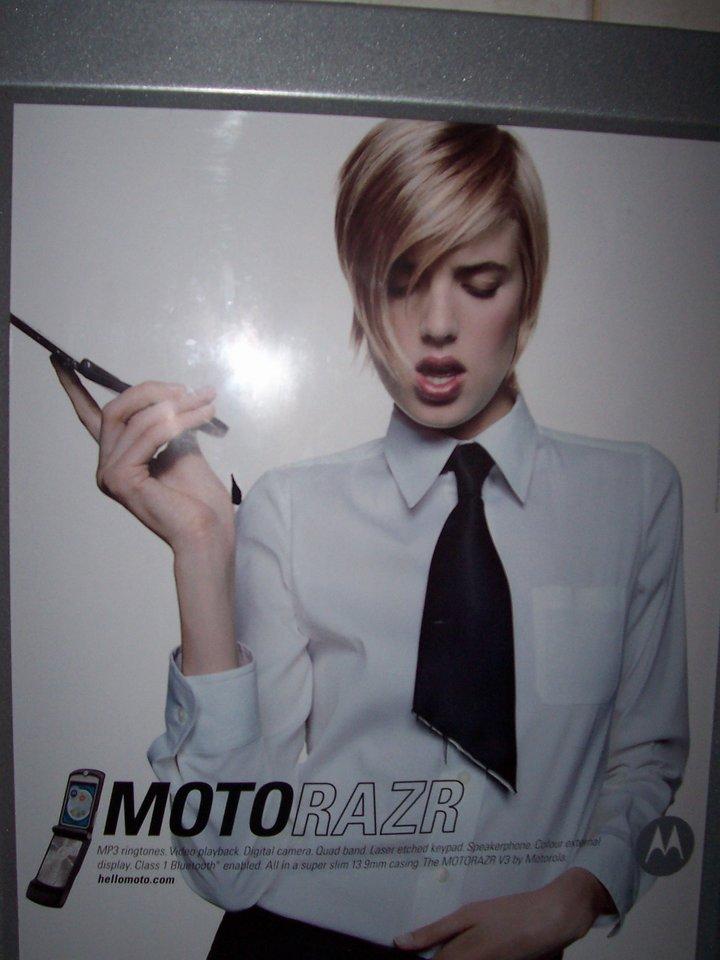 Wow, David Bowie looks great, don't you think?
Subscribe to:
Posts (Atom)