
Saturday, September 17, 2005

Mission from 'Arry

This is a reference to a non-musical track by Iron Maiden, in which Nicko is secretly recorded fretting about a roadie interrupting him during a performance. In truth, it should be called Mission from Dave, because it was a comment made by Dave Till on his excellent website that sent me off this afternoon on this particular mission. Like Dave, I'm interested in closed roads, exploring them, and trying to imagine what was.

This particular road is Westgate Blvd., which is today closed from the crest of the West Don valley downward. At its base, it meets up with a public works facility (sewage treatment, from the smell), and still exhibits the evidence of another street, Northbourne Street, which was constructed in the mid-20th century, but likely abandoned after Hurricane Hazel passed through Toronto in 1954, putting an end to any future construction in river valleys in the Greater Toronto area ever since. Anyway, shall we begin?


Map of Westgate Blvd., MapArt

I live east of where I was going to be exploring, so I got on the 401 and exited at Avenue Road (see map). I'll always remember the Avenue Road exit. In a blinding snowstorm one day, I left the 401 there in hopes of a better trip home along Sheppard Avenue. But as I tried to picture the intersection of Avenue Road and Sheppard Avenue in my mind, I couldn't. Then I remembered: there isn't one. I ended up having to double back, creep home along Wilson Avenue... what would normally take fifteen minutes too me over two hours. But, as usual, I digress.
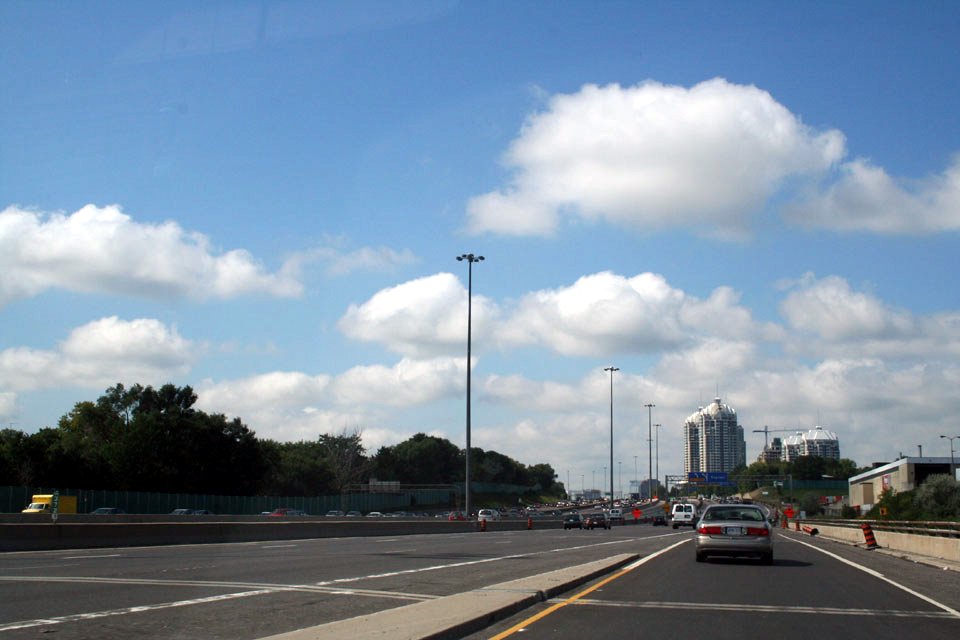

Merging onto the 401 westbound

Today, the part of Westgate Blvd. open to traffic ends at the crest of the West Don valley. Beyond that, it's open to bike and pedestrian traffic only. I don't know exactly when they closed it to automobile traffic, but there's really not much down there to drive to anyway, so it might have been some time ago. A manhole cover I happened across bore the datestamp "NYT 1969". It's sobering to think that the last time we know for sure work was done on this road was right around the time Neil Armstrong and Buzz Aldrin were setting foot on the moon for the first time. Incidentally, "NYT" refers not to New York in some capacity, but to North York Township, which was what the part of the city in question was called in 1969. North York Township was part of Metropolitan Toronto. Shortly afterwards, it became the City of North York, until it and four other municipalities were folded into the City of Toronto in 1997, and the Metro level of government that united them was eliminated as redundant.


The "official" end of Westgate Blvd. in 2005
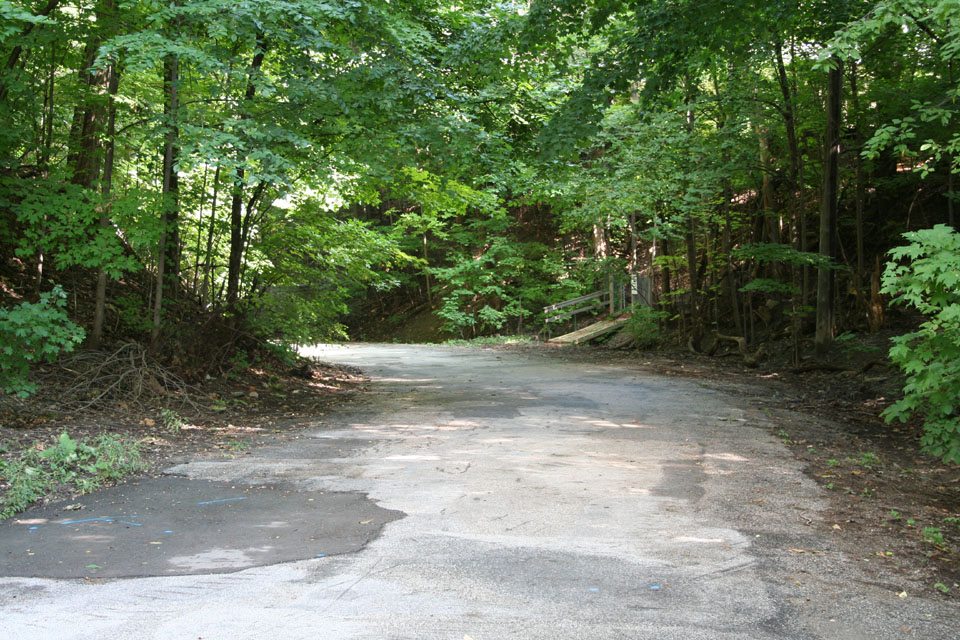

Heading down into the West Don valley
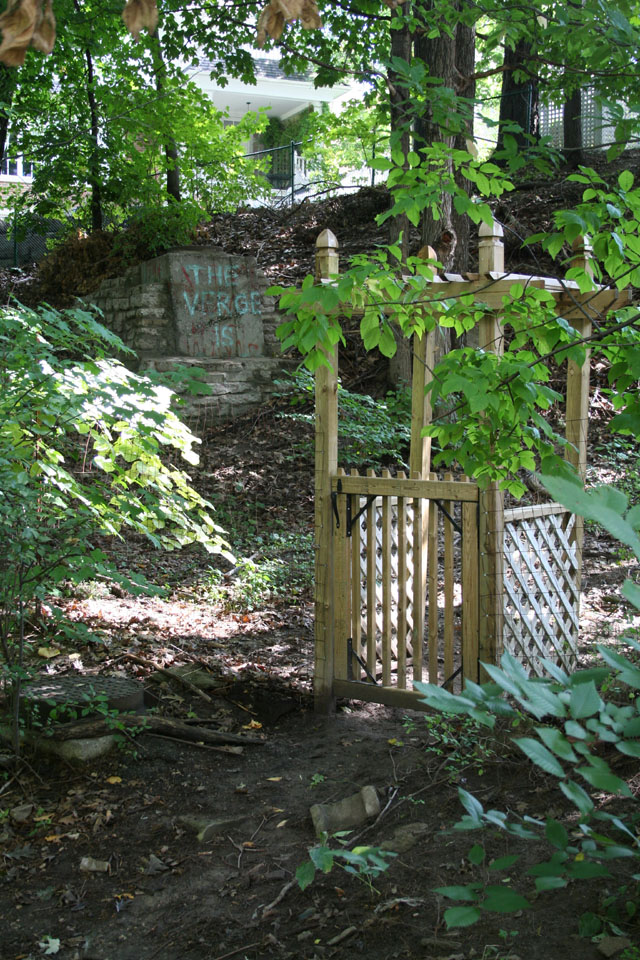

If this is a school bus shelter, you've got a long wait, kid
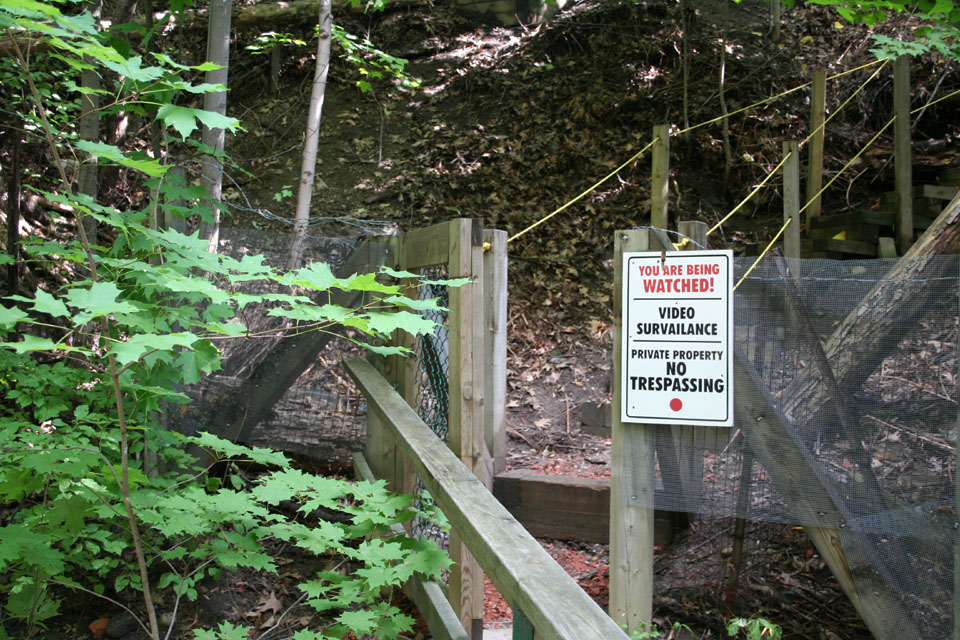

Yeah, nice try; the valley is city property below the crest, dickhead
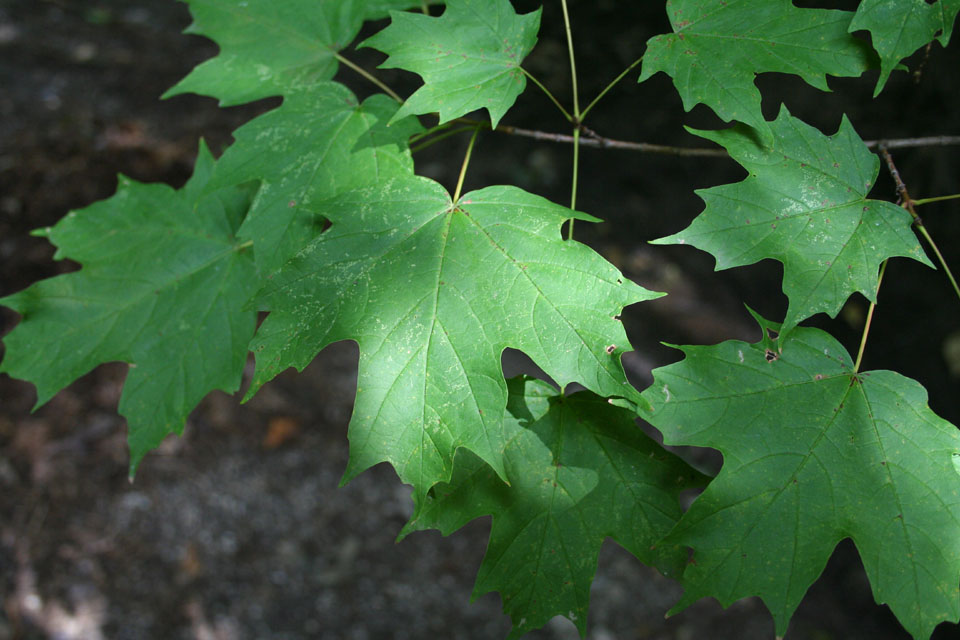

O Canada
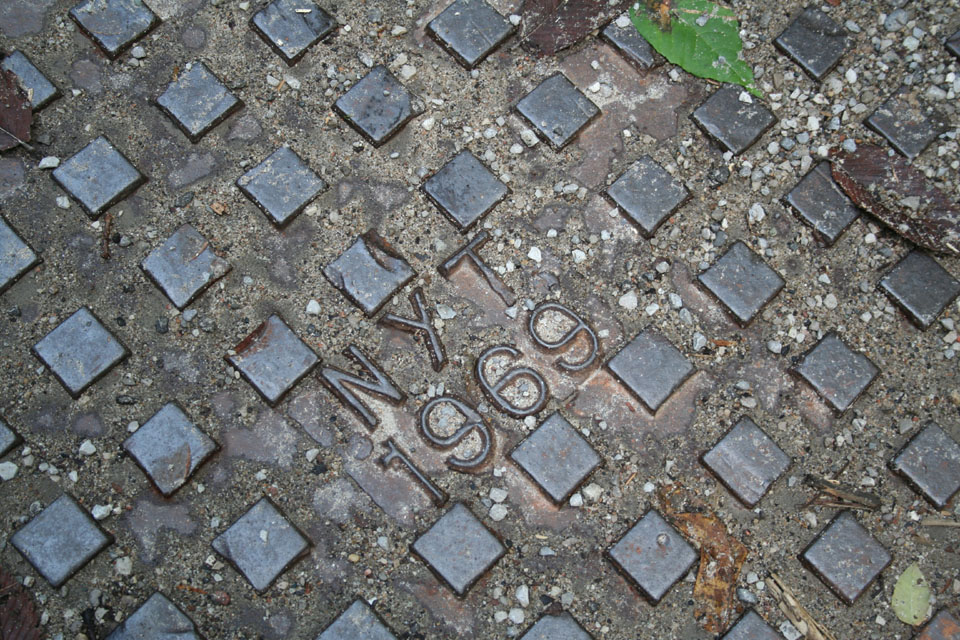

Good nyt, 1969!!

This view with the leaves in the foreground looks back the way I came, after the first curve (see map). It's mostly here because I waited years for a camera that could manage depth of field changes this way instead of being focused on infinity. Sue me; I dig it. :)


Through blurry leaves we see thee rise

This is standing on what was part of Westgate Blvd. and looking at the intersection with Northbourne Street, which heads off into the distance at the upper left of the photograph. Dave Till speculates that it might have once been intended for occupation, but that planning priorities (after Hurricane Hazel) made that impossible, so the road was abandoned. It doesn't appear on the map above, but the course of it basically follows the west border of the Metro Works facility in the centre. It ambles on as a gravel road for about a quarter of a mile, then ends at a creek bed, where I found a rather abused picnic table. Beyond that, a path leads further along the creek. The way is lined in slippery clay, for which I abandoned my sandals (a benefit on gravel, but a detriment on slippery surfaces). Another two minutes of walking brings you to the end of the path, which heads up the sharp face of the valley again. Along the way down Northbourne and back, I took some of the shots I liked best. A couple that look like pictures from some calendar of New England scenes, and several of a bee doing its thing on a flower, with the depth of field extremely narrow. This is the kind of shot that, ultimately, I bought the Rebel XT for. I was less than a foot from the bee when I took the shot, and probably not three feet from the leaves behind it, which are in magnificent soft focus, while the bee and flower are sharp. I love it!


First glimpse of Northbourne Street
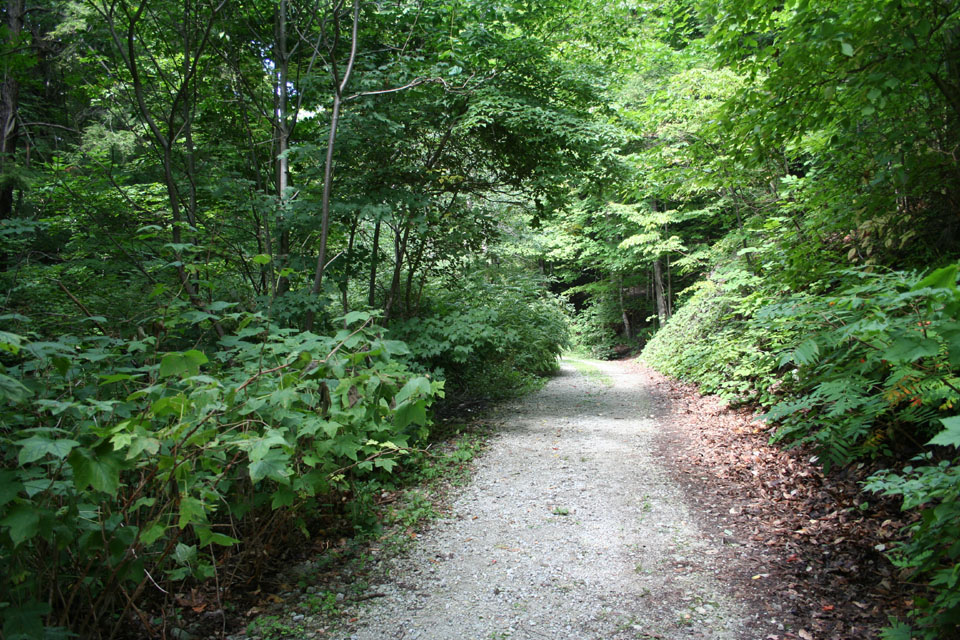

Heading west along Northbourne (why not Westbourne then?)
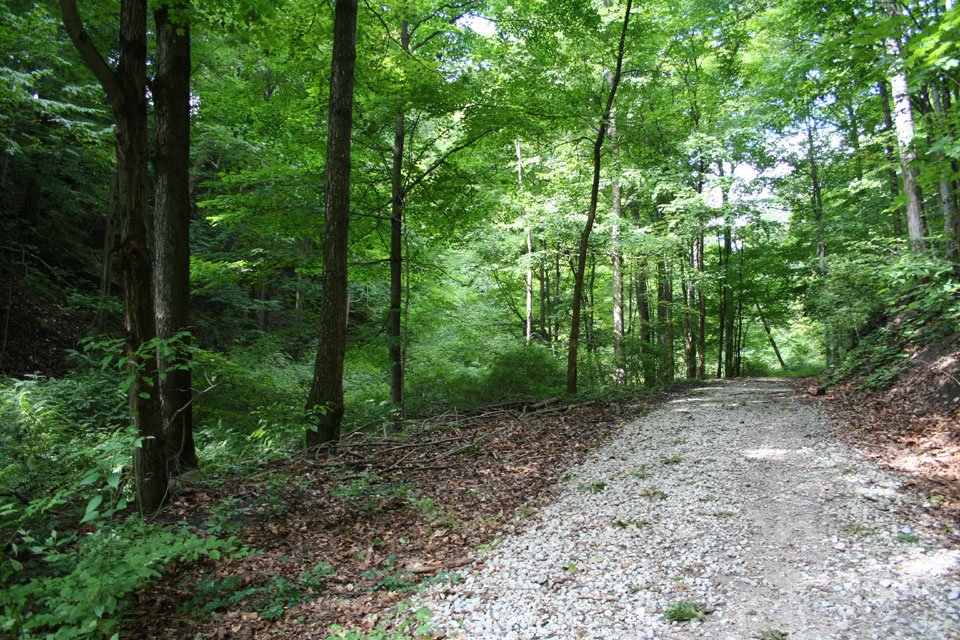

Calendar shot #1


The artsy shot for today


Well, so much for the picnic
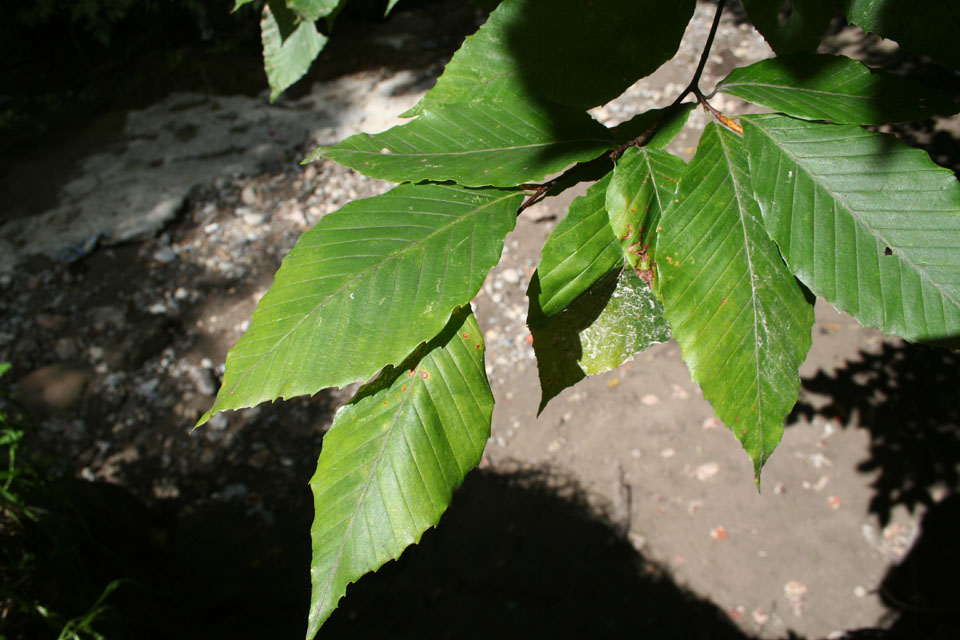

Ten foot drop with leaves outstanding


Intrepid rugged barefoot hiker picture #721! :)
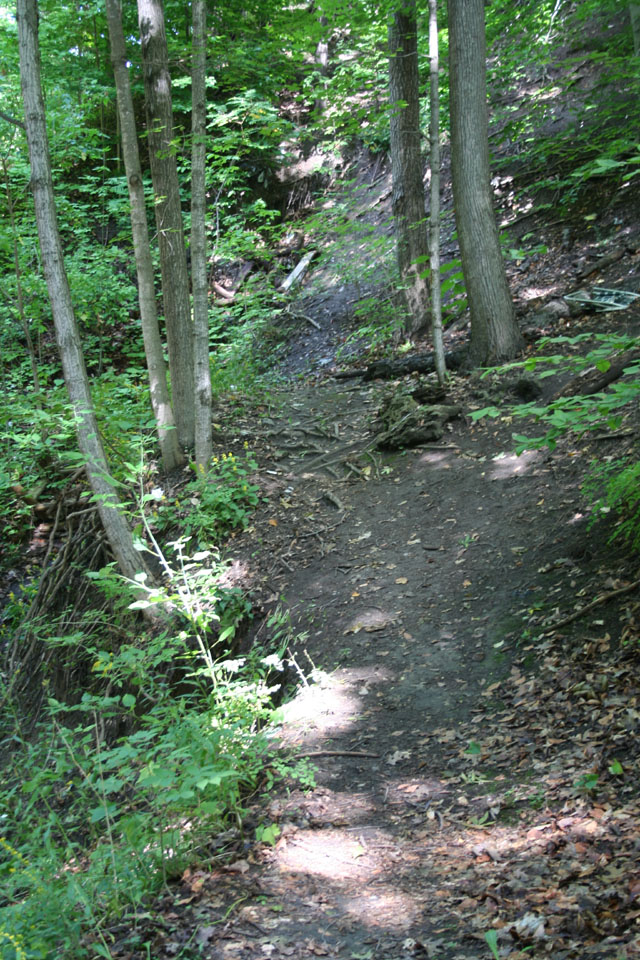

End of the line for the Northbourne trail


What is that thing, anyway?


A wounded tree remembers you always, Jeff


Calendar shot #2

After I got back to Westgate Blvd., I continued down along its course. After just a few moments, I encountered the first of what turned out to be a series of bizarre scuptures rendered from debris. One, made entirely of wood and plants, looked like the skeleton of some strange horselike being from remote prehistory...
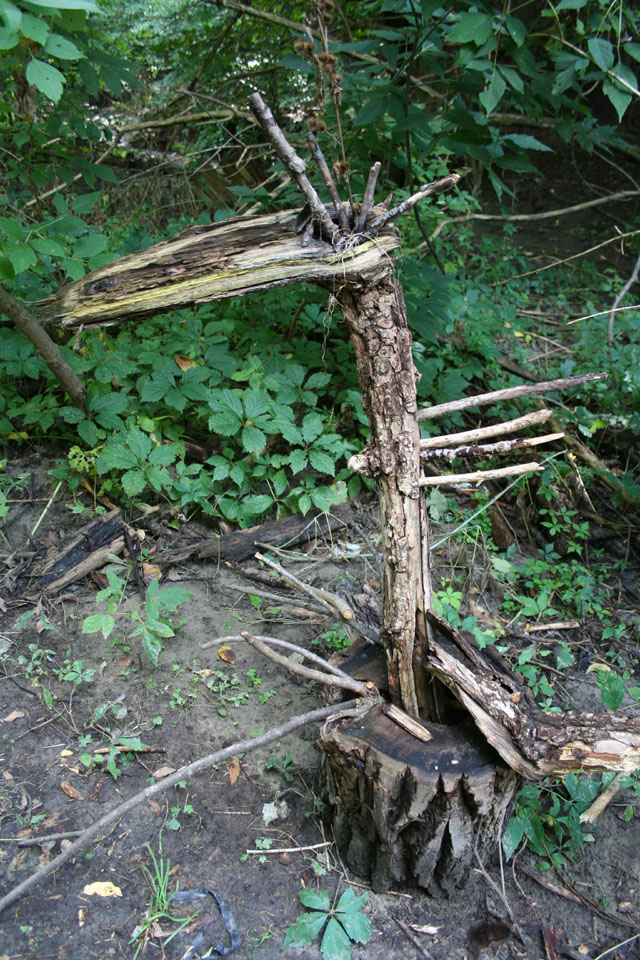

What manner of beast am I?


The next reminded me of someone's short, fat uncle, growing out of his easychair while he watches football game after hockey game after baseball game. In memory of an ongoing highschool in-joke, I've called the sculpture (for my own purposes, since I don't know the real title), Tribute to Uncle Bill.
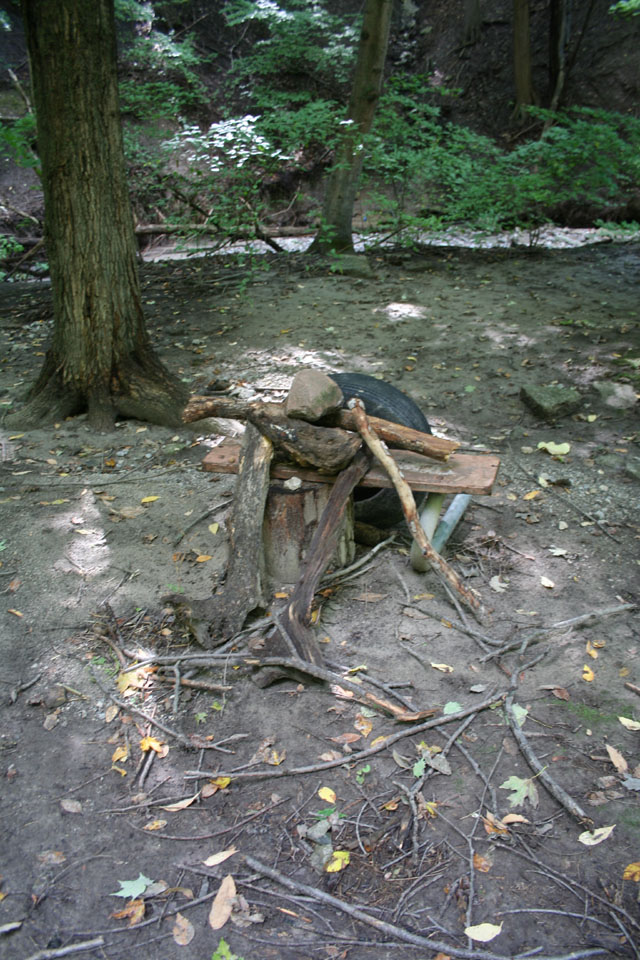

Tribute to Uncle Bill
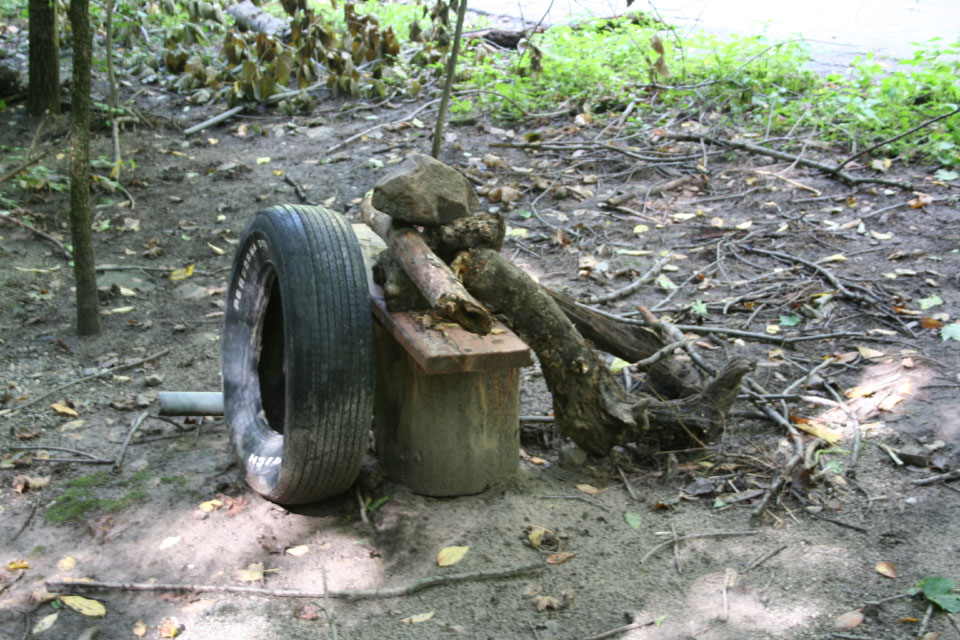


I don't know what this next one is all about at all. It looks to me like the rendering of some toaster that's been canonized by the Catholic Church or something. "All I said was, 'That piece of toast was good enough for Jehovah!'"
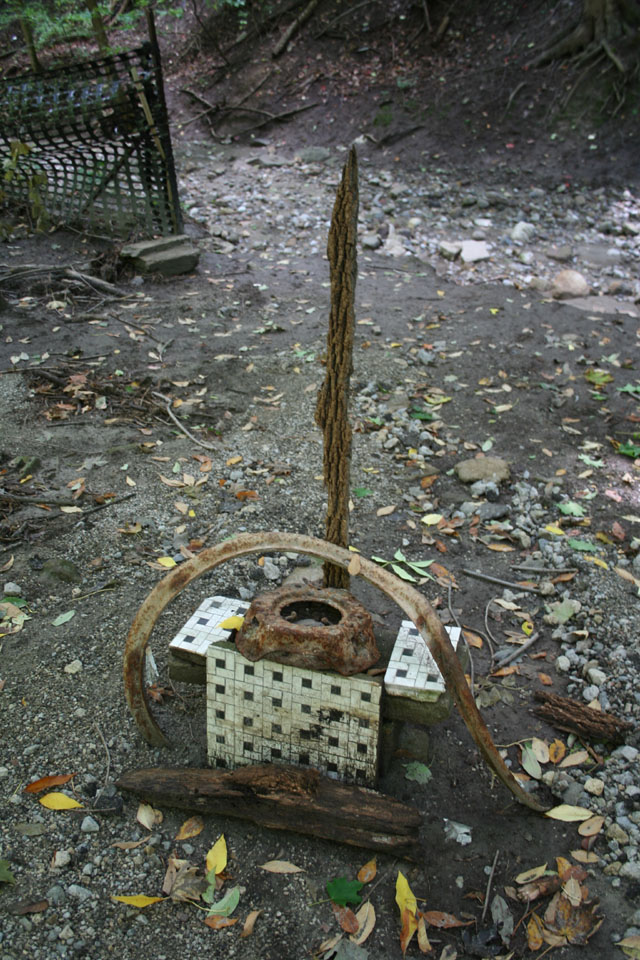

The Martyring of St. Toaster

This next one looks to me like a robot gas station attendant, doing double duty as the pump.


Check the oil, sir?

What can I say? I look at this one, I think: Romanian Olympic Figure Skating Champion.
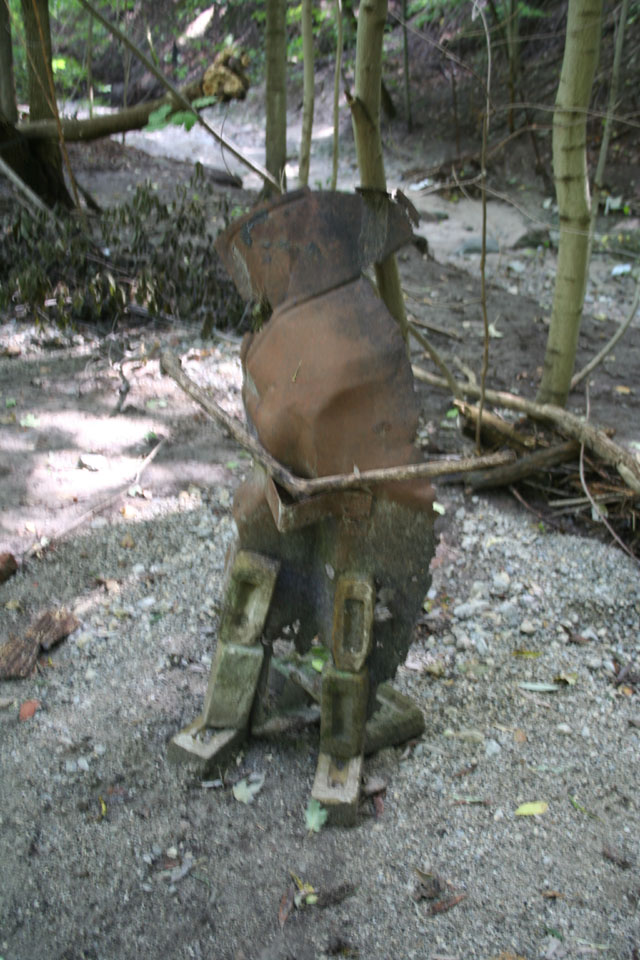

Romanian figure skating champion

This last one, assuming it's part of the same collection, simply looks to me like a chair. If you were some animal who took himself to be King of the Forest, you might have a throne like this made for yourself, it seems to me.
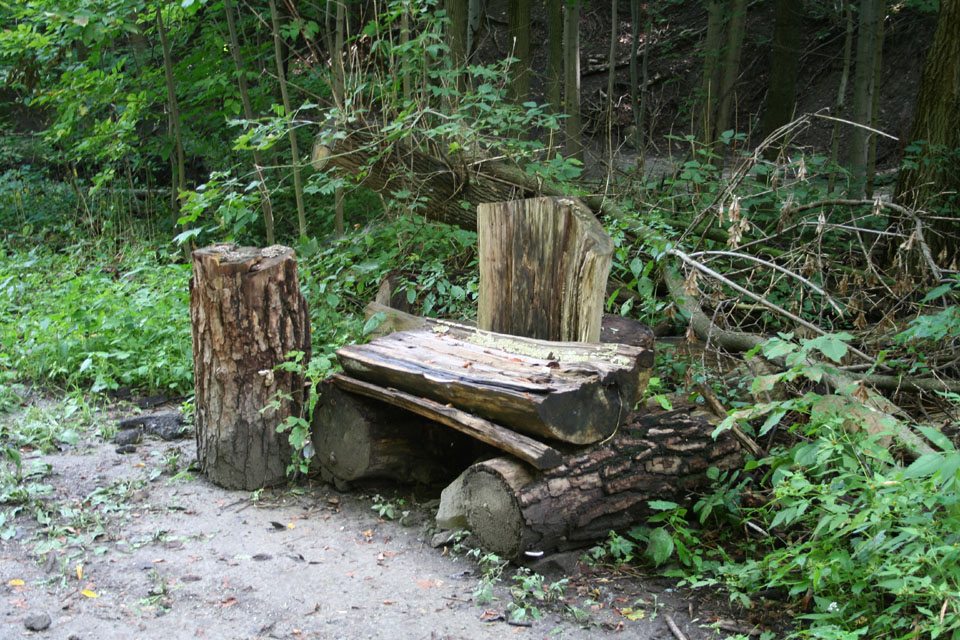

Throne of the Forest King

As with the flood plain around Old Cummer bridge, there's evidence of the flooding from the big storm in mid-August down in this park, too.
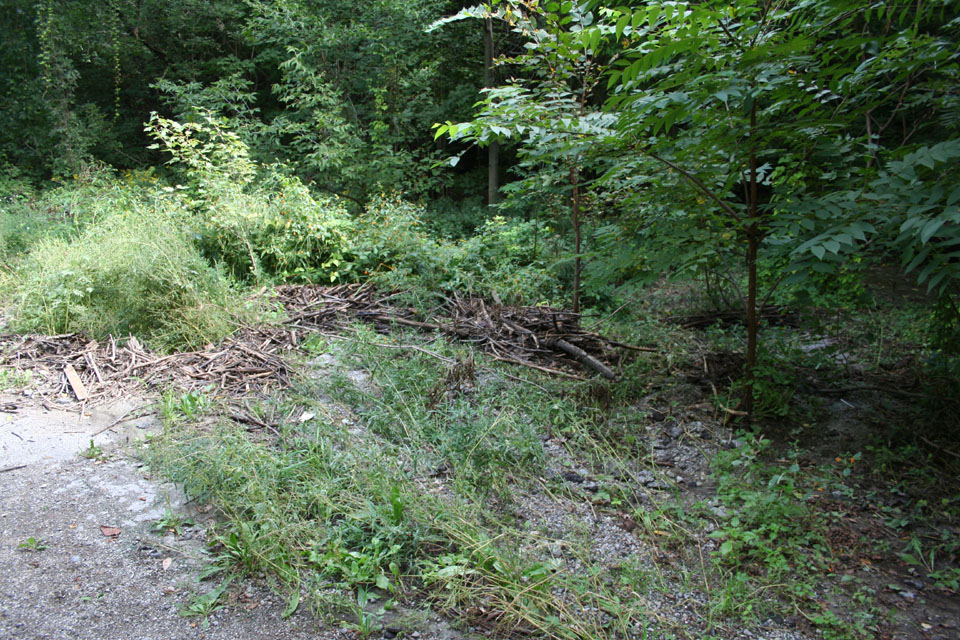

Evidence of flood damage from August

The road itself seems to end at the Metro Works property. However, a path leads off through the property heading north. According to the maps, this path will eventually take you to Sheppard Avenue. I love this shot... it reminds me of places I used to haunt as a kid. The only downside is that damned trash basket at centre right.
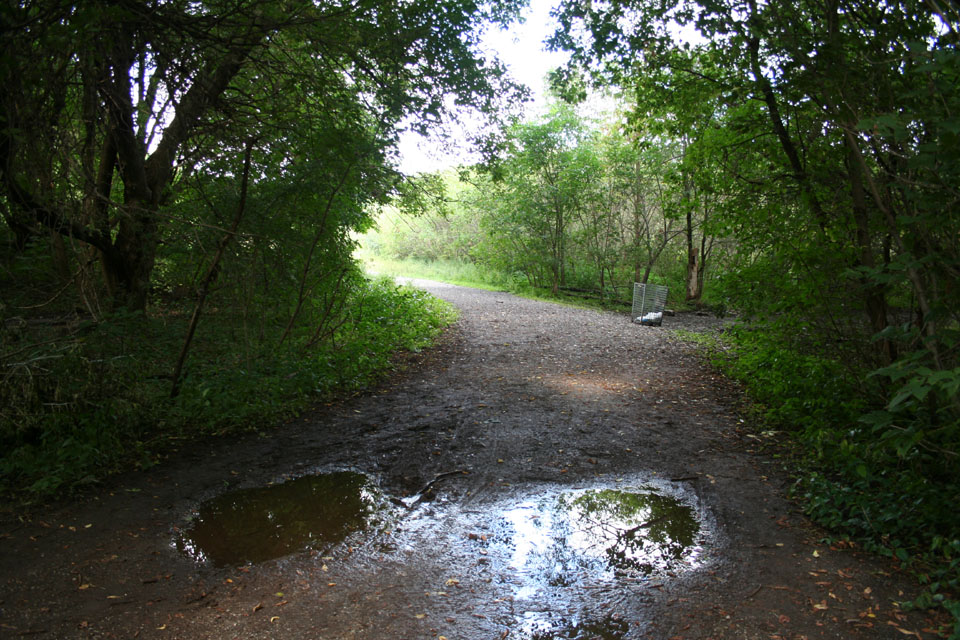

Garbage can ruins shot, film at 11

This is a dove, I think. Surprisingly calm. Kept an eye on me, but let me get within about fifteen feet of it without getting spooked. Whenever I see a dove -- that is, a pigeon that isn't that usual combination of blue-greys that mark it as the sort of city dweller you just know is due to be flattened by a bus sooner or later, I immediately think I'm looking at one of the last passenger pigeons... just that someone missed one or two. I guess if that were true we'd have spotted a few by now.
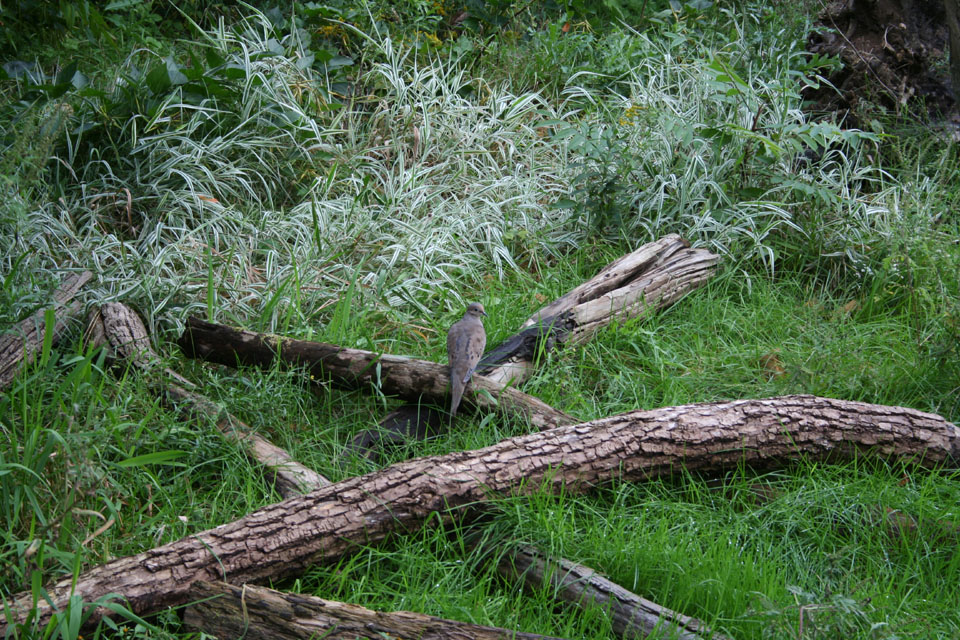

It's the last passenger pigeon!

I don't know what the hell this is supposed to be. If I were in a malicious mood, I might suggest that the raccoons had taken a stab at building a wigwam, and this was the best they could manage.
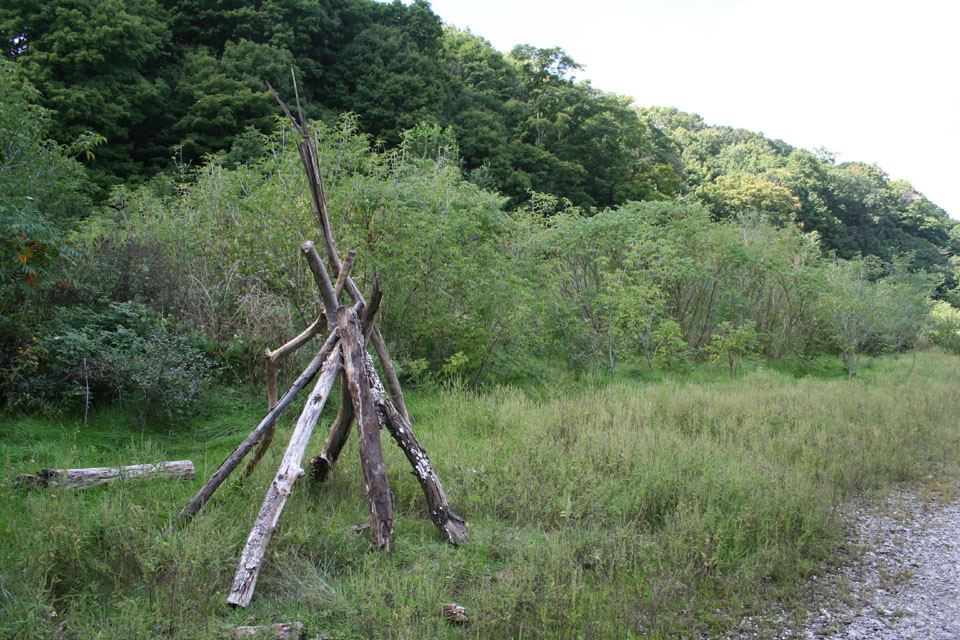

World's Worst Wigwam

The open plain and wooded hills surrounding it on the other side of the fence reminded me of nothing so much as either Wentworth Valley in Nova Scotia where we used to camp when I was very, very young, or else the open brush between my home and the first school I went to in Hamilton (land that is now part of an expressway). Either way, it filled me with warm nostalgic feelings. This place was utterly alive with butterflies; little white ones... hundreds of them.


Kingdom of the butterflies
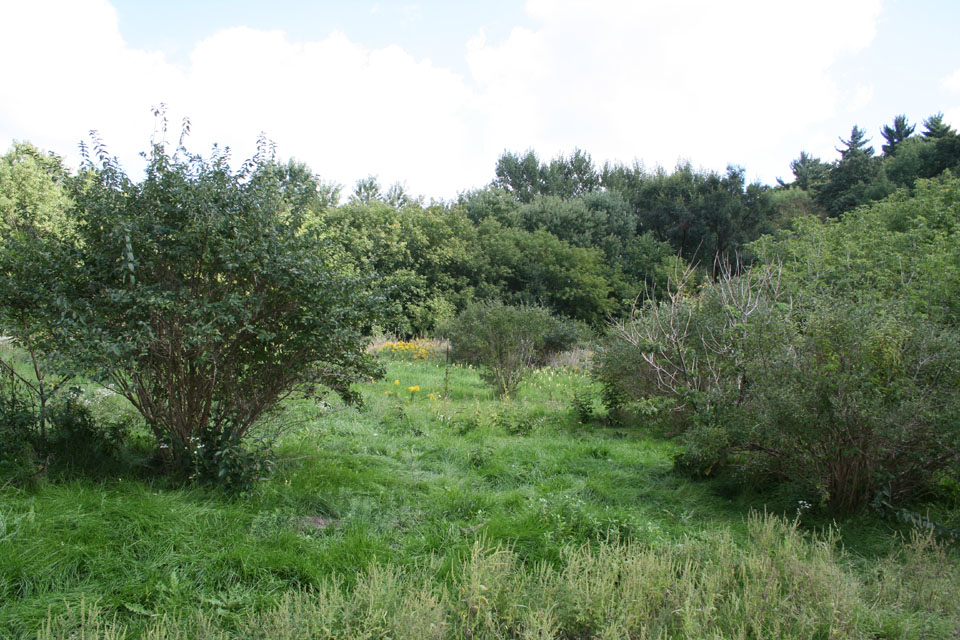


And it feels now just like Heaven comin' down...


Heading down into the woods at the other end of the cleaning, the path splits in two at what seems to be the aeration stream of the sewage treatment plant. On the fence is this warning. More in sympathy than in mirth it occurred to me that the more appropriate city administration sticker for this sign would be "New Orleans", rather than "Toronto".


Looking off to the right from the warning sign, one sees the bridge over the stream. The far side of the bridge represents the far point of my journey; it's where I decided to head back.


Just before crossing the bridge, I saw this rather remarkable sign. Here's something you never expected to see east of Arizona, huh? But coyotes, unlike most other animals besides raccoons and oppossums, have done fantastically well during the European colonization and subsequent urbanization of North America. When I was a teenager in Mississauga, coyotes already had a reputation for eating small dogs in vicinity of Lake Wabuakyne in Meadowvale.
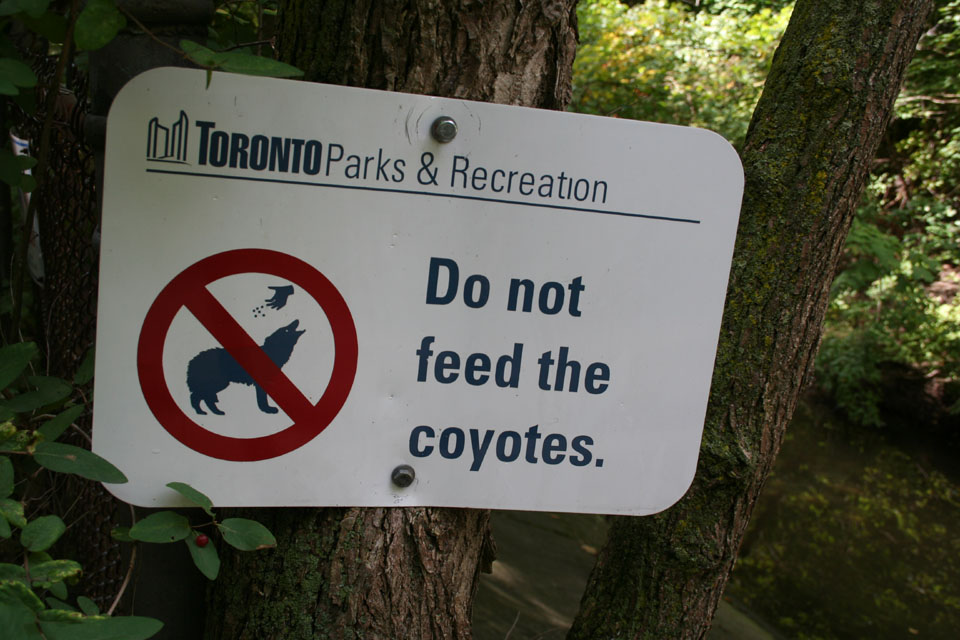

Beep beep!

Far side of the bridge. I almost missed this. I know who this is... I've seen his face before. Nobody was really sure if he was from the House of Lords... But I can't recall exactly who this dopey-looking character is supposed to be. But it struck me funny... it's like Canada's version of Traitor's Gate. Naturally, it would be small, understated, and out of the way, wouldn't it? "Behold the head of a traitor!"


Enemy of the state?

And here we are all the way back along the trails, up the hill, and back on the still-open, surrounded-by-houses part of Westgate Blvd. The manhole cover says 1959, though these streets appear on maps predating that period.
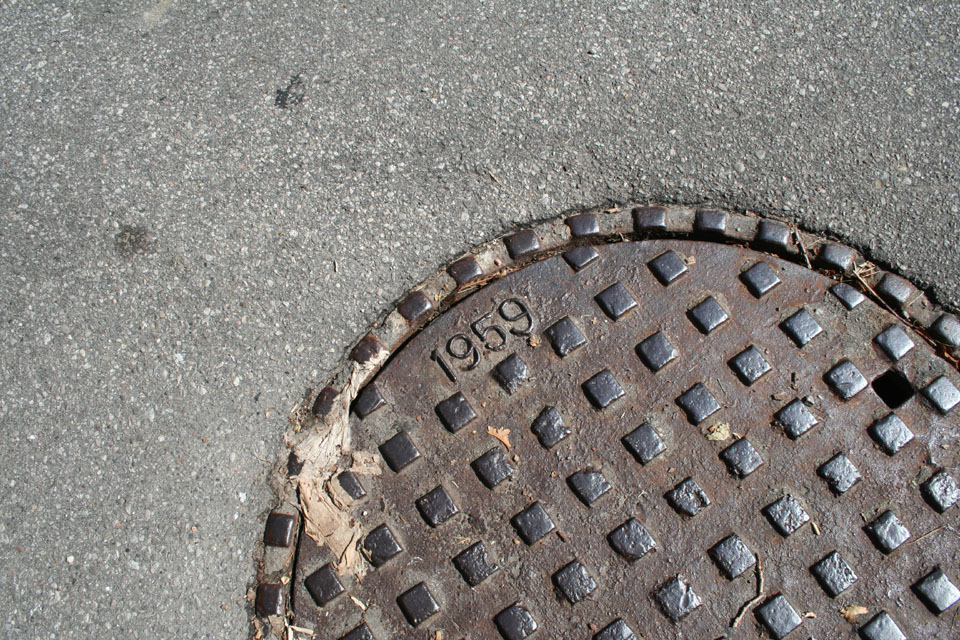

End of the line, 1959

Heading back, this is a view looking northward from the 401 offramp at Leslie Street. You can see the elevated overpass of the 401, and North York General Hospital beyond it. The next shot is taken from just the other side of the 401, just north of it, and just across from the hospital. The sign offers you the way back to the site of our little expedition. Well, you go ahead. For me... it's Miller Time! So to speak. :)
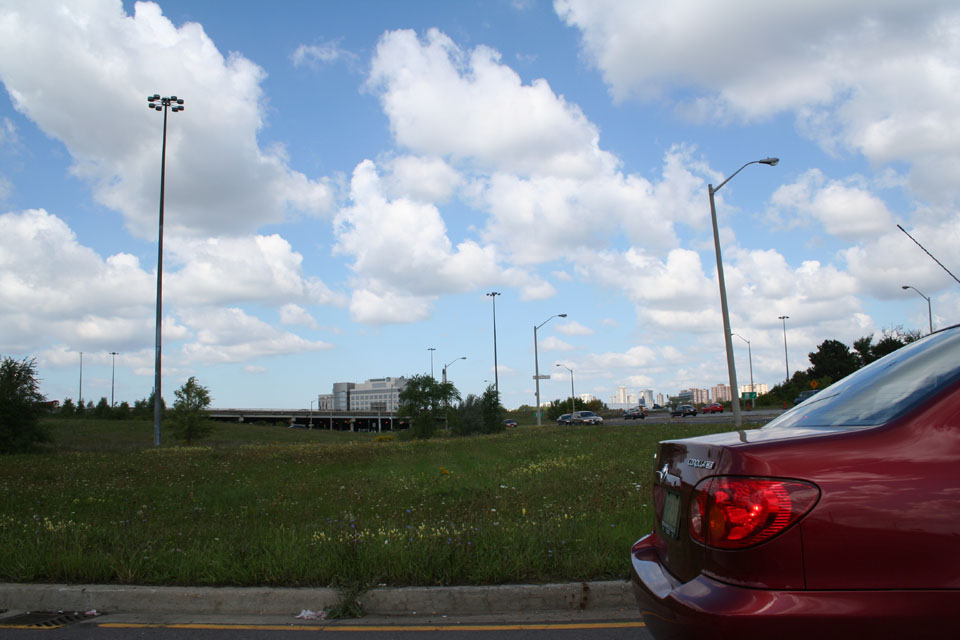

Exiting the 401 at Leslie Street


But if you change your mind...

Friday, September 16, 2005

The Naked and the Fed

And so, off we went again to Hanlan's Point, where Babe Ruth hit his first professional home run, which lies to this day in the waters of Lake Ontario just offshore in Toronto.

P-Doug was teasing me on Monday about the warm temperatures both in the city and in the waters around it, offering me pity that I didn't live and work closer to the lake. I told him I was merely a subway ride away, and could venture down there whenever the mood suited either us both, or me in particular. So Tuesday night, he called me up and invited me down after work.

I wore my wandering clothes to work under my business clothes on Wednesday, and drove down to the depot to catch the subway after work was over. I stripped off my workplace veneer in the car and stored it in the trunk, and then, comfortably beach garbed, caught the subway to head down to the ferry docks.


Crossing Lake Shore Blvd.


Lining up westward down Lake Shore for the Gardiner

I arrived around 6 PM, which was comfortably within the 6:15 departure time for the ferry. P-Doug was waiting. I bought my ticket and, not seeing the usual attendant at the gate, dutifully tore my own ticket and put it in the collection box. It was drizzly that day, and as we sat waiting for the ferry, I took out the Kodak CX7330 refurb I bought this week and filmed the rain falling in the centre of the marshalling area. When the ferry came in, we went to board, and I realized to my dismay that the tickets were being gathered by the ferry operators! Luckily for me, the man collecting the tickets took me at my word that I'd paid and sacrificed my own ticket already like a good little Canadian... that little tiny bit of stiff-upper-lip British do-right attitude that still remains among us runs deep.

At this time of year, the ferry to Hanlan's does triple duty. We sailed across to Ward's Island first. Ward's Island, as you'll recall, is where we accidentally ended up last time, and had to walk clear across the islands to the eastern side to get to the beach. It's also one of the two remaining inhabitied islands in the archipelago (the other is Algonquin Island).


Algonquin Queen II at Ward's Island


Looking back at the city from Ward's Island


A cozy home on Ward's Island

After we disgorged some people at Ward's Island, the ferry headed over to Centre Island, where the restaurants and amusement park are. I don't remember if anyone got on or off there; if so, there weren't many.


City view on the way to Centre Island


Island Paradise restaurant at Centre Island


We arrived at Hanlan's Point around 7. As we headed for the beach, we walked along the path this time instead of the grass. This gave me an opportunity to photograph the sailboats moored at the jetties on Mugg's Island as we passed.


The yacht club on Mugg's Island

When we got to the boardwalk that leads out to the beach, I let P-Doug go on ahead. I used the new camera to video my walk to the beach. It ran about four minutes, along the boardwalk, to the beach, through the barrier and then past P-Doug right into the water to test the temperature. It was quite warm... warmer than the last time we were there. Much calmer, too, though it was drizzly. Here's the best part. There was not another single soul on the beach. It was like it belonged entirely to us. Made me feel kind of let down that skinnydipping was allowed! We could have gotten away with it anyway.


This one's for Kat :)

I waded back out of the water with the camera still rolling while P-Doug undressed. I started humming The Stripper, and then cut the camera to let the man undress with some dignity. He did so, and headed in, beating me to it for once. We must have been in the water for an hour, just enjoying it, chatting away during the sunset and after, as the beach grew darker and darker. Off to the southeast, it was so inky we couldn't tell where the lake ended and the sky began. But in the west, it was still quite clear. Finally we started wondering what the time was, and headed in. By then it was 8:20; the next ferry back was at 9:15, so we decided we should get going by ten to nine to make sure we made it. Till then, we wandered around, letting the air dry us off. I remember clearly standing near the end of the beach, gazing off into the distance, and catching sight of traffic racing to and fro on the Gardiner Expressway, and marveling at the idea... there I was, standing legally naked on the beach in line of sight of one of the busiest urban stretches in North America. It was a powerful realization.

Just before we left, I dashed off into the dunes for a few minutes. No real reason, other than to be bold and to be able to say I'd been in the dunes at Hanlan's Point. What I remember about that was glancing back at my footprints and seeing them almost glowing in the dark. The wet sand at the top was unusually dark, and so when it was disturbed by my feet, it yielded the light-coloured dry sand underneath. In the gloom, the subtle constrast was oddly more striking than it would have been in daylight, I think.

So then we dressed, and set off. P-Doug decided to stop at a picnic table, dry his feet and put on his socks and shoes; this ate up about five minutes. You know me; I'd brought my sandals but I wasn't about to wear them on the way back. Not with the last of summer's warm puddles left waiting for me. :) So as it turns out, the ferry was waiting when we got there -- in fact, within seconds of leaving! We had to run, just like last time, but we made it. We walked to the same LCBO as last time, and P-Doug's wife G swung by to pick us up. We all went to the Three Monkeys to eat. Couple of pints, two bowls of all-you-can-eat chili (it was all I could eat), and then off to slumberland at our respective homes. First time I've been to the beach on a day when I had work the next day. Slept like a log. I don't imagine I'll get to Hanlan's Point again this year... autumn will soon be upon us, and even if the air stays warm, the lake's going to steadily cool. But there's next year. And P-Doug has sworn he's going to be down there a lot, seeing as how he works downtown and all. I waited eight years since the city turned it back into a nude beach to go, and then waited till the end of the summer when I finally did go. Well, I'll sure make better use of it next year.

Tuesday, September 13, 2005

Apocalypse Now Pending

Wasn't this the plot of some crappy teenflick in the early 80s? I thought it was...

Pentagon Revises Nuclear Strike Plan
Strategy Includes Preemptive Use Against Banned Weapons

By Walter Pincus
Washington Post Staff Writer
Sunday, September 11, 2005; Page A01

The Pentagon has drafted a revised doctrine for the use of nuclear weapons that envisions commanders requesting presidential approval to use them to preempt an attack by a nation or a terrorist group using weapons of mass destruction. The draft also includes the option of using nuclear arms to destroy known enemy stockpiles of nuclear, biological or chemical weapons.

The document, written by the Pentagon's Joint Chiefs staff but not yet finally approved by Defense Secretary Donald H. Rumsfeld, would update rules and procedures governing use of nuclear weapons to reflect a preemption strategy first announced by the Bush White House in December 2002. The strategy was outlined in more detail at the time in classified national security directives.

At a White House briefing that year, a spokesman said the United States would "respond with overwhelming force" to the use of weapons of mass destruction against the United States, its forces or allies, and said "all options" would be available to the president.


Read the rest here.

Sunday, September 11, 2005

Bush goes to New Orleans

A friend just sent me this in e-mail. I think it pretty nicely sums up the attitude at the top these days... don't you?

Saturday, September 10, 2005

Who'll Stop the Rain?

I carried over two weeks of vacation from last year, and I convinced my boss to let me use them up as Fridays off this summer. Friday (yesterday, as I write this) was my last. Ah, it was a good summer, full of the kinds of wanderings I've always wanted to do. Seemed to me the best way to spend part of my last summery Friday was to make my way back to the East Don Parklands, since I hadn't visited since I photographed Orion.

If I had only been able to better see in the dark! A few things have changed about the park since I was out there photographing the full moon on the very eve of the storm.

The first real "ah ha" moment was as I was approaching Old Cummer bridge. I suddenly noticed that a chunk of the asphalt on the path had been undermined at the drainage ditch the runs down the hill parallel to the old road surface. My mind immediately went back to the big storm that raged so briefly but so furiously a few weeks ago. Seems it had worked some of its black magic in this part of town too, not just bisecting Finch Avenue.


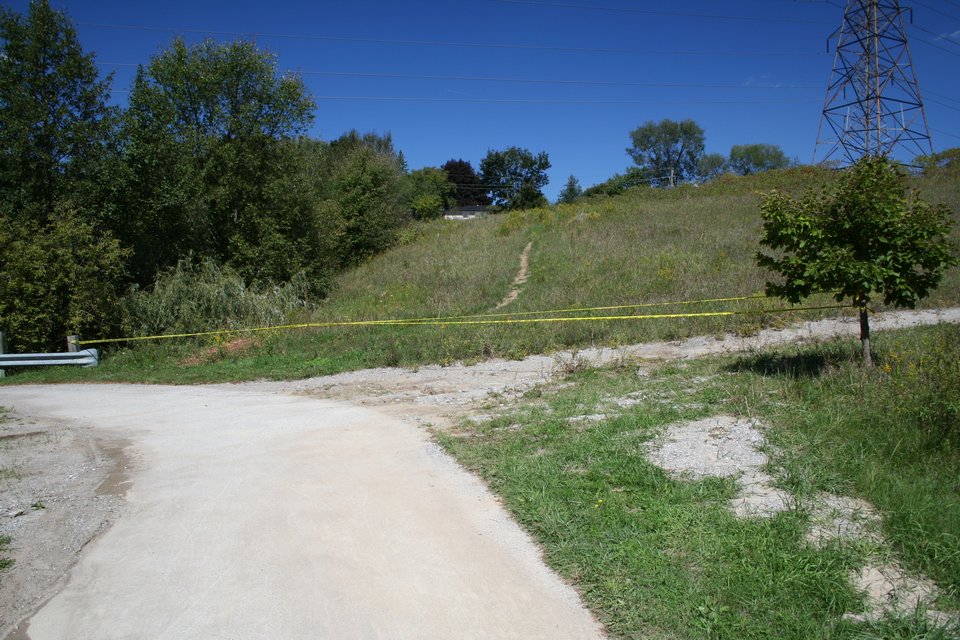
I noticed there was police tape across the bottom of the old road course. A first I wondered if a line had fallen. One up near the new course of Cummer did, starting a fire that my friend Dave and I were witness to on our way home on the day of the storm. It didn't occur to me, at the point I took the picture, that it might have been there to protect people from the volume of water that must have been pasing through.


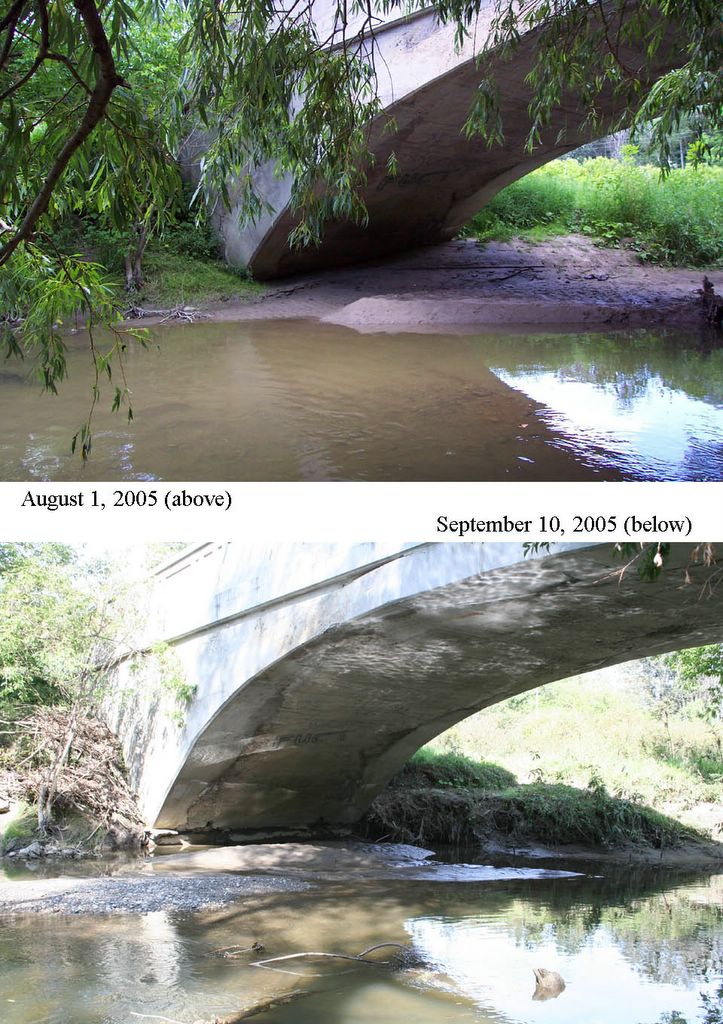
It was when I got to the bridge that I got my first big surprise. The way down on the west side had been a gentle slope down to a sandbar that afforded easy access to the river. No longer. The river had eaten a huge bite out of the bank. It was now a three-to-four foot drop straight into the river. All the sand that had built up against the western abutment had been washed away -- deposited, in fact, up on the grass of the southwest bank, by my reckoning. I went back there earlier today to try to match a shot I'd taken at the beginning of August, to provide some contrast. You can imagine the volume of water it took to rip away this much sand and clay in just an hour or so.


Friday, I didn't attempt to access the river at this point, but I had a friend with me today who held onto my camera and the photos I was trying to match as I eased down the hill. I waded to the centre to get this contrasting shot.


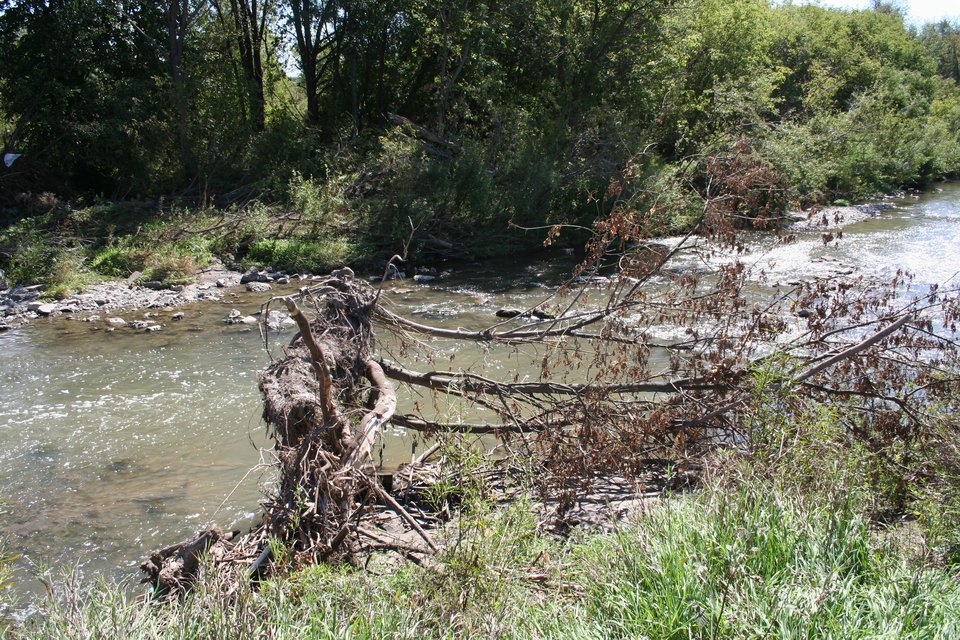
But before all this realization, yesterday, I decided to head down the river a bit to see how the beaver dam had fared. Along the way, I noticed things like this tree over turned in the water...


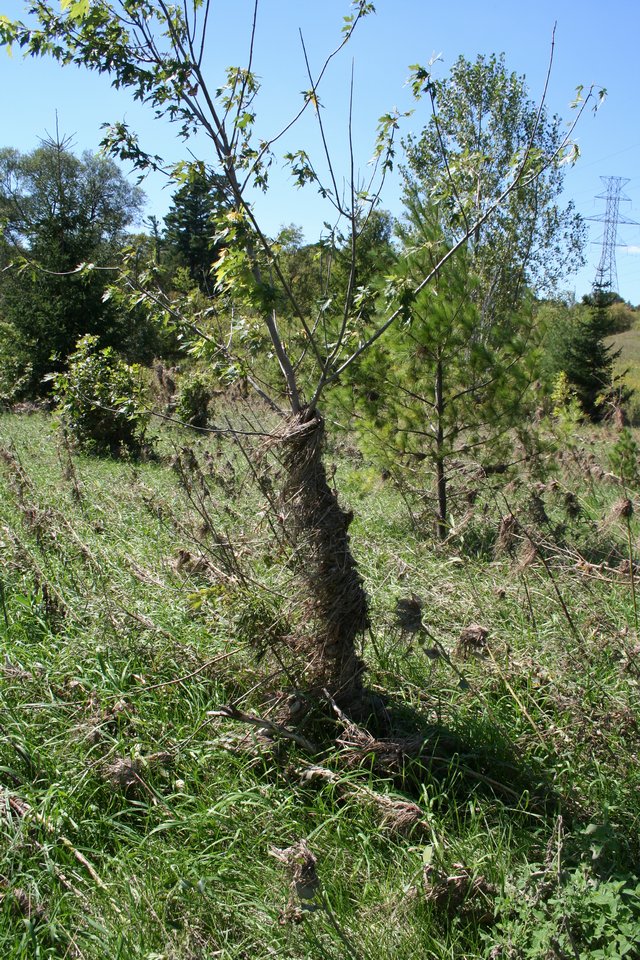
...and debris in the arms of the trees, and wrapped around the plants. It was then that it really began to dawn on me just how much water must have been running through this place. The flood plain had literally become just that.


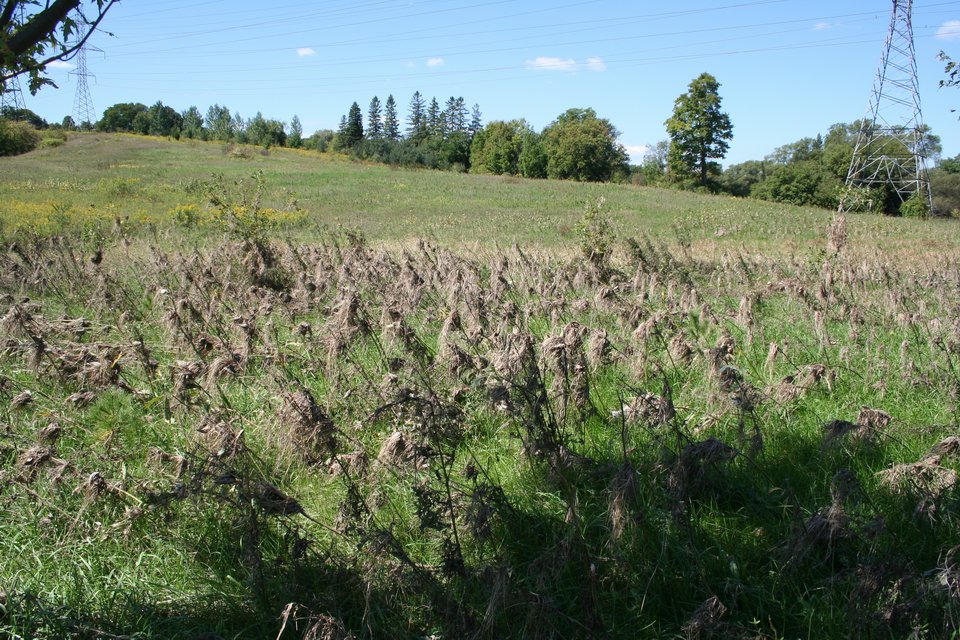
Across the field, some of the plants must have been bowed down, so they exaggerate the depth of the water passing...


Evidence of rushing water on planet Earth


Waist-height debris

...but not the trees by the river. They report the depth of the water as it fell over the bank. This water here must have been the chest height of a grown man. Incidentally, the background of this picture shows where the beaver dam had been. It's been utterly washed away. Beavers must have dealt with this millions of time in their history. I only hope these ones lived to build again.


Chest-height debris


Scour at beaver dam

To give you some idea of just how powerful the water was passing through here, look at these massive sitting logs. It would have taken a crane to move them. You can see nature found its own way.


At this point on the river, I did make my way down to the water. I was determined to see the far side, even though I'd never forded the river here before (in fact, this represents the first time I have actually forded the East Don at any point). Looking east towards where the beaver dam sat, I noticed this massive treed that had been felled by the water. Situated at the bend in the river, it was doomed. The water hit it full force, scoured the earth from its very roots, and when it was left with nothing to hold onto, finally pushed it aside. I can't imagine what it would have been like to have been anywhere near this place when this was going on.


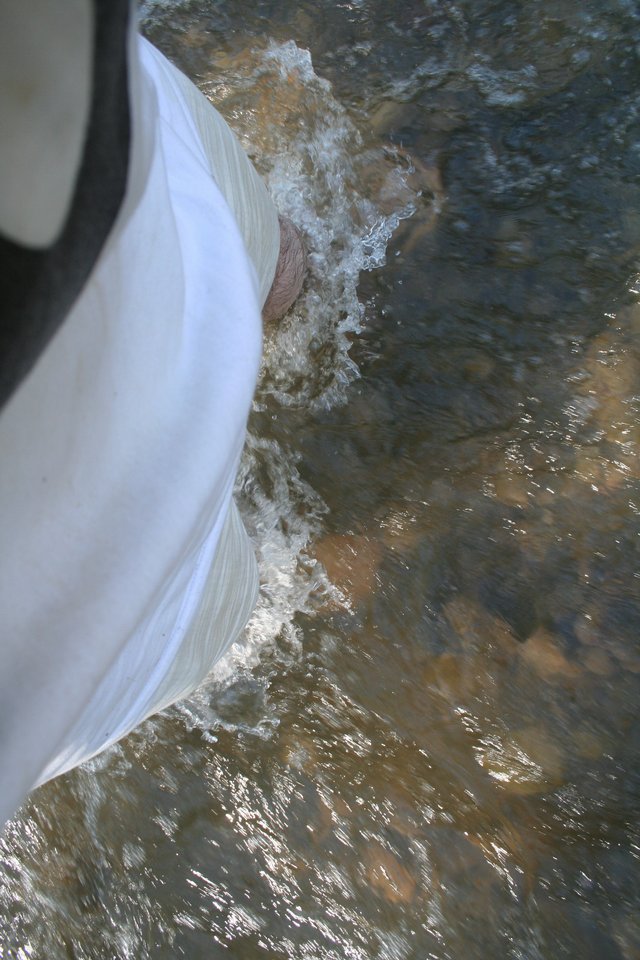
The water was actually mostly shallow there, running over gravel, except at one place where it had carved itself a race only a few yards wide. It was knee deep, and running at ten or fifteen miles an hour, I'd guess. Very strong, making it a challenge to stand up. The rocks were hard to walk on, blunt but still painful, and since I was carrying a very expensive camera, I had to choose my footfalls well. It took a minute or two to make my way.


Having crossed the river, I made my way to the far bend, and here I found evidence that life goes on...


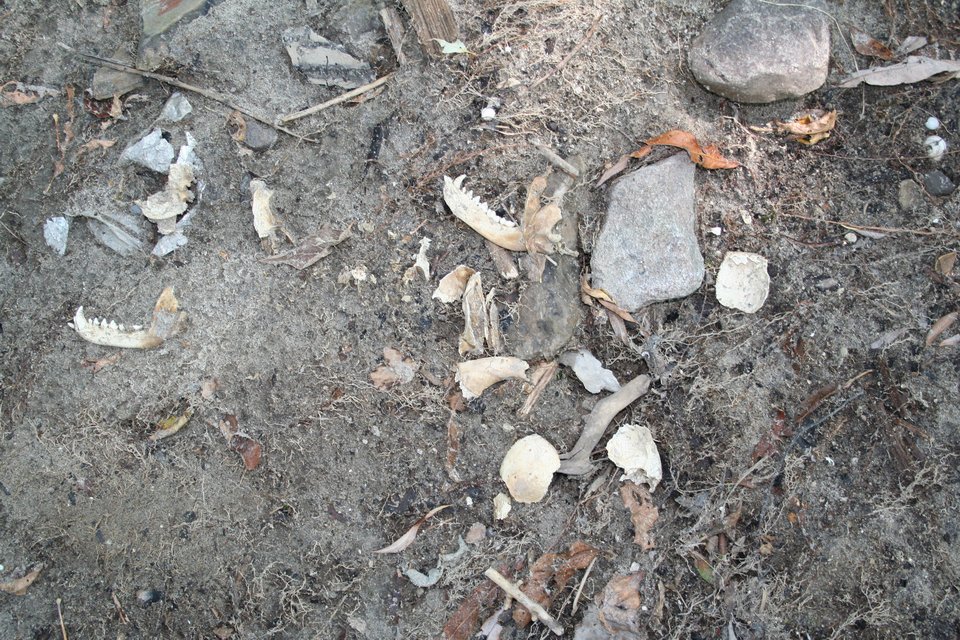
...or does it? I almost literally stumbled over these bones. They are the jaws and some of the cranium of some unfortunate animal. Did this animal drown in the flood, only to have his or her body picked over, cleaned by the ants, and discovered by a passing human three weeks later? Or did the water unearth the bones of some long-gone animal from years ago? Initially, I left the bones. Later on, as I was on my way back, I reconsidered. I found a bit of plastic hanging in the trees, and recovered the three jaws I found there. I know it seems macabre, but I was motived by sympathy and my desire that the little bones should mean something to someone. I tucked them into my back pocket, all the while the lyrics from the Talking Heads song Swamp running through my head: Now lemme tell you a story; the devil, he has a plan... bag of bones in his pocket... get anything you want...


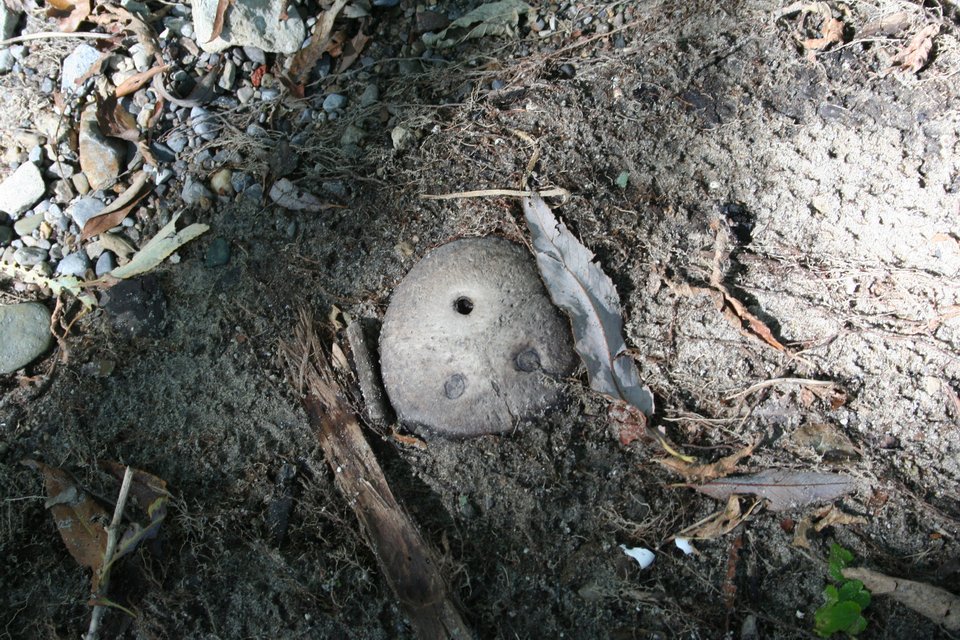
But first, I explored. Not far from where I found the bones, I found this... very unusual find, buried in the sand of a Canadian river. It's a coconut. I'd love to know the story of how it came to be lying here. Probably a mundane and fairly unsurprising story, but... who knows? Actually, when you stop and think about it, it's pretty amazing that coconuts wind up in southern Ontario anyway... it's a miracle of human agency. It's the quirk of how it wound up mostly buried in sand in the East Don River that would intrigue most of us jaded modern types.


Where's the Professor when you really need him?

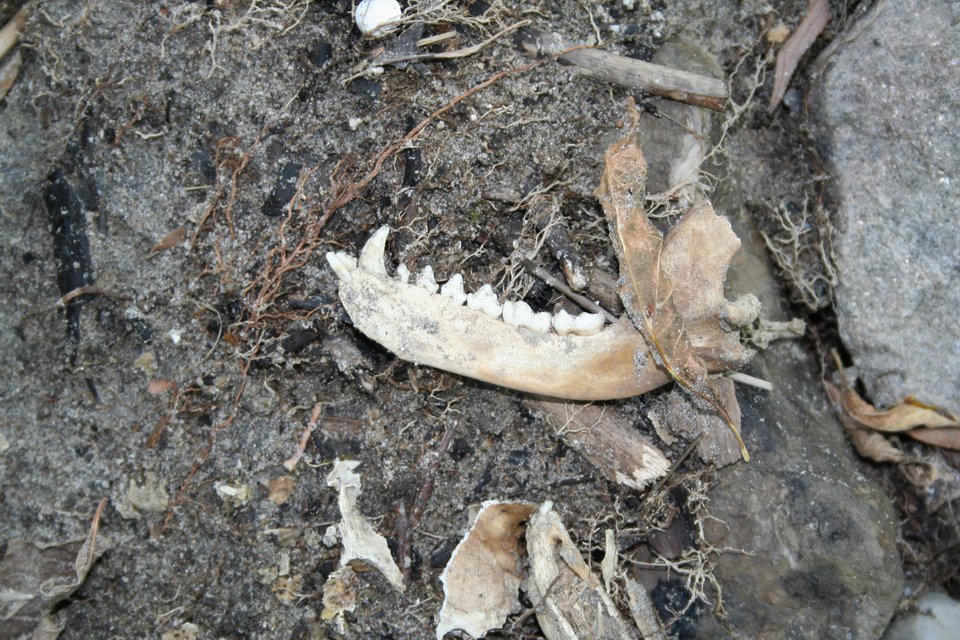
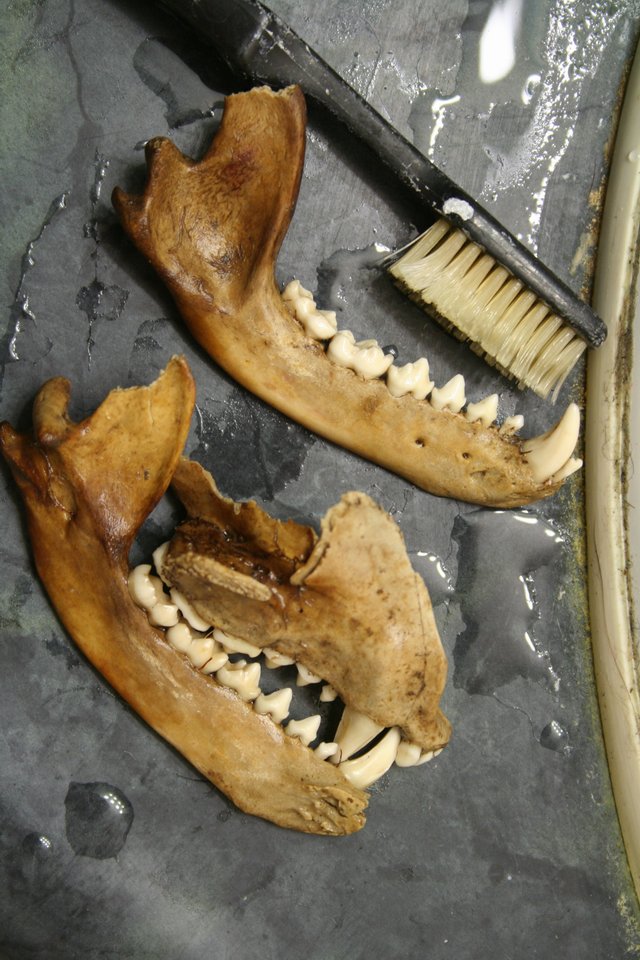
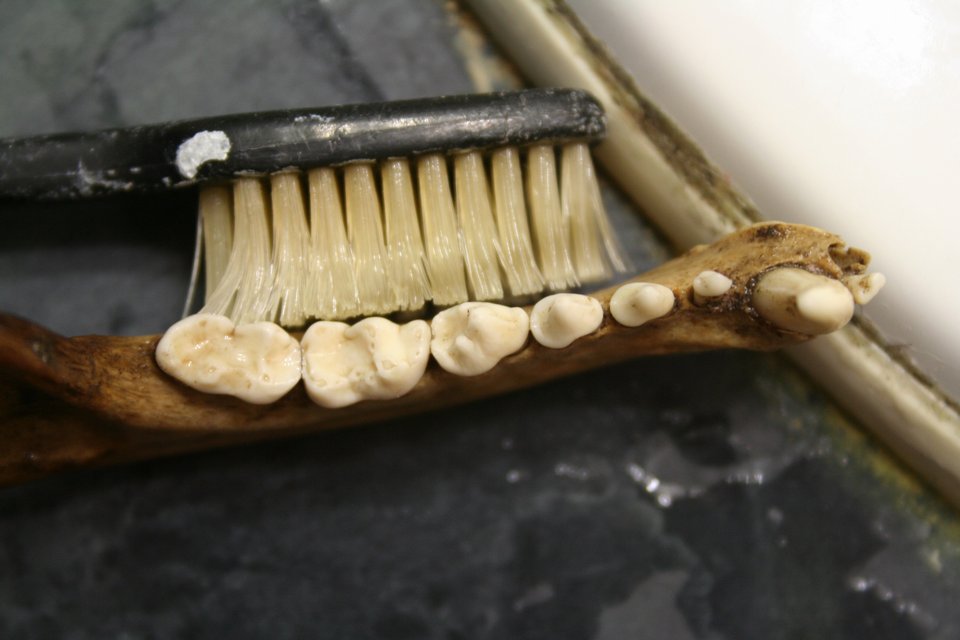
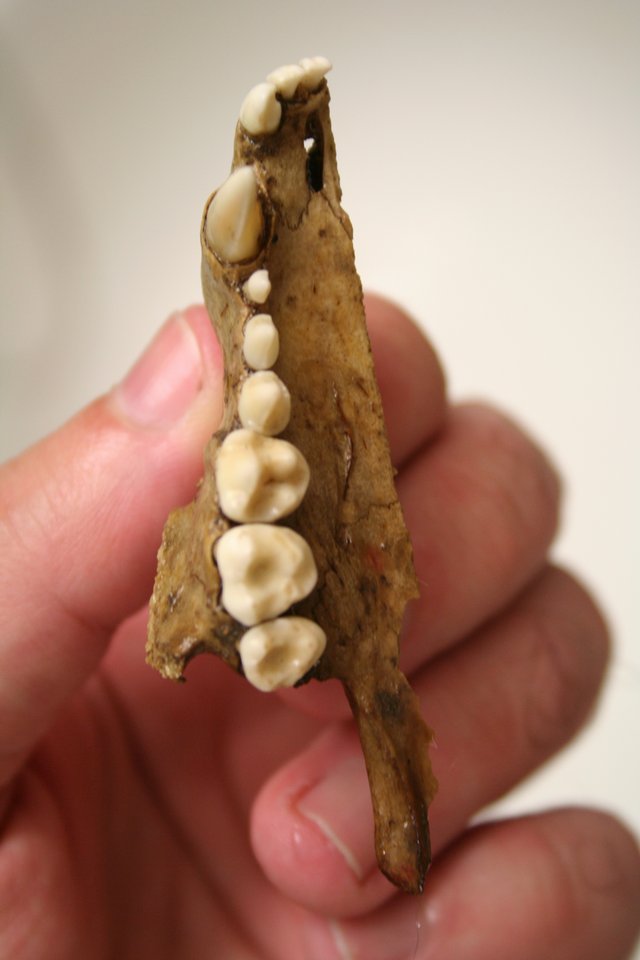
When I got home, I dug out the three bones I'd recovered and cleaned them off. I used an old toothbrush I keep around to clean the grout between the tiles in the bathroom. I tried to match up the jaws. As it turns out, I blew it: mixed up the right and left bottom jaws. But you still get some idea of how the top and bottom jaws fit together.


This is the bottom left jaw.


And this is the top right, where the roof of the mouth was.


When I first found these bones, I wondered what kind of animal had left them behind. At first, due to the prominent canines, I thought it was some sort of wild dog or cat. Perhaps, I thought, a bobcat, or a coyote pup. It was when I got them home and started cleaning them up and taking a good look at them that I started deducing otherwise. Notice that the molars are broad and flat like ours, rather than narrow and pointed like your dog's or your cat's. Now I'm no expert by any means in taxonomy, but what little I've read led me to speculate that such an animal would be a fellow omnivore. When I thought of that, immediately I thought of raccoons, which are extremely prevalent within Toronto's urban environment... there are an estimated forty-to-fifty thousand of them within the City of Toronto alone, and probably hundreds of thousands across the GTA: roughly one raccoon for every fifty humans. So this morning, I went online to look for what a raccoon's skull looks like. Among others, I found this one. As you can see, there's little mistaking it. The bones I found almost certainly came from a raccoon. I'm not sure of the age of the animal who laid down these bones, but he or she wasn't a baby. The molars have points worn down to the dentine, but still are still robust, so I'm guessing an adult, maybe of middle age for a raccoon... which would be about age three in the wild, based on things I've read that give them an average five years outside captivity. That said, urban raccoons, who manage not to get run over, can live a decade or more due to the proximity of warm shelter and ample foodstuff, courtesy of their friendly neighbourhood primates (you and me). So perhaps this raccoon was five or so.

I wonder about the raccoon who grew these bones, these teeth. Was it male or female? Was she someone's mother? Someone's father? What did he or she see in that short lifetime? What kind of life was it? What happened at the end? Most animals die and are never regarded in any sense. At least this raccoon drew the attention of another, more intelligent animal, who recognized it for what it was, and brought some kind of meaning a relevance to its death, and, by extension, its life. I suppose in some odd way, it ties in with what's been going on in New Orleans. The water came, lives were lost. I don't know. Maybe it resonates with me somehow, in this small, strange way.

Thursday, September 08, 2005

The Big Easy gets inured to the macabre

From The New York Times, by way of The International Herald-Tribune...

In the downtown business district here, on a dry stretch of Union Street, past the Omni Bank automated teller machine, across from a parking garage offering "early bird" rates: a corpse. Its feet jut from a damp blue tarp. Its knees rise in rigor mortis.

Six National Guardsmen walked up to it Tuesday afternoon and two blessed themselves with the sign of the cross. One soldier took a parting snapshot like some visiting conventioneer, and they walked away. New Orleans, September 2005.

Hours passed, the dusk of curfew crept, the body remained. A Louisiana state trooper around the corner knew all about it: a murder victim, bludgeoned, one of several in that area.

The police marked it with traffic cones maybe four days ago, he said, and then he joked that if you wanted to kill someone here, this was a good time.

Night came, then this morning, then noon, and another sun beat down on a dead son of the Crescent City.

That a corpse lies on Union Street may not shock; in the wake of last week's hurricane, there are surely hundreds, probably thousands.

What is remarkable is that on a downtown street in a major American city, a corpse can decompose for days, like carrion, and that is acceptable.

Welcome to New Orleans in the postapocalypse, half baked and half deluged: pestilent, eerie, unnaturally quiet.

Scraggly residents emerge from waterlogged wood to say strange things, and then return into the rot. Cars drive the wrong way on the interstate and no one cares. Fires burn, dogs scavenge, and old signs from bon temps have been replaced with hand-scrawled threats like the one on Chartres Street: "I WILL SHOOT YOUR SORRY ASS - BE NICE and LEAVE."

The incomprehensible has become so routine here that it tends to lull you into acceptance.

On Sunday, for example, several soldiers on Jefferson Highway had guns aimed at the heads of several prostrate men suspected of breaking into an electronics store. A car pulled right up to this tense scene and the driver leaned out his window to ask a soldier a question: "Hey, how do you get to the interstate?"

Maybe the slow acquiescence to the ghastly here - not in Baghdad, not in Rwanda, here - is rooted in the intensive media coverage of the hurricane's aftermath: Floating bodies and obliterated towns equal old news. Maybe the concerns of the living far outweigh the dignity of a corpse on Union Street.

Or maybe the nation is numb with post-traumatic shock.

Wandering New Orleans this week, away from news conferences and search-and-rescue squads, has granted haunting glimpses of the past, present and future, with the rare comfort found in, say, the white sheet that flaps, not in surrender but as a vow, at the corner of Poydras and St. Charles Avenue.

"We Shall Survive," it says, as though wishing past the battalions of bulldozers that will one day come to knock down water-corrupted neighborhoods and rearrange the Louisiana mud for the infrastructure of an altogether different New Orleans.

Here, then, the New Orleans of today, where open fire hydrants gush the last thing needed on these streets; where one of the many gag-inducing smells - that of rancid meat - is better than MapQuest in pinpointing the presence of a market; and where images of irony beg to be noticed. The Mardi Gras beads imbedded in mud by a soldier's boot print. The "take-away" signs outside restaurants taken away. The corner kiosk shouting the Aug. 28 headline of the New Orleans Times-Picayune: "Katrina Takes Aim."

Rush hour in downtown now means pickups carrying gun-toting men in sunglasses, SUVs loaded with out-of-town reporters hungry for action, and the occasional tank. About the only ones commuting by bus are dull-eyed suspects shuffling two-by-two from the bus-and-train terminal, which is now a makeshift jail.

Maybe some of them helped to kick in the portal to the Williams Super Market in the once-desirable Garden District, and who could blame them if all they wanted was food in those first desperate days? The interlopers took the water, beer, cigarettes and snack food. They did not take the wine or the New Orleans postcards.

On the other side of downtown, across Canal Street in the French Quarter, the most raucous and most unreal of American avenues is now little more than an empty alley with balconies. The absence of sweetly blown jazz, of someone cooing "ma chère," of men sporting convention name tags and emitting forced guffaws - the absence of us - assaults the senses more than any smell. Past the famous Café du Monde, where a slight breeze twirls the overhead fans for no one, past the statue of Joan of Arc gleaming gold, a man emerges from nothing on Royal Street. He is asked, "Where's St. Bernard Avenue?"

"Where's the ice?" he asks in return, eyes narrowed in menace. "Where's the ice? St. Bernard's is that way, but where's the ice?"

In the water-weary Seventh, Eighth and Ninth Wards, the severely damaged streets and neighborhoods bear the names of saints who could not protect them. Whatever nature spared, human nature stepped up to provide a kind of democracy in destruction.

At the Whitney National Bank on St. Claude Avenue, diamond-like bits of glass spill from the crushed door, offering a view of the complementary coffee table. A large woman named Phoebe Au - "Pronounced 'Awe,"' she says - materializes to report that men smashed it in with a truck. She fades into the neighborhood's broken brick, and a thin woman named Toni Miller materializes to correct the record.

"What line of crap's she feeding you?" she asks. Then she says, "They used sledgehammers."

Farther down St. Claude Avenue, where tanks rumble past a smoldering building, the roads are cluttered with vandalized city buses. The city parked them on the riverbank for the hurricane, after which some hoods took them for fare-free joy rides through lawless streets, and then discarded them.

On Clouet Street, where a days'-old fire continues to burn where a warehouse once stood, a man on a bicycle wheels up through the smoke to introduce himself as Strangebone. The nights without power or water have been tough, he said, especially since the police took away the gun he was carrying - "They beat me and threatened to kill me," he says - but there are benefits to this new world. "You're able to see the stars," he says. "It's wonderful."

Law enforcement troops have now begun lending muscle to Mayor C. Ray Nagin's vow to evacuate by force any residents too defiant or too stupid not to leave the toxic metropolis. They searched the streets for the likes of Strangebone, and that woman whose name sounds like Awe. Meanwhile, back downtown, the shadows of another evening crept like spilled black water over someone's corpse.

What the hell happened?

According to the UK Guardian:

Louisiana ready with 25,000 body bags
Mark Oliver and agencies
Thursday September 8, 2005

Rescuers continue to search for survivors in New Orleans.

Emergency officials in Louisiana have 25,000 body bags at hand in the aftermath of Hurricane Katrina, it was revealed today.
Asked if the authorities expected so many bodies, a spokesman for the state's department of health and hospitals said: "We don't know what to expect ... It means we are prepared."

Predictions of the death toll from the hurricane and its repercussions have ranged from a few hundred to 10,000.


From another story:

A total of nearly 40,000 are officially unaccounted for but it is accepted that the vast majority of them have probably either survived the storm or had already left the city without necessarily informing anyone of exactly where they were going.
The figures of those still unaccounted for in this city of just under 500,000 people have been used to draw up a computerised estimate of the dead which is double that of Mr Nagin's. But some believe that the true figure will be far, far smaller, even just in the hundreds.

"The estimates are always far in excess of the reality," said one American reporter who specialises in covering disasters as the rescue operations were coordinated outside Harrahs casino in New Orleans. "I would not be surprised if we were looking at as few 200 to 300."

Such enormous discrepancies are not unusual. When the World Trade Centre was attacked in September 2001, initial estimates of the dead were between 30,000 and 40,000. These were gradually revised down to a figure of 10,000 which was accepted initially as a likely total. In fact, the final figure was fewer than 3,000.

"The honest answer is we just don't know," said a Fema official in Baton Rouge. "All we have to go on is what the official figures are as people are identified. Anything else is a guess."


I'm entirely in accord with this latter sentiment. I remember the huge, overblown estimates on 9/11 myself. I think -- oh, God, I sure hope -- that 25,000 is a huge overstatement. But suddenly, it's at least in the realm of possibility. And that alone is utterly amazing.

I remember following dozens of hurricane stories in my life. As a child, I was fascinated with volcanoes, tornadoes, and hurricanes. Hurricanes were particularly interesting because they happened with regularity every summer, and ran their courses over days or weeks with whole cities as their targets, so there was a sense of suspense. And in all that time, I can never remember a hurricane that made landfall in the US where the numbers of the dead ever got into even the mid-range three-digits. I never heard of hundreds of thousands of people being displaced. I never heard of months, seasons, years being projected before a city would be liveable again.

Now you can say that New Orleans is a special case. It's below sea level, on the Gulf, with a huge river running through it.

My response is: New Orleans is a special case. It's below sea level, on the Gulf, with a huge river running through it. And it has been for three hundred years. It's not like people just suddenly noticed that. I was reading this morning that the US Army Corps of Engineers has been planning the upgrade of the levees to withstand a category 5 hurricane since 1965. What the hell happened? There's a record of a funding boon under Clinton in 1995, and that may have helped, but then an 80% cut under Bush. This goddamn war of his. It's ruined Iraq, sent the price of oil skyrocketing, chewed up 2000 American lives and God alone knows how many innocent Iraqi ones, spiked the US deficit and debts to levels from which I cannot realistically imagine they will ever recover, and now this: a famous city of the American homeland, ruined and unliveable for the foreseeable future. Why is this man still in office? If a Democrat had been incumbent and this had happened as a result of a terrorist attack, Congress would be convening to impeach him as we speak -- but all this happened as a result of the actions of this president himself! I didn't think there was this much teflon in the universe! Good God... is there nothing left of the American Constitution? Nothing at all?
Welcome to New York!

I found this map several years ago and always found it amusing. I know it's a little hard to see at this resolution, but the large blue area at mid-left on the map, clear across the lakes, is titled "PROVINCE OF NEW YORK" on this map, made on the eve of the French and Indian War. Clearly, New York was anticipating a win, and staking out an early claim to the New World's New World Order afterwards. We did win, but the Proclamation of 1763 killed the hopes of all these claimnants west of the Appalachians, and led to the Revolution. In only about a generation, it all went from being two places, down to one, and then back to two again.

I show the map here in honour of Laura and Allan, who've just moved to Toronto, New York (at least according to this map). Hope it gives them a smile. :)

Huske map, 1755, reproduced in "The French and Indian War" by Seymour I. Schwartz

Monday, September 05, 2005

Labour Day luna

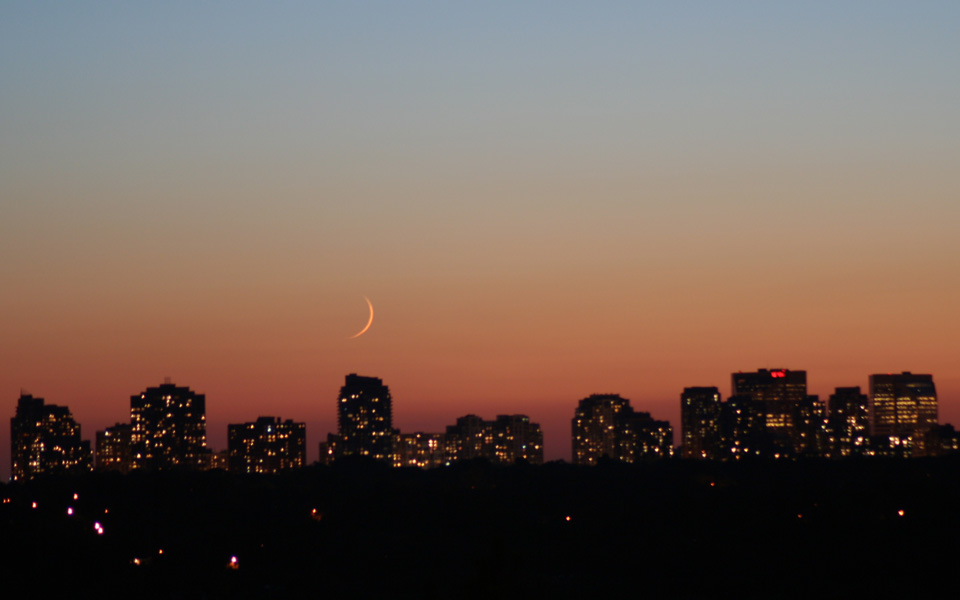
Happened to be out this evening and caught sight of this wonderful setting of the first sliver of the moon. The view is over Yonge Street in North York. Took about a dozen shots. This is the one I like best... one-second exposure using the Tamron 70-300 mm lens at f/4.5, ISO 100, focal length 124 mm. Thought I'd share it with you.


Moon over Mel's Bells

I hear the train a-comin'...
I think it's gonna stick this time.
The Guardian is suggesting 10,000 people may, stress may, have died in Louisiana alone. Now that may be an exaggeration, but that's really beside the point. The fact that major British newspaper can even speculate about numbers of that magnatude is in and of itself an indictment of the gross incompetence and obliviousness of the current US administration.

I probably don't need to fill the page with links at this point. Even the mainstream media is now full of stories about budget cuts to FEMA, cuts to the budget the US Army Corps of Engineers requested summer last year for the levees, wasted money and manpower in Iraq, days passing before federal help got rolling. All of this, all of it, can be laid at George Bush's doorstep. Think about it. On 9/11, Al Qaeda killed three thousand Americans and change, as well several hundred foreigners also working in the WTC. This week, the United States government may have been, through its negligence and belligerence, directly culpable in the deaths of three or four times that many.

Let's be blunt. George Bush tied New Orleans to the railroad tracks, even though people kept telling him they knew a train was coming. He gambled it wouldn't roll by on his watch, and he lost. Richard Nixon resigned over a break-in and some subsequent ethics breaches, for God's sake. George Bush squandered thousands of American lives at home and has put a major American city out of action for perhaps the next two years. In truth, it may never completely recover. Nixon quit... what is Bush prepared to do?

America: this is your last chance. If you can't pull it together, stand up, and make these people accountable now, it's finished. Your grand republican experiment is over. It's now or never.

I think it's gonna stick this time.

Jesus, I hope so.

Fuck you for all the help, Britain, fuck you very much

I remember the British TV show Spitting Image taking the Americans to task for cancelling all their trips to Britain over fears of terrorism after the Brits let the Yanks use their airbases to attack Libya in the 80s. Seems some things never change. Regardless of what I think of their motives, the British were the first and foremost to stand by the States in Iraq, and no doubt will be the last by their side when it finally all comes crashing down. And what kind of thanks does this garner them when it really counts?...

You're on your own, Britain's victims told

Mark Townsend
Sunday September 4, 2005
The Observer

British families trapped in New Orleans last night claimed that US authorities had refused to evacuate them as Hurricane Katrina approached the city.

Although assistance was offered to US residents, British nationals were told they would have to fend for themselves. According to those who remain stranded in the stricken city, police had visited hotels and guest houses on the eve of the hurricane offering to evacuate Americans, but not Britons.

The order meant UK holidaymakers without cars were left helpless in the face of the hurricane. Some have been trapped in hotels and guest houses since the hurricane struck at 7am local time last Monday.


Read the rest here.

Must give the British a real warm, fuzzy feeling. Must really do your heart good to go to war and make a terrorist target of your country only to be treated like an expendible family pet when the waters rise. I guess we Canadians can't complain. All they're doing to us is screwing us over on beef and lumber.

Sure, you want fries with that?

Sunday morning. 3:30 AM.

[Phone rings]

Lone Primate: Hello?

20-something guy: ...Hello?

Lone Primate: Hello?

20-something guy: Who's this?

Lone Primate: [exasperated snort] You tell me!

20-something guy: This is Art.

Lone Primate: Uh huh?

20-something guy: I was looking for some girls there.

Lone Primate: Well, I'm sorry, I can't help you.

20-something guy: Wow, that sucks.

Lone Primate: Yeah, doesn't it. I think you have the wrong number.

20-something guy: Okay, take care. [hangs up]

----------------

Sorry to disappoint you, Art. Even sorrier that whatever girl had the good sense to blow you off with a fake telephone number happened to give you mine. And I'm sorriest of all there are no girls at my place. But you know what? If there were, I don't think I'd be inclined to share with you anyway. :)

Saturday, September 03, 2005

Wearing the wind

Yesterday (Friday), I made arrangements to meet P-Doug downtown after work to go out to Hanlan's Point and splash around in the altogether. Won't be warm enough to do this much longer. So, about 4 PM I set out for the subway.

I didn't have my Rebel XT with me this time, but I decided instead to bring my Aiptek Pocket DV II. It's just this little 1.3 megapixel still camera-slash-video camera that I picked up on a whim about a year ago for $70. The images are fairly low quality, but it fits in your pocket and I've found it useful a hundred times for taking a quick picture of something funny or scenic I wanted to remember and show other people, so I can't complain.

Also, I took my MP3 player with me. I could have brought a book to read on the trip, but I found more comfort in the warm, droning, and informative voice of Al Franken reading his recent best seller Lies, and the Lying Liars Who Tell Them. I picked this up last weekend at a used book store for $14; it's an 8-CD set that, when converted to 128 kb/s MP3s, nicely fits on a single disk. In this case, I transferred about 128 MB of the end of the book to my player, and listened to the balance of the book on the trip. Man, it's astounding the amount of wool the right wing has pulled over American eyes... but I digress.

...Okay, more digression, since this is my blog, right? :) When I was a kid, I really didn't like Al Franken. He was doing that "Let's call the 1980s 'The Al Franken Decade'" bit on Saturday Night Live, and for some reason, that really got up my nose and I wrote the guy off as a pompous jerk. Now to be fair, I was 12, maybe 13 at the time, and I guess spotting self-deprecating humour wasn't my long suit yet. Anyway, years went by, and then he showed up on SNL again, this time as Stewart Smalley. I can't explain why, but my attitude changed. Stewart's a frustrating character and his neuroses are essentially impenetrable, but he's appealing somehow and I guess it must have dawned on me that to create a personna like that, Al Franken had to be someone with a keen sense of observation and a fair amount of compassion... both of which are fairly extroverted traits that put the lie to the "Al Franken Decade" self-absorption. Anyway, I started listening to the guy, and now I think he's great. There you go, Al. Some jerk you don't even know in a different country likes you. Bet that made your day. :)

Now then... where was I? Oh, yes, on the subway. Well, I got to Union Station just before five, and I headed down Bay Street to the ferry terminal. Along the way I passed a guy playing the bagpipes. I discreetly took out the Pocket DV and started to video him. Or so I thought. The damn thing was in menu mode, and I got nothing. I was too embarrassed to give it a second pass, so we're all SOL on this one. ...Of course, given it was the bagpipes... maybe that's just as well.

I made it to the terminal just after five, bought my ticket, and sat down to wait for P-Doug. P-Doug had assured me earlier in the day that one of the trips to Hanlan's was leaving at 5:30. I listened to Al Franken talk about the ramifications of Bush's phase-out of the inheritance tax, and the minutes ticked by. 5:25, no P-Doug . I started thinking, well, do I go, and wait for him on the beach, or just sit here and we catch the next one? But of course, as scripted, the man arrived at the last moment, and we caught the ferry. I had noticed that the gate this time didn't just say "HANLAN", but "WARD HANLAN". I mentioned this to P-Doug, remarking that a well-dressed woman we saw in our line-up holding an HP printer seemed an unlikely sojourner to a nude beach, but he seemed unconcerned, which reassured me, and we caught the same ferry as last time.

Which promptly headed for Ward's Island.

P-Doug noticed it first. Me, I was content to take the ride. You know, picture your dog with his head out the car window, panting, as you speed towards a tornado or something. I was still waiting for the ferry to make its turn when he started cursing and drew my attention to our route. He voluntarily blamed himself because he'd misread the schedule, but I personally don't hold it against him. It was an easy mistake to make, and even having spotted the confusing sign, I was happy enough to board the wrong boat, so I can hardly point the finger.


The way we weren't

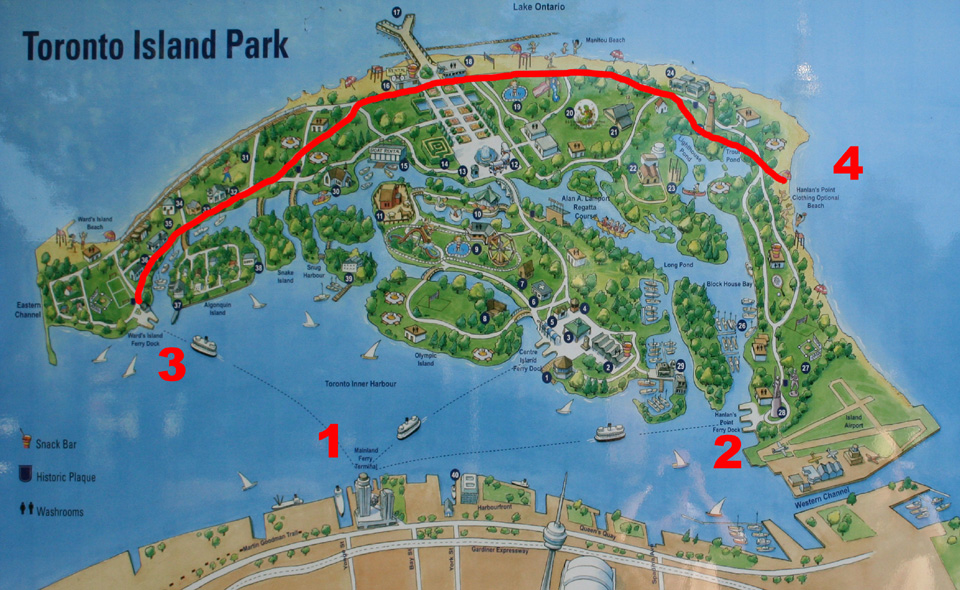
Anyway, we arrived at Ward's Island about twenty to five or thereabouts. Ward's is one of two harbour islands on which people still live (the other is Algonquin). Well, there was really nothing for it but to start walking. You know, they don't look like much on the map, but the Toronto Islands really are a sizeable little archipelago for a lake. Using a photo I took last time of a map display at Hanlan's Point, I can show you where it all happened. The red number "1" is the ferry terminal. "2" is the landing at Hanlan's Point, where we wanted to be. "3" is the landing on Ward's Island, where we actually wound up. And "4" is the sanctus sanctorum of the in puris naturalibus set, the nude beach. The red line drawn from "3" to "4" is the route we had to walk. I actually measured it out on a map this morning. As the crow flies, it's about the equivalent distance of walking from Parliament Street to Bathurst Street. But in actuality, because it's not a straight line, it's more like the distance from Bayview Avenue to Bathurst. More concisely: about 4.3 km. That's just a little shy of three miles. It took us 45 minutes, but we saw some really beautiful scenery along the way. The people who live on the islands have to really bust their balls to get back and forth to their jobs, shopping, movies... anything, really. But it's worth it, obviously. They're living in a Norman Rockwell painting (except the flags have the maple leaf instead of the stars and stripes).

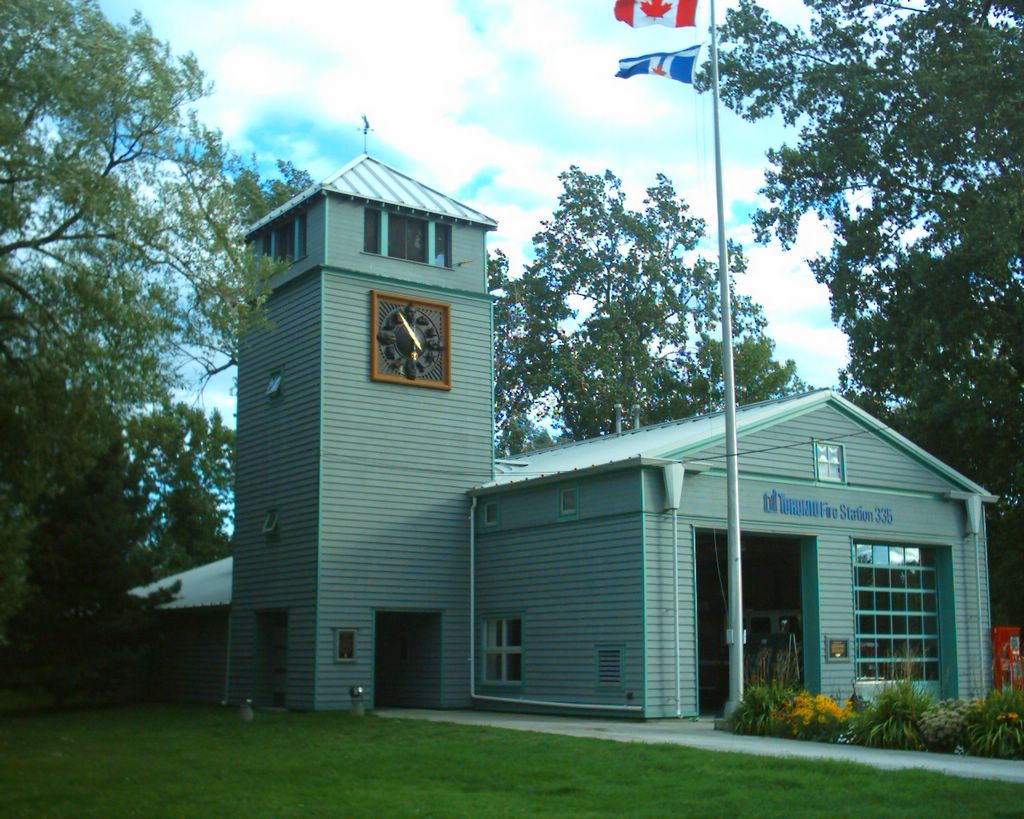
One of the things we passed was the Ward Island fire station. The clock was extremely interesting. It features human faces at the cardinal points. Some of them, maybe all of them, look aboriginal. Toronto was a meeting place (supposedly, that's what "Toronto" actually means) for various native tribes long before the British made it their colonial capital. The people who lived hereabouts before the Europeans, Africans, and Asians arrived were of the Algonquin and Iroquois linguistic families, and there was significant conflict between them from time to time. Control of the trade here has always been important, as long as humans have lived in the Americas.


Ward's Island fire station

Eventually we got to the east end, and nearing the beach, P-Doug pulled me aside on a short cut that also took us past the Gibraltar Point lighthouse, where I got this shot. I'm surprised and a little disappointed to realize, in reviewing my shots, that I didn't photograph the lighthouse itself, just this plaque. Oh, well. You've probably seen a lighthouse, and I doubt I'd be mentioning it at all if not for the sensational story attached to it. As P-Doug tells it, the lighthouse keeper in 1815, J. P. Rademuller, was also a bootlegger. The story goes that one night, two soldiers from the nearby barracks showed up in hopes of procuring some. Supposedly, he told them he had only one bottle to sell them. They didn't believe him, killed him, ransacked the place, and it turned out to be the case. So, they buried the body nearby. Eventually, the assistant keeper discovered a patch of disturbed earth, which yielded the late Mr. Rademuller to the authorities. The offenders were court martialed and hanged, so I'm told… buzz on the sites I’ve seen is that aside from the keeper’s disappearance, the rest is likely apocryphal. But it’s a good story. So these guys actually killed someone to get booze. Now I don't feel so bad for driving 10 minutes out of my way to get to an LCBO that actually stocks the rum I like.


A story of light, liquor, and losers

When we got to the beach, it was very windy. Cloud cover was skating in from the north. The water was very active; lots of tall breakers. I stepped in right away, and the water was pretty cool... nowhere near as warm as last weekend (incendentally, you can learn a lot about the water temperature of Lake Ontario as time passes here; turns out it was 58 or 60 degrees Fahrenheit while we were there).


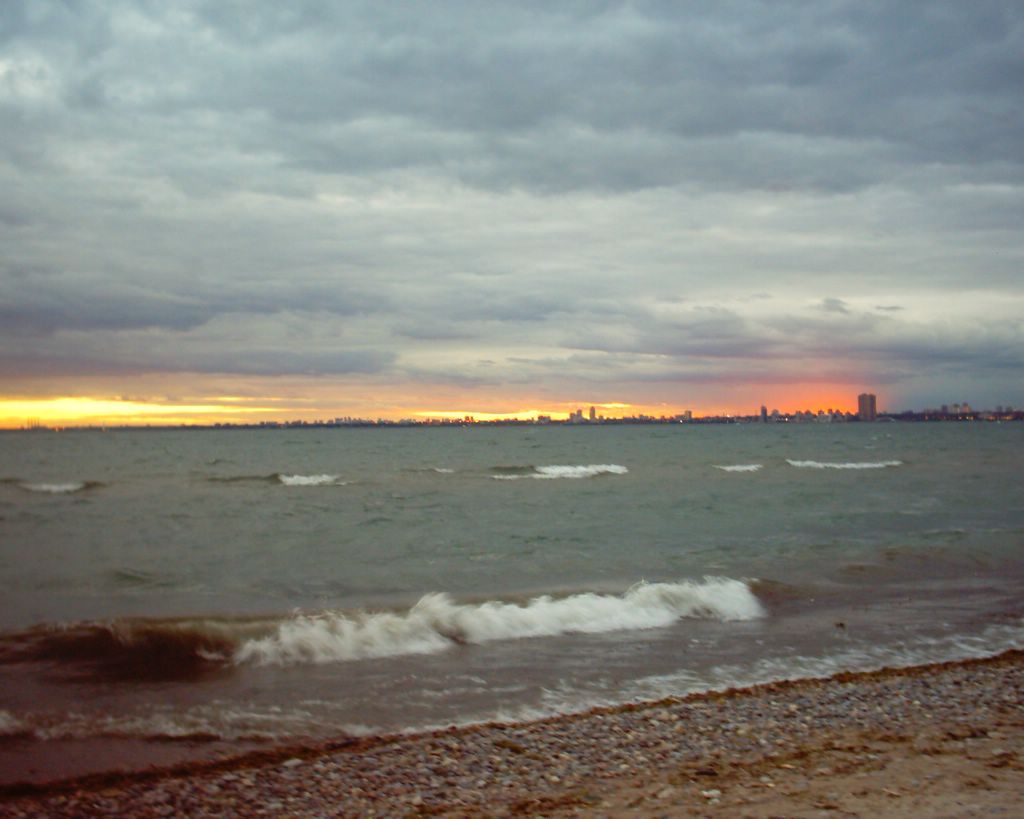
The weather started getting rough... the nudist beach was toss'd...


Not bad for a $70 P.O.S. camera, eh?


Trust me, there is a cityscape in there somewhere...

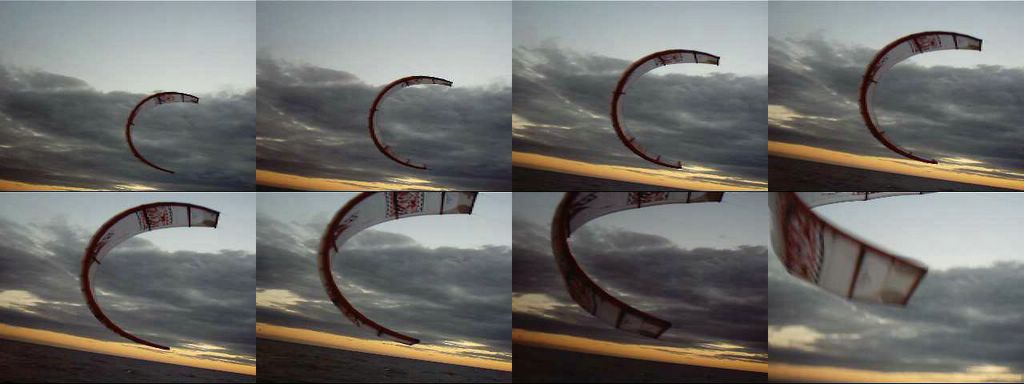
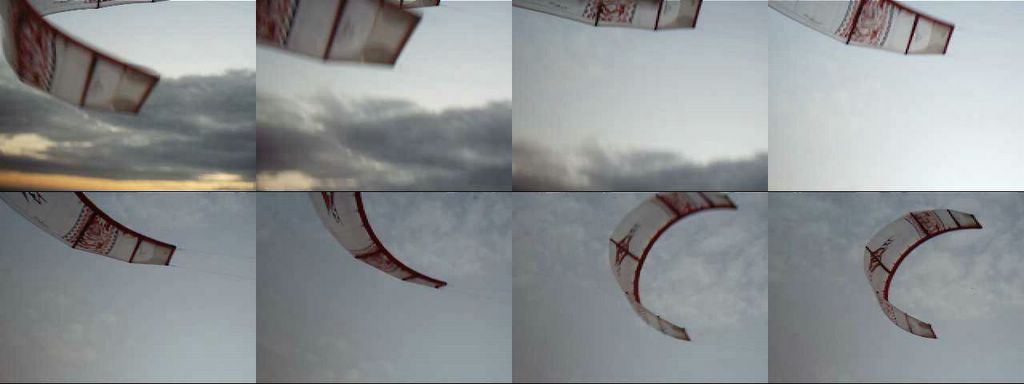
We decided to head south along the beach, and I made the journey wading at the water's edge. I noticed the warmth of the water picking up as we went. We finally stopped at a picnic table near the water at the north end of the beach. There was hardly anyone on the beach... it was a Friday, 6:30 in the evening, so we mostly had the place to ourselves. I stripped off and headed in. It was, I guess, about the same temperature as the first time I was there. Took a little getting used to. Out past the first sandbar, it was cooler (but I really didn't notice that till I retreated to the sandbar later). P-Doug came in too, and we splashed around and talked while watching the clouds, the sunset, someone flying a kite, and a guy parasurfing. As time passed we made our way back from neck-deep to the sandbar, which is knee-deep and where the water, I noticed, was considerably warmer (after 15 minutes, my fingers had started getting numb). We both sat around on it for a while, letting the surf crash over us. I guess we were in the water somewhere between half an hour and forty-five minutes. Finally went in, dried off, and just lounged on the picnic table, watching the sunset and the guy parasurfing. He actually passed right in front of us at one point, and I took the opportunity to video his approach. As he passed us, his sail came within about ten feet of smacking into us. I'm hoping to convert some of the frames into stills to illustrate this. If I can't, you'll just have to take my word for it. It was a pretty interesting moment. I think I can safely say that it is, without a doubt, the most thrilling event I have ever filmed while sitting naked outdoors in public. At least so far.


Sorry, no blood spurts. :)

It was around 8 PM when we decided to get going. I was really hungry by then, and it was beginning to get dark. We missed the 8:15 ferry back by about ten minutes, and were forced to wait till 9. I was in shorts and a t-shirt, and the wind was just cool enough to make it slightly unpleasant. In the meantime, P-Doug used his cell to call his wife, G, and arranged for her to meet us at the LBCO down on Queen's Quay (this is a coincidence... we are not colossal boozehounds, I swear).


Eerie green open Skydome, spooookyyy!!

From there, we headed uptown to Satay On the Road for Thai food. That was my own suggestion, partly prompted by a recent recommendation I made to a commenter to my previous Hanlan's Point posting. I had the hot and sour soup, to which I added chili oil and soy sauce... fiery! and curried beef and rice. It was delicious. The bill for me came to just over $18 with tax. I put down a $20, expecting change; taking the loonie and putting down a toonie would have put the tip over 15%. But the girl never brought the change. She just assumed this was her tip. This was unfortunate for two reasons. One, it pisses me off. What it had been a $50? Would she have assumed her tip was 31 bucks and change? I hope not... so which assume that in this case? Secondly, since there was no opportunity to make change for myself, I had no way to leave a more substantial tip (at least, in a range I felt justified). And at that point, I was hardly inclined too. So I look cheap, and she's out a fair tip. Her presumption shames us both. Sorry to end on a sour note. Ah well, when you add it all up, it was a nice evening.

Friday, September 02, 2005

Is this America? <:(

Anyone familiar with this blog will know by now I have some issues with the attitudes and actions of the United States, generally speaking. But what I'm reading about New Orleans astounds and distresses me. It's one thing for them to disregard the rights of unseen millions on the other side of the world... but among themselves? Each other? What's left?

This is from the Australian Broadcasting Corporation...

In quotes: Chaos in New Orleans

New Orleans has descended into chaos in the wake of the devastating Hurricane Katrina. Following are quotes about the situation on the ground.

CNN reporter Chris Lawrence, who is holed up with a group on the roof of a police station in the middle of New Orleans:
"Right now it's the only safe place to be in the city. We were on the street earlier but the police said under no circumstances would you be safe on the street."
"They said anybody walking in the streets of New Orleans is basically taking their life in their hands.
"As they hustled us off the street some of the officers told us that groups of young men had been looting the city, shooting at people, attempting to rape young women.
"They directed some of the young women to get off the street immediately."

Louisiana Governor Kathleen Blanco:
"Three hundred of the Arkansas National Guard have landed in the city of New Orleans.
"These troops are fresh back from Iraq, well trained, experienced, battle-tested and under my orders to restore order in the streets.
"They have M-16s and they are locked and loaded.
"These troops know how to shoot and kill and they are more than willing to do so if necessary and I expect they will."

Thomas Jessie, a 31-year-old roofer, who spent a night in the New Orleans convention centre:
"We got dead bodies sitting next to us for days. I feel like I am going to die. People are going to kill you for water.
"This is America, I don't understand the lack of communications between the authorities and the people.
"It is disgusting, we feel we have been forgotten."

A New Orleans police officer, who asked not to be identified:
"This city knew something like this would happen a long time ago. They did nothing to prepare for this. They just rolled the dice and hoped for the best.
"People were raped in [the Superdome, where refugees were living]. People were killed in there. We had multiple riots.
"You can't be trapped in there for so long without going crazy. People were locked in the dome like prisoners.
"There was no ventilation. We had 80 to 90-year-old people who needed medication and couldn't get it."

Baron Duncan, describing the time he spent inside the Superdome:
"The last few days were utter hell. The stench was unbearable. We were treated like animals.
"There was shooting, our lives were in danger. A seven-year-old girl and an eight-year-old boy got raped."

Audrey Jordan, who also sought refuge in the Superdome:
"We were treated like this was a concentration camp. One man couldn't take it. He jumped over the railing and died."

Japanese tourist Ryo Gotanda, who is trapped in New Orleans:
"We are lost. We are tourists. We don't know how to get around, how to protect ourselves. It is like being in a jungle.
"People were staring at us, waving clubs [when we walked through one inner-city neighbourhood].
"I was scared. For the first time in my life I thought I would die."

Australian woman Kelly-Rae Smith, whose parents are hiding on a road overpass with 40 other tourists after their hotel was flooded:
"The violence is escalating. There are shootings. They have three dead bodies at the bottom of the stairwell where they are.
"They have a payphone but have to strategically plan when they go.
"There's so much violence going on even the SWAT team has locked themselves in their building."

Robert Lewis, 46, after spending two days at a shelter before being shifted to Houston:
"Call it biblical. Call it apocalyptic. Whatever you want to call it, take your pick.
"There were bodies floating past my front door. I've never seen anything like that."

Dr Andrew Sandler, working at a hospital in New Orleans:
"It's very easy to get from our point to the bridge that can get us out of here. The problem is that the buses that have been ordered ... that were supposed to come here today ... two were commandeered by FEMA and the other four, they were told that it wasn't safe for them to evacuate us because of the snipers.
"With 60 residents, the average aged 87, that have not had air-conditioning in five days, three have died and another eight - no matter how much water we give them, could expire because it's too hot for them.
"The variable I never, that I hadn't planned for, are the snipers - in fact that nobody would give the buses, they won't let the buses get us out."

Thursday, September 01, 2005

How New Orleans was Lost: Another Terrible Casualty of the Iraq War

From an article by Paul Craig Roberts on CounterPunch:

Chalk up the city of New Orleans as a cost of Bush's Iraq war.

There were not enough helicopters to repair the breeched levees and rescue people trapped by rising water. Nor are there enough Louisiana National Guards available to help with rescue efforts and to patrol against looting... The National Guard and helicopters are off on a fools mission in Iraq...

Now the Guardsmen, trapped in the Iraqi quagmire, are watching on TV the families they left behind trapped by rising waters and wondering if the floating bodies are family members. None know where their dislocated families are, but, shades of Fallujah, they do see their destroyed homes...

Why can't the US government focus on America's needs and leave other countries alone? Why are American troops in Iraq instead of protecting our own borders from a mass invasion by illegal immigrants? Why are American helicopters blowing up Iraqi homes instead of saving American homes in New Orleans?...

All Bush has achieved by invading Iraq is to kill and wound thousands of people while destroying America's reputation. The only beneficiaries are oil companies capitalizing on a good excuse to jack up the price of gasoline and Osama bin Laden's recruitment.

What we have is a Republican war for oil company profits while New Orleans sinks beneath the waters.


Read the rest here.

Dog help us

From the NY Times:

Teaching of Creationism Is Endorsed in New Survey

In a finding that is likely to intensify the debate over what to teach students about the origins of life, a poll released yesterday found that nearly two-thirds of Americans say that creationism should be taught alongside evolution in public schools.

The poll found that 42 percent of respondents held strict creationist views, agreeing that "living things have existed in their present form since the beginning of time."

In contrast, 48 percent said they believed that humans had evolved over time. But of those, 18 percent said that evolution was "guided by a supreme being," and 26 percent said that evolution occurred through natural selection. In all, 64 percent said they were open to the idea of teaching creationism in addition to evolution, while 38 percent favored replacing evolution with creationism.

The poll was conducted July 7-17 by the Pew Forum on Religion and Public Life and the Pew Research Center for the People and the Press. The questions about evolution were asked of 2,000 people. The margin of error was 2.5 percentage points.


All I can say is, we're living in an age where we've been to the moon, sent probes looking for life on other planets and their moons, mapped our genome and those of several other creatures, and, most disquieting of all, have realized the power to vapourize all life on the Earth in an afternoon. With all that in mind, I find the fact that we're still sharing the world with so many stupid, willfully ignorant people truly terrifying.

There may or may not be a God. I, personally, hope there is. But His/Her/Its plan was not, evidently, to make the world in six days and then take a snooze. The senses and intelligence we're endowed with (be it by God or the simple mechanics of the universe itself) lead us to this conclusion. Anything else is wishful thinking and a denial of the world around us.

New primates in the city in the trees

American blogfriend Laura K and her SO Allan have arrived to live among the trees. Read about their northward trek here.