

Showing posts with label Bayview Avenue. Show all posts

Monday, November 16, 2009

Nature Trail to Hell in 3D

Kind of an interesting weekend as it went. P-Doug had a front yard full of leaves he's been waiting to attack. Last week, his leaf sucker's motor burnt out, so at some point during the week, he went looking for another. The timing was bad and he ended up with a gas-powered one with a two-stroke engine.

I offered to give him a hand because it's nice to get out and do something with the weekend, and I figured we'd wind up at a watering hole once the job was done. I also wanted to test a couple of camera tricks. I put the new 3D camera on my dashboard with a class 6 SDHC card in it to see if it would be fast enough to keep up with the writing speed of the camera when it records video (it wasn't). Also, when I was digging around looking for my 0.8x wide angle attachment, I discovered the 0.75x one that came with the G9 when I bought it from the wedding photographer just about two years ago. Forgot about it! Was delighted to discover it. I put it on the adapter for the G9 (giving it an effective focal length of about 26mm, nice and wide) and put the camera on the suction cup tripod I bought a few weeks ago. This time, I stuck it on my sunroof... outside the car. Just to reassure myself, I also closed the sunroof on the wrist strap of the camera. :) I started it up and drove down to East York, and I got a really neat, wide-angle, up-high video of the trip. As for the 3D camera, the W1 overflowed the buffer every three minutes, so I gave up on that for the time being.

Anyway, I got down there about quarter to 11. P-Doug and I set to work assembling the gas-powered leaf sucker. We wound up with something that looked like a tumourous bagpipe. Spilled gas all over the place having to add blue engine oil to it. He managed to get it started. He told me it was heavy, ungainly, and vibrated annoyingly. It half-heartedly sucked leaves for a few minutes, filled the bag (it promised to mulch leaves at a volume of 16:1, but the proportion of leaves that survived without so much as a nick was disappointingly high), and we emptied it. Try as he might... and he tried, and tried, and tried... he could not get the thing to start again. At one point, I said to him that the thing certainly did suck, but only in the figurative sense, not the literal one (it was a good line, I thought, but I kind of fumbled the delivery).  We pondered what to do, and decided finally to take it back and get his money back, and use the rake to do it the old-fashioned way.

When we got near the store, I asked if he'd tried the competitor we were passing by when he was looking for an electric leaf sucker and he admitted he'd overlooked it. He decided to take a look, once he got his money back. That actually went surprisingly smoothly; they didn't give him a hard time (he had the coupons they dish out to hand back and all). When he presented the leaf sucker, he opened with my "sucks figuratively but not literally" quip (much to my delight), but I think it was lost on the bored cashier. We went to the other store, and they actually had one last leaf sucker of the exact model that burned out on him. And it was just a little over half the cost of the gas-powered one, too. He grabbed it and we headed back. Now this thing was so easy to assemble I actually had it put together for him in the time it took him to go inside and get the extension cord. We spent the next hour and a half or so sucking up the leaves in his front yard and doing what we could for his neighbour. I took a few turns at it, but mostly I kept the cord out of the way, provided a second pair of hands for emptying the bag, and raked leaves into handy piles. When the ones from between the houses were sucked up and mulched, the air was filled with the heady aroma of raccoon shit. That's something I won't soon forget. The fun upshot was that I briefly videoed P-Doug leaf sucking in three dimensions. I feel this will be important to the people of the future someday.

Afterwards, P-Doug and G and I took off uptown to a pub we haven't been to in ages — The Three Monkeys, which was once my and P-Doug's regular haunt. There I had a salad and a sandwich on bread that was twice as long as the modest chicken breast it accommodated, but it was spicy and I enjoyed it. We wiled away a few hours and headed off in opposite directions.

Sunday I was determined to get out and work with the new camera some. I went down to James Salmon's old neighbourhood to try to recreate some of the shots he took in the 1950s. I brought the G9 with the wide angle attachment and the W1 to capture scenes in 3D. I also decided to try one last experiment to see if I could overcome the problem the W1 was having with keeping videos rolling. On my way down Leslie Street, I set up the camera on my dashboard beanbag tripod and ran a test with the  4G Sandisk Extreme III card I got when I got the G9. It ran for 11 minutes non-stop till I turned if off. Given the longest the camera can record at 640x480 is about 15 minutes, I'd call that a successful run. Limits the cards I can use to those By Appointment to Her Majesty, though. The G9 seems to do just fine with slower cards, even when I record video, so I guess I'll use the class 6 16G card with it and cede the fast card to the W1.

James Salmon lived on Broadway Avenue, a street that runs parallel to Eglinton Avenue, a couple of streets north of it. I parked near the house and took a few photos of it, then I set off to recreate some of his shots. I'd printed them and had them in my jacket pocket for reference. The first ones were shots he took near Eglinton and Bayview back in the 50s when the strip mall was being built there and the swamp was being filled in. I did my best to recreate them, but it was hard to know exactly where he stood. I also shot the intersection itself from a few angles for the benefit of future researchers. On my way back, I briefly videoed a dozen or so 30-somethings tossing a football around in the bowl-shaped park south of Eglinton.

(...Just so you know... the colour shots here were taken with the G9, not the new 3D camera.)

Below is his house, 461 Broadway.
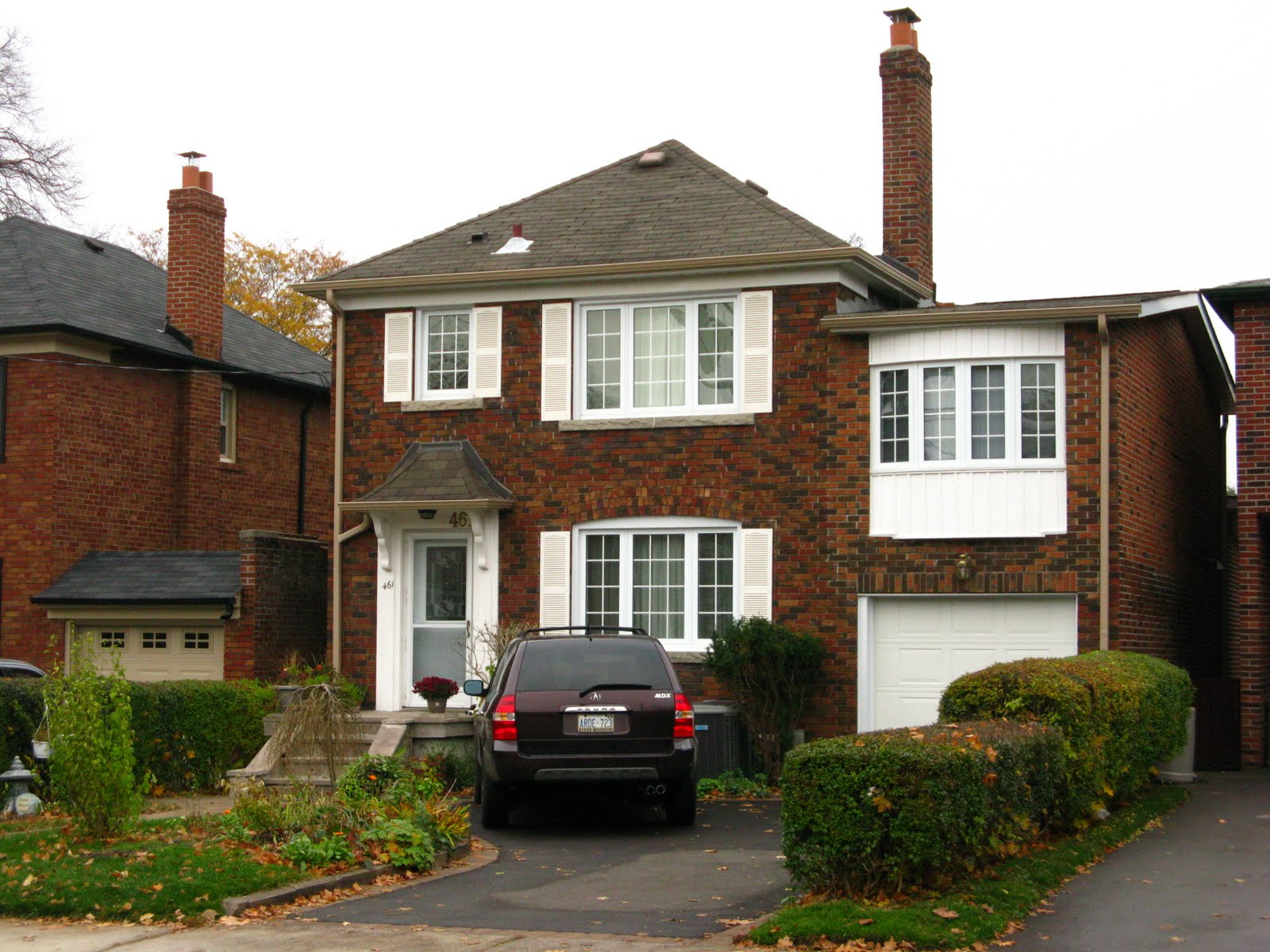


...and the view across the street from his house; 458-464 Broadway, in 1948, 1949, and 2009. You can orient the view with the fire hydrant in the 1948 and 2009 shots. Incidentally... if you look closely, you'll notice an interesting trend. None of these places seems to have a garage or attendant room above it at the time of construction... but they pretty much all seem to have grown one on in the meantime (including, probably, James Salmon's house, above). I wonder when the vogue for doing this hit the neighbourhood. "So, what'll it be, honey... a garage and a family room, or a bomb shelter?" :)


 ...Looking west down Eglinton towards Bayview, 1951 and 2009...


...and east up Eglinton from Bayview, from in front of Sunnybrook Plaza. In the distance on the right is Leaside Secondary School. Again, 1951 and 2009.


I drove along Broadway a few blocks east to Brentcliffe. Brentcliffe was once the street where Eglinton effectively ended west of the Don Valley. When the Salmons first lived in the area, Eglinton didn't cross the Don yet. It more or less dead-ended in the trees above the valley. I know this for sure because one of the photos James Salmon took in the early 50s was just that. Later, he took photos of the work being done building what was called "the Eglinton Extension" between there and Victoria Park Avenue. No one calls it that anymore; I was astounded to find out there'd even been an "Eglinton Extension" when I first read about it four or five years ago. I took photos more or less matching Salmon's, and then just for good measure, walked west to Laird where he had photographed some store fronts at the northwest corner. They still looked kind of the same, in shape, if not in function. Eglinton and Brentcliffe, 1954 and 2009; Eglinton west of Laird, 1955 and 2009.


Something I noticed when I got home and processed the 3D shots into JPG pairs I could work with (geotagging, etc.) was that my camera had a displeasing tendency to shoot the right image with a hazy cast over it that was increasingly visible towards the upper right. There were no strong blacks in the right side images; they were all faintly grey. Colours were muted towards the right side, too. Earlier in the week I wondered if it were a function of the light direction, but by yesterday it was clear to me it was chronic... it had nothing to do with the direction the light was coming from. It was a defect.

I took the camera back to Henry's at lunch time today, with a few printed examples to make the point in case they thought I'd messed up the camera somehow and was just making up an excuse to bring it back. To my relief, they didn't give me any trouble at all. They simply replaced the camera from one they had in stock (I kept all the accessories that came with my original camera). I took a few shots with it in the parking lot and at stop lights, so when I get home I'll see if it has the same problem. If not, great; if so, it's a "feature" of the model I'll have to live with till there's a better one (e.g., the "W2"). Anyway, that's one reason I'm glad I bought it at Henry's and not off eBay or something.

P.S. Below, a "bonus" shot of Eglinton, looking west towards Bayview (intersection out of sight in the dip). Doesn't match up with anything; I just kind of like the look of it.


Friday, November 02, 2007

Old Bayview Avenue bridge, summer 2007

I can't believe I've never written about this before on the blog. It's one of my favourite places for wandering and just poking around, but apparently I've always neglected to mention it. Well, a little background.

Toronto is a city of river valleys. Nothing huge, but ones substantial enough that they usually formed interruptions in the road network well into the 20th century, and in some places, still do (Leslie Street and St. Clair Avenue feature prominent discontinuities, for example). Things like that intrigue me... I suppose because they imply change; that one day, what seems impossible now might be bridged. When I lived in Mississauga, I was not far from huge bridges across the Credit River that hadn't even been built yet when I was born; bridges of major streets with names that people in Toronto would recognize like Eglinton and Burnhamthorpe. In Toronto itself, Steeles Avenue didn't cross the Humber until I was in high school; Finch Avenue didn't until I was an adult. Hard to believe now. So I've always enjoyed combing old maps for hints of places where bridges might have been lacking till recently, or better still, where older ones might exist or at least still be hinted at where newer ones have taken their place.

One such place, in spades, is Bayview Avenue over the West Don River. Anyone who has long lived in Toronto is familiar with this area; it's where Lawrence Avenue meets Bayview at a rather inconvenient intersection near York University's Glendon Campus. Heading north, you shoot across a huge, six-lane bridge that vaults from crest to crest as though the valley didn't exist at all. But it does, and until sometime around 1929, the crossing was nothing so grandiose or convenient...

Lawrence Avenue is, to this day, discontinuous at the West Don River underneath Bayview Avenue. The two roads meet only at the top, at Bayview's west side, south of the river. But pretty much hidden from view and the consciousness of most people, Lawrence Avenue actually does ease down into the valley below; in fact, it ends just a few yards short of the bridge itself, so high above it. The area is today largely fenced off, unfortunately. But it's here that Lawrence once had another meeting with Bayview Avenue, and the evidence of that is still there to be seen.

Till the much larger bridge was built, Bayview was a much more modest road, slipping, as Lawrence still does, down into the valley to meet the river at pretty much its own level. And where it did, the little one-lane concrete bridge that let traffic across still proudly, and even somewhat gracefully, spans the river. I'm not sure when it was built, but I'd guess sometime in the late 19th century. A photo of it, taken from just upstream, appears in a book I have about North York, undated except to suggest it was taken at the beginning of the 20th century.

Maps today still show a crossing there, and it was from such maps that I was first prompted, three or four years ago, to go have a look for myself. They also show a path between Lawrence Avenue and Glendon College up at the top of the valley. That's technically true; I've walked it; but there are places where you'd be forgiven for not knowing you were on a path if you hadn't arrived already knowing that. The original course of Bayview Avenue, it's been overgrown for decades, and nothing like a clear vehicle path still exists. But it's lovely. What the view up the road allowance must have looked like before it was crowned with modern-looking condominiums, I can only imagine.

As I said, I've been there several times, usually in the spring when the wanderlust to get out and look at natural anew is upon me; as often as not with friends. This year, though, I went back there in late August, and by myself. When I arrived at the end of Lawrence Avenue, I found a new fence had been put up, blocking the easier access I was accustomed to. But it occurred to me that the adjacent parking lot ran right alongside the river, and must surely furnish access. So, I cut across the parking lot and stepped into the bush, and was pretty much immediately at the river. I could see that the quickest approach was via the river iself; well, comporting myself in rivers in warm weather is hardly an imposition to me. I welcomed the opportunity. I set my sandals aside and stepped in; as I was in shorts and the water was little more than knee deep, the situation was ideal. Initially, I had been pestered by a few mosquitoes, and that was a concern. But it was quickly forgotten once I was actually in the river and they left me alone.

The real reward of being in the river was the view itself. I had always approached the bridge from the road course, and in fact had only ventured onto the bank beneath it once or twice. But approaching it from the river was a whole new experience. The bridge was so much more beautiful from down there. From above, it's messy, overgrown, crumbling, and perennially covered with unsightly graffiti. But from the water, it's a clean, smooth arch, moodily shadowed, pressed against the trees that hide it from all but the most persistent view. Photographed in infrared, it was positively stunning, as I hope you will agree.

I took my time, choosing my footings very carefully as I made my way upstream, carrying two cameras that between them represented over a thousand dollars. I passed under the bridge, pausing to photograph the arch in different ways, and then ventured further beyond it, towards the current Bayview Avenue bridge. Glimpsed from below its predecessor, it has its own grace and elegance, though it's nowhere near as lyric as makes one anything like wistful to view.

I went back to the old bridge and climbed up onto the deck, taking in the views I knew well from before... the overgrown bridge itself, the scene of the hillside capped by the apartments, and to the north, the little twist of road that once brought cars to Lawrence Avenue. Exactly what happened then I'm not too sure, aside from the obvious access to Lawrence easterly itself. Maps hint at other roads down there but contradict one another and I've seen little photographic evidence to make me believe there was ever much in the way of a corresponding access directly up the north side. There may have been, but I confess myself unconvinced. That the bridge itself is still visited with some frequency is obvious thanks to the copious, bland, disheartening graffiti that changes each time I'm there.

There was little there to keep me topside, so I retreated to the newer experiences down at the river's level itself. I sat beneath the bridge on the bank for a while, simply enjoying the setting, imagining its construction and what it was like for the men here then; the people who came and went across is over the years, and what Toronto was like for them. The water was warm, the day was sunny, the air was still and balmy. Surrounded by nature, at the edge of civilization, I was sitting somewhere once so much a part of who and what we were, but that was now disregarded and forgotten.

The afternoon wore on and I decided to make my way back down the river. I climbed back up the bank where I'd entered it and padded, wet, across the parking lot back to the car. Couldn't resist a couple of lighter shots; one of my footprints, and the other of me with everybody's favourite number... all that was missing from the shot to make it perfect would have been someone doing a handstand. :)

Tuesday, April 10, 2007

Dreaming of Home (Vimy Ridge rededication)

Yesterday, Easter Monday, 2007, was the 90th anniversary of the beginning of the Battle of Vimy Ridge… at least in Canadian terms. Canada’s most impressive war memorial is to be found there, towering over the lush plains of northern France.

I don’t work for the government — which is another way of saying I was in the office yesterday — and missed actually seeing the ceremony live. I would really have liked to. God knows, I would love to have been there. But I did set the DVD player to record it, so I got to review it when I got home.

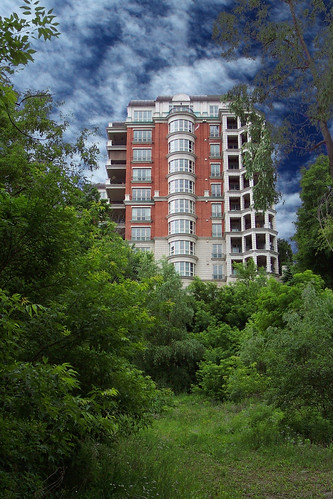
To be honest, I wasn’t really paying close attention. The French prime minister, Dominique de Villepin, was there, as was our prime minister, Stephen Harper, and Her Majesty the Queen. The first half hour was pretty much just getting everyone in place, and then the speeches began. The prime ministers spoke first, and then the Queen. As you might expect, they said wonderful things about the heroism of the men who died there, the gratitude of France, and the solidarity of Canada, France, and Britain. The words were moving; it seemed heartfelt, none of it over-the-top in the way of previous generations… I think we’re too cynical these days to be truly effusive. I was working in Photoshop at the time on the photo you see here, one eye and one ear on the screen, the other on what I was doing. It was weird… it was as though I were standing on one of the balconies of the building, listening to the speeches being given in the forest below; that’s how it formed in my mind...

When the speeches were over, there came this moment when music began. The tune was familiar… I realized later I’d heard it in the movie Joyeux Noël, about the Christmas armistice of 1914. The song is called, I think, “The Fraternizers’ Hymn (I’m Dreaming of Home)” in English. At first, just the melody, as I recall. Then men of the Canadian Armed Forces gave the song voice…

I hear the mountain birds
The sound of rivers singing
A song I’ve often heard
It flows through me now
So clear and so loud
I stand where I am
And forever I’m dreaming of home
I feel so alone, I’m dreaming of home

It was taken up by two or three dozen young girls in a choir from Charlottetown, Prince Edward Island. They were joined by Susan Aglukark. It pulled my attention utterly from what I’d been doing, and just overwhelmed me. I can’t explain it. The longing of the song, the idea that they were speaking for all those men so long ago; it made them very immediate. Big tears started to spill from my eyes as I watched and listened; it just came up out of nowhere so suddenly and easily it was frightening. I felt like I was standing on that balcony watching all this, feeling the yearning for home those young soldiers must have felt, the desire to be anywhere but where they were, aching for the love, familiarity, and security of a home many of them would never see again. I was reminded of my Dad, who served in the Navy for twenty years, and how proud I’ve always been of him, and how hard it’s going to be someday to lose him (if I live long enough… you never know)... that feeling really cut into me.

The song ended with a magnificent shot of a long line of army trumpeters, facing the monument soaring in alabaster into a featureless sky of perfect azure. At that moment came a thundering fly-past by four Mirage jets of the French Air Force. By this point, I was actually crying. I had to turn it off. It completely swept me away emotionally. The only other moment in my life I can remember being so spontaneously carried off was when I was 17, stepping out of the Peace Tower on Parliament Hill just as the bells of the Carillon began to play high over my head, and the sense of Canada as something that existed before me and would endure long after me really struck home for the first time, and stood there in tears for a quarter of an hour. Like that, this was a strange, terrible, wonderful, singular moment that will be with me all my life.

I did finish the photograph. Suddenly it became the symbol of home that all those men, Allied and German alike, were fighting for, dying for, yearning for. In some small way, it’s for them. I hope they’re all home now.

I’m Dreaming of Home
by Gary Lewis / Lori Barth

I hear the mountain birds
The sound of rivers singing
A song I’ve often heard
It flows through me now
So clear and so loud
I stand where I am
And forever I’m dreaming of home
I feel so alone, I’m dreaming of home

It’s carried in the air
The breeze of early morning
I see the land so fair
My heart opens wide
There’s sadness inside
I stand where I am
And forever I’m dreaming of home
I feel so alone, I’m dreaming of home

This is no foreign sky
I see no foreign light
But far away am I
From some peaceful land
I’m longing to stand
A hand in my hand
… forever I’m dreaming of home
I feel so alone, I’m dreaming of home