

Back in November I achieved the long-sought goal of acquiring the means to capture a scene in three dimensions for real. Given the nature of the weather, I haven't been able to put it to much good use yet, but I'm intending to put it through its paces once the temperature is routinely in the positive numbers again... moreso when it's double digits.
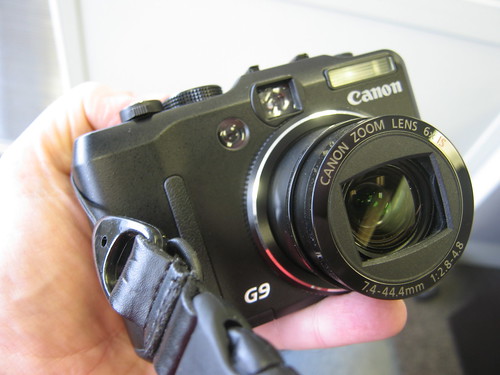
As much as I've always wanted to shoot scenes in 3D without having to worry about whether or not a leaf moved in between exposures – much less anything larger (which has meant that 3D photograph in an urban environment was essentially impossible for me previously), it was never my intention to use the medium exclusively. Frankly, I don't think we're there yet. The facilities for people to routinely view things in three dimensions are probably still years away, and it's a difficult medium to work in (how do you stitch together three or four 3D images into a coherent panorama, for example?). I've continued to carry the G9 with me alongside the W1, and most of the time, I've preferred the G9. The W1 comes out for the icing-on-the-cake shots. This is particularly true since the image quality on the W1 is relatively poor... I don't say that with an air of disappointment; I knew that before I bought it. This is the state of the art, such as it is; it was either this or I waited years to start capturing views in 3D. But when capturing the volume of a view isn't crucial, I tend to prefer the G9. I don't now, and didn't last November, imagine I'd be leaving the G9 on the shelf with the W1 doing it all. It does what it does; the G9 does the rest.
Still, times change, and technology moves on. I've had the G9 for two years now and it's been excellent. But I have my eye on another camera now, one that will provide both new abilities and a streamline workflow for the Millennium Project of recording the here-and-now for posterity. The camera is the Cyber-shot DCS HX5V, one of Sony's two new entries with pretty much the same abilities (the other being the slightly more expensive TX7). There are some cutesy features about the new pair that I wouldn't miss if they weren't there; wireless transfer to certain devices, face recognition, cropping images inside the camera, etc. But they do have some abilities that make me reach for the HX5V.
What it won't do
The G9 shoots RAW. That was important to me when I got it, principally because it meant I would have the ability to squeeze shadow and highlight information out of the sensor's recorded data and form a single, wide-ranged HDR image without having to shoot multiple exposures and, again, worry about what moved in between. Like the old S80 I carried around for nearly three years, the HX5V does not record in a RAW format. Strangely enough, when I read that, I didn't have the reaction I would have anticipated. It wasn't so much a turn-off as it was a liberation. One of the things about having the ability to shoot RAW has been the sense of obligation it's imposed on me. For years I've vacillated back and forth using the XT and G9, shooting RAW to get the best image, and then remembering what a huge pain in the ass it is having to process every single image just to get something I can post on Flickr, and going back to shooting JPGs... then looking at all these 'compromise' images and cursing myself for not shooting them RAW... you see what I mean. Combine that with the fact that RAW tends to take up three or four times the space on a drive as the equivalent JPG image and it's been kind of a headache. If technology dealt with RAW images as readily as it does with JPGs and a 12MB file size weren't an issue, I'd shoot RAW all the time. But it doesn't, and it is, so having that decision taken out of my hands is, strangely, sort of a relief. I didn't think I'd see it that way.
The HX5V also doesn't have in-camera controls for sharpness, saturation, contrast, and the like. I'm not overly bothered about that because I never messed with that stuff in the camera anyway. Sharpness? Either a shot's clear or it's not; if it is, I'm certainly capable of improving it in Photoshop. Ditto the colour.
The G9 has a time-lapse video feature that's kind of kicky, fun to use experimentally, but really, hasn't amounted to much for me. I know how to do the same thing with far more compelling results using real-time video and Premiere. So that's not something I'll miss day-to-day either.
The HX5V doesn't have an optical view finder. Now, even though I haven't used a view finder on any camera but my XT since about two weeks into owning the S80 (got tired of nose smudges on the LCD), it kind of bugs me that I'm forced to depend on a battery-powered technology to compose shots. I shouldn't be; it's been how I've been doing it for about five years now, but... I just don't like not having the option. Still, obviously, it's not central to my concerns.
What it will do (why I'm interested)
The thing that led me to discovering this camera was that I'm increasingly fed up with the way I have to embed GPS data in my photographs. The process is cumbersome and cranky at every turn. First, there's the PhotoTrackr itself. When it works, it works pretty well, but there are times when it completely fails to bring up a signal. Secondly, it's often out of sync with the camera(s) in question, and when you're moving in a car, even six or seven seconds makes a difference that could, one day, be really misleading to someone without the same visual references that exist today (I mean, that's why they enabled GPS in EXIF in the first place). Sometimes the battery runs out. The software for transferring and applying the log files, not infrequently, can't find the PhotoTrackr on the COM port it's expecting to find it. All told, it works, but not as well as I'd like. Honestly, it's like working with 1990 technology in 2010.
The HX5V has GPS built into it; it's among the first cameras that do (there have been others over the past two or three years, but surprisingly, not that many). I think soon, this will be the norm, but for now, it's rare. Now, I don't know the HX5V will be any better at acquiring and keeping a signal than the PhotoTrackr. But even if it isn't, it eliminates the concern about a separate battery dying (if I run out of juice on the camera, I don't NEED the GPS facility anyway), and the rigmarole of uploading log files, matching them to photos, and having to overwrite the metadata.
Relatedly, the HX5V also has a compass, and can not only record where the photo was taken, but in which direction the camera was oriented. This is actually something I can't do now, and have been waiting to see for over a year. Someone has finally done it. I can't tell you the number of times I've looked at old photos – and not just those taken by others 50 year ago, but my own from unfamiliar places just a summer or two in the past – and spent ages arguing with myself as to which way I was looking. This facility will, hopefully, spare people in the future that kind of head scratching. Even if those "people" turn out only to be me!
The HX5V also has a couple of new facilities that will save someone like me a lot of time in post-processing. First of all, it has what Sony calls "Intelligent Sweep Panorama". That is, the camera itself has the ability to generate a panorama simply by the user sweeping it through (approx.) 130, 180, and 270 degree sweeps. The camera, which can take 10 10MP photos per second, does the work to sew the view together. Apparently, it even compensates for moving objects in the scene, though I'm not expecting great things from that. Basically, if I can stand on a hilltop or a sleepy rural intersection and get a lovely pano of what it looks like today in three or four seconds, without having to spend 15 minutes finding the photos and dragging them into another application that, as often as not, ignores half of them or craps out when the memory ceilings, that'll be just fine with me.
Another thing that will save time, if it works as advertized, is what Sony calls "Backlight Correction HDR". One of the things I've always hated about digital photography is how it never seems to represent the range of shading you remember having seen with your eye... a blue sky and details in the medium shadows. Probably it's an illusion, a trick of the mind in retrospect, but nevertheless, that's how we're used to thinking we remember seeing something, and how we expect to see it represented. The HX5V has the ability to take two different exposures in a faction of a second and merge them into an HDR shot that extends the range of detail, so that highlights and colours are preserved and shadow detail is recorded, all in the same shot. That's something that used to require a lot of work in Photoshop and, realistically, a RAW exposure (or three rock-steady AEB shots across two seconds and change). If I can routinely have pleasing shots of earth and sky together, right out of the camera, that will be gratifying.
The camera also has an image stabilization system that seems to have come from Sony's camcorder line. I gather Sony has only recently gotten over its fear of cannibalizing sales by porting its good ideas from camcorders to point-and-shoots; the facilities they've given the $450 (CDN) HX5V were features of Sony's $1000 HDRTG5V camcorder just last year. Among them is a gyro-managed optical stabilization system that, I'm hoping, will make for better road videos as we record the roads of the rural fringe that will one day be the wide boulevards of shopping malls, condo complexes, and housing tracts. The camera also records in full HD, though given the memory and speed requirements, I'm expecting to use that rather sparingly.
There are down sides to it. I don't think the battery usage is as robust as it is on the G9, for one thing. I'm concerned that the only format for images is JPG, because it's a lossy format, though if they're using minimal compression and the optics are good that shouldn't turn out to be a big concern; after all, the idea is to record something that will be informative 25, 50, or 100 years from now, with as little overhead on my end as possible. I believe this camera will do that and be the workhorse for the next two or three years of the project. Hoping to get hold of one within the month. Stay tuned.