


Yesterday was indeed a day marked by a broad range in the little enjoyments to be had at this time in history and this place in the world.
At lunch time, I decided to take a quick jaunt to a wilderness park not far from work. On arrival, I changed into light clothing and set forth on one of those barefooted forest hikes of which I'm fond. In the course of it, I came upon a lovely, inviting spot. For a quarter of an hour, I sat on the cool, moist forest floor, cross-legged and naked, nestled in the embrace of the upturned roots of a fallen giant, staring up through the leaves and branches as the sky, eternal and dispassionate, rolled above me with the most magnificent calm. The warm breeze brushed over my body, scented with pine, and evocative of Christmas morn.
Half an hour later found me once again clad in business casual, standing in a cramped, air-conditioned kitchenette, waiting for a metal box to issue me a cup of what a friend of mine lovingly refers to as "machine urine"... you might know it better as coffee. I'd certainly like to, at any rate. But at least it's free.
A further half hour; I was in the parking lot of the building, rollerblading with co-workers, passing a ball back and forth with a hockey stick. Where an hour earlier had seen me pressed to the soft, natural body of the Earth, I now hurtled over the unforgiving charcoal roughness of the cement, bristling like a porcupine at every stumble.
Ten hours passed, and again I was to be found in the forest, this time in the company of a friend. We had ventured to a broad river plain not far away, sheltered from the lights of town, in the hopes of photographing the Perseids as they streaked across the sky. Unfortunately, it was the first overcast night in many days, and there was nothing to be seen or recorded. So, instead, we stripped and spent over an hour wading in the river, graced now and then by a gentle rain... marveling at the velvet of the silt beneath us, listening to the insect symphonies on the banks to either side of us, talking about our friends, movies, and the lousy seeing in the sky on such a rare night. The water was delightful; the temperature of any unheated municipal pool, rolling past us like silk. At last we decided to leave, and having no towel, simply elected to air dry as we walked along the path, undisturbed and forgotten, it seemed, in the depths of night. It was as though we had somehow stepped aside from the ordinary world into a pocket one, some twilight universe with us as the only inhabitants, until at last we climbed back into the world of light.
And so twice in the course of the day I was in the forest as any of our remote ancestors might have been; unprotected and natural, a part of nature myself instead of apart from nature. And in between, swathed in synthetics; enclosed in polymers, glass, and steel that hurtles faster than natural man ever ran or even fell; closed in spaces of precise straight lines where heat is banished and darkness outlawed. And for all that, still, the clouds could deny the stars; now, as then.
Friday, August 12, 2005

Thursday, August 11, 2005
Different kinds of nukes for Iran and China...
...As a result of the influence of Israel's neoconservative supporters and evangelicals expecting The Rapture, conservatives and Republicans are focused on the Middle East. They are apoplectic over Iran's nuclear power program. If Iran has a nuclear power program, Iran might be able to produce a nuclear weapon in ten years. Vice President Cheney has ordered a plan for the US to use tactical nuclear weapons to take out Iran's capability should an excuse arise.
That would be the third Islamic country the US would have attacked in as many years. All hell would break loose. Meanwhile, the chairman of the US Nuclear Regulatory Commission has announced that the Commission will approve Westinghouse's sale of two nuclear reactors to China.
Conservatives and Republicans think this is a good idea. Vice President Cheney has lobbied in behalf of the sale. It is good for private business. It means $2.4 billion in revenues for Westinghouse Electric Company.
Iran will never again be a world power, even if it has a few nukes. Persia was a power in ancient times, not today. If we don't bother Iran, Iran won't bother us.
China is a different matter. China already is a world power. China holds enough US government debt to have the dollar and US interest rates in its hand. Last month in an official briefing a top Chinese general, Zhu Chenghu, said that if the US messes around with China or tries to interfere with China's reunification with Taiwan, China will nuke the US: "If the Americans are determined to interfere, then we will be determined to respond. We Chinese will prepare ourselves for the destruction of all the cities east of Xian. Of course, the Americans will have to be prepared that hundreds of cities will be destroyed by the Chinese."
VP Cheney and the US Nuclear Regulatory Commission want to make sure China has what it takes to do the job.
Read the rest here.
That would be the third Islamic country the US would have attacked in as many years. All hell would break loose. Meanwhile, the chairman of the US Nuclear Regulatory Commission has announced that the Commission will approve Westinghouse's sale of two nuclear reactors to China.
Conservatives and Republicans think this is a good idea. Vice President Cheney has lobbied in behalf of the sale. It is good for private business. It means $2.4 billion in revenues for Westinghouse Electric Company.
Iran will never again be a world power, even if it has a few nukes. Persia was a power in ancient times, not today. If we don't bother Iran, Iran won't bother us.
China is a different matter. China already is a world power. China holds enough US government debt to have the dollar and US interest rates in its hand. Last month in an official briefing a top Chinese general, Zhu Chenghu, said that if the US messes around with China or tries to interfere with China's reunification with Taiwan, China will nuke the US: "If the Americans are determined to interfere, then we will be determined to respond. We Chinese will prepare ourselves for the destruction of all the cities east of Xian. Of course, the Americans will have to be prepared that hundreds of cities will be destroyed by the Chinese."
VP Cheney and the US Nuclear Regulatory Commission want to make sure China has what it takes to do the job.
Read the rest here.
Grenades for the hothouse flowers
This morning I was reading the latest issue of National Geographic. There's an article in it about how we will power civilization in the coming years, called After Oil. It makes it plain that there are rough times ahead, but we have some solutions in the works. One of them, probably the one with the best short-term potential, is wind power. The technology already exists. All we have to do is build it.
What amazes me was that there is opposition to it. People in England kvetching that the windmills will spoil the view. Same in Massachusetts. I've heard the similar noise about the handful of ones we have here in Toronto, mostly from the condo crowd... people downtown moaning about how a bank of offshore windmills will spoil the natural view. Pardon me, but aren't these some of the same self-satisfied hothouse flowers who sneer at cars and freeways as they rollerblade to the bike shop so they can go further afield ecologically for their special little coffees and quaint bookstores that only stock tomes printed on hemp? You know, the narcissistic douchebags who think airplane noise is something for other people to suffer as they nix a 50-foot fixed link to the Island Airport while continuing to demand a rapid transit line all the way from Union Station to YYZ? They charge suburbia with being the problem and that the rest of us have to give up our cars and live like ants. But when part of the solution means even a minor inconvience to them, they don't want to be part of it, either. You know, I don't mind the suggestion that my lifestyle is wrong and, in the long run, needs adjustment to some real level of sustainability, half as much as I despise this self-serving, duplicitous hypocrisy. If I eventually have to return to that miserable fucking public transit slog to school and work I endured for ten years, then you assholes can goddamn well put up with a few dozen graceful white pinwheels on the horizon, you know?
We can have a future of wide expanses of solar power harvesters and fields and shorelines gathering the wind, with some minor impact on the vista, or else one where an increasing dependence on dwindling fossil fuels impoverishes us while it devastates those views, until at last our civilization collapses and humans return to lives of subsistence farming, with little or no time to waste looking up at the pretty view. Pick one. You can't have both.
What amazes me was that there is opposition to it. People in England kvetching that the windmills will spoil the view. Same in Massachusetts. I've heard the similar noise about the handful of ones we have here in Toronto, mostly from the condo crowd... people downtown moaning about how a bank of offshore windmills will spoil the natural view. Pardon me, but aren't these some of the same self-satisfied hothouse flowers who sneer at cars and freeways as they rollerblade to the bike shop so they can go further afield ecologically for their special little coffees and quaint bookstores that only stock tomes printed on hemp? You know, the narcissistic douchebags who think airplane noise is something for other people to suffer as they nix a 50-foot fixed link to the Island Airport while continuing to demand a rapid transit line all the way from Union Station to YYZ? They charge suburbia with being the problem and that the rest of us have to give up our cars and live like ants. But when part of the solution means even a minor inconvience to them, they don't want to be part of it, either. You know, I don't mind the suggestion that my lifestyle is wrong and, in the long run, needs adjustment to some real level of sustainability, half as much as I despise this self-serving, duplicitous hypocrisy. If I eventually have to return to that miserable fucking public transit slog to school and work I endured for ten years, then you assholes can goddamn well put up with a few dozen graceful white pinwheels on the horizon, you know?
We can have a future of wide expanses of solar power harvesters and fields and shorelines gathering the wind, with some minor impact on the vista, or else one where an increasing dependence on dwindling fossil fuels impoverishes us while it devastates those views, until at last our civilization collapses and humans return to lives of subsistence farming, with little or no time to waste looking up at the pretty view. Pick one. You can't have both.
Wednesday, August 10, 2005
"He's not lost, he's dead."
[Cindy Sheehan] told the audience of veterans from World War Two to today’s war in Iraq, that the two main things she plans to tell the man she holds responsible for son Casey’s death are “Quit saying that U.S. troops died for a noble cause in Iraq, unless you say, ‘well, except for Casey Sheehan.’ Don’t you dare spill any more blood in Casey’s name. You do not have permission to use my son’s name.”
“And the other thing I want him to tell me is ‘just what was the noble cause Casey died for?’ Was it freedom and democracy? Bullshit! He died for oil. He died to make your friends richer. He died to expand American imperialism in the Middle East. We’re not freer here, thanks to your PATRIOT Act. Iraq is not free. You get America out of Iraq and Israel out of Palestine and you’ll stop the terrorism,” she exclaimed.
“There, I used the ‘I’ word – imperialism,” the 48 year-old mother quipped. “And now I’m going to use another ‘I’ word – impeachment – because we cannot have these people pardoned. They need to be tried on war crimes and go to jail.”
As the veterans in Dallas rose to their feet, Sheehan said defiantly, “My son was killed in 2004. I am not paying my taxes for 2004. You killed my son, George Bush, and I don’t owe you a penny...you give my son back and I’ll pay my taxes. Come after me (for back taxes) and we’ll put this war on trial.”
Read the rest here.
“And the other thing I want him to tell me is ‘just what was the noble cause Casey died for?’ Was it freedom and democracy? Bullshit! He died for oil. He died to make your friends richer. He died to expand American imperialism in the Middle East. We’re not freer here, thanks to your PATRIOT Act. Iraq is not free. You get America out of Iraq and Israel out of Palestine and you’ll stop the terrorism,” she exclaimed.
“There, I used the ‘I’ word – imperialism,” the 48 year-old mother quipped. “And now I’m going to use another ‘I’ word – impeachment – because we cannot have these people pardoned. They need to be tried on war crimes and go to jail.”
As the veterans in Dallas rose to their feet, Sheehan said defiantly, “My son was killed in 2004. I am not paying my taxes for 2004. You killed my son, George Bush, and I don’t owe you a penny...you give my son back and I’ll pay my taxes. Come after me (for back taxes) and we’ll put this war on trial.”
Read the rest here.
Shots for the Asking
I mentioned to James that the EFS 18-55mm lens was capable of shots tight enough to detail a human hand at far less than full extension. Here's the proof... Self-portrait; one of the Lone Primate's bare paws.
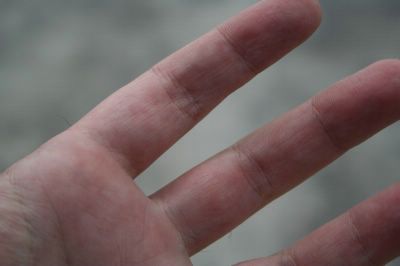
The EFS 18-55mm lens comes in handy.
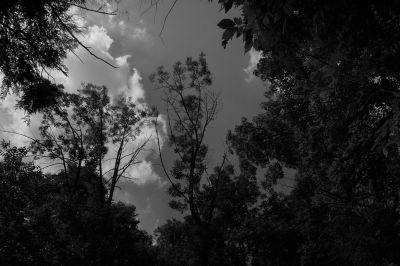
No diamonds, no Lucy, just sky.
Now Toronto is, after all, the city in the trees. Bruce's Mill Conservation Area is, after all, part of the Greater Toronto Area. So here you go. I love this picture. It's dark, moody, and yet happy and hopeful. This shot was taken in black and white (no duh) with the red filter setting.
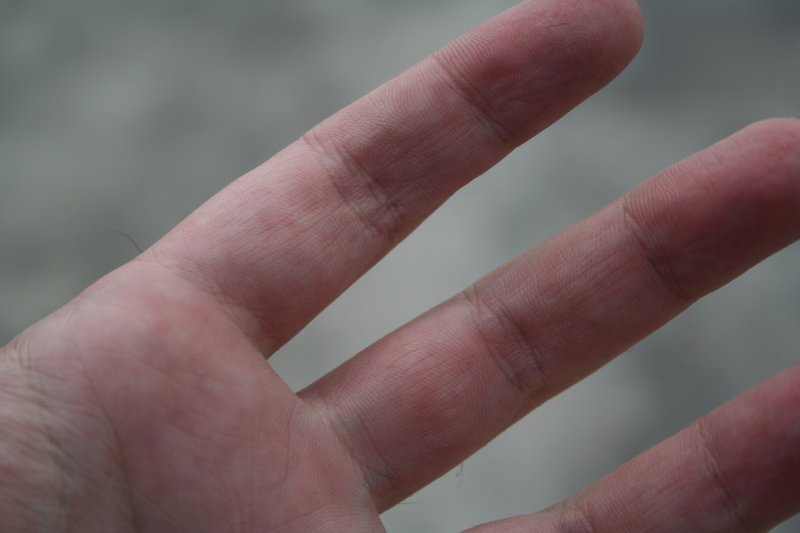
The EFS 18-55mm lens comes in handy.
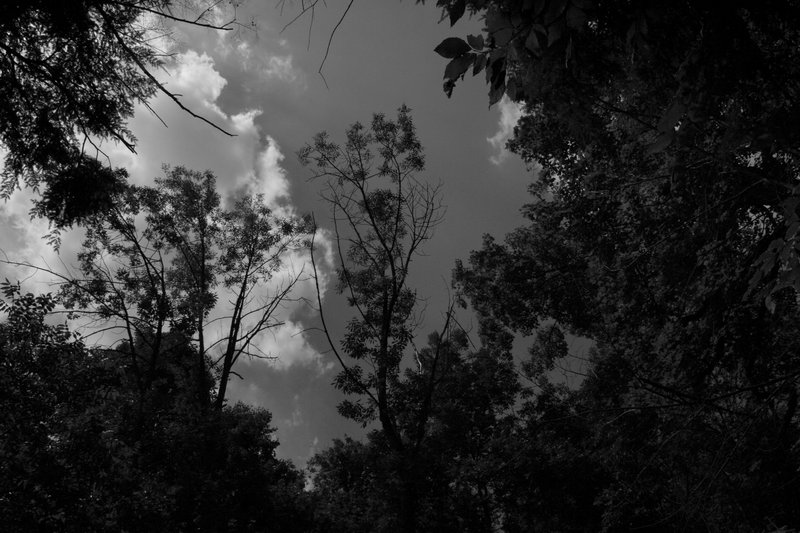
No diamonds, no Lucy, just sky.
Now Toronto is, after all, the city in the trees. Bruce's Mill Conservation Area is, after all, part of the Greater Toronto Area. So here you go. I love this picture. It's dark, moody, and yet happy and hopeful. This shot was taken in black and white (no duh) with the red filter setting.
Tuesday, August 09, 2005
WTFWTF?
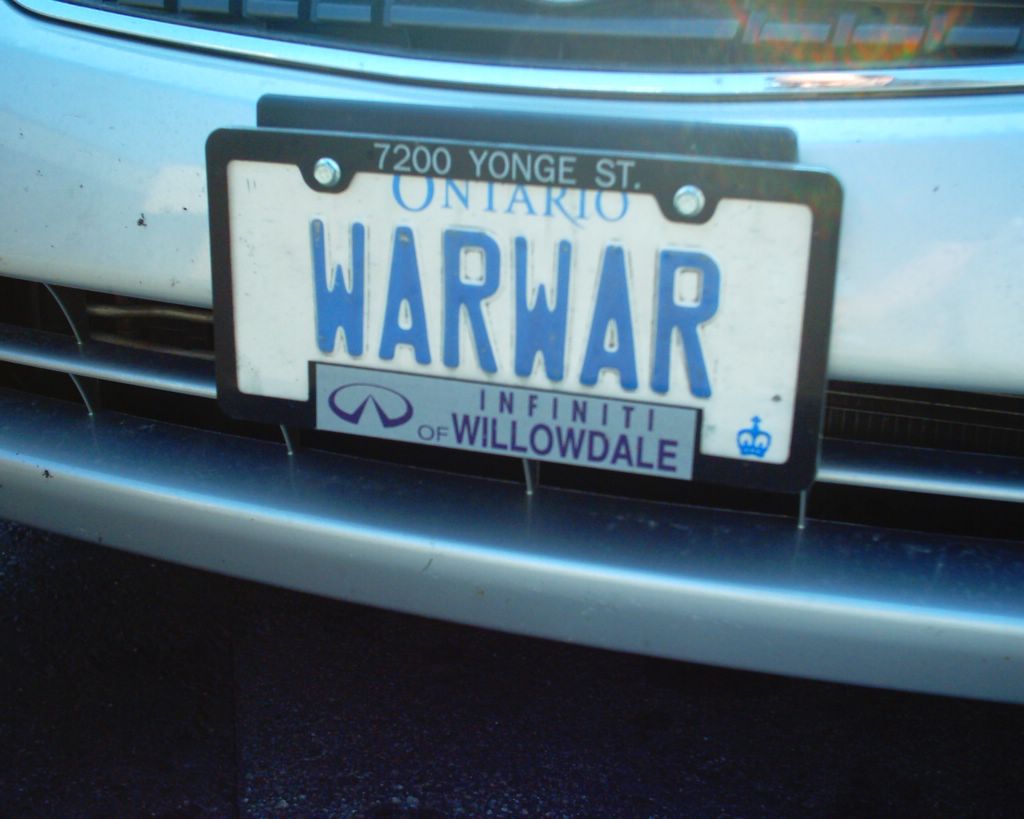
I offer the following without comment, except to say I photographed it not with my Rebel XT but my little dinky Aiptek DV-II, which I carry with me on my fannypack. I took this shot in the parking lot of the Bayview Village Shopping Centre where I was picking up Black Seal rum at the LCBO and soy sauce at Lablaw's. What is in this guy's mind when he's on the road?

War War!
War War!
What is your legacy?
Suppose, for a moment, our civilization will end tomorrow. You can leave three books that will, through the miracle of City In the Trees Magic, be unambigulously understood by our successors... be they other humans in a thousand years, or lemurs, raccoons, foxes, or rats in several millions. What would they be?
So as not to prejudice you, I will post my own selections in a reply to this post.
So as not to prejudice you, I will post my own selections in a reply to this post.
Monday, August 08, 2005
Hi, thanks for coming out...
This has to be the ultimate "welcome to Toronto" photo I've ever seen. I love "daily dose of imagery". :)
Sunday, August 07, 2005
Adventures with a new camera
Thought I'd report on how it's going with the Rebel XT, particularly since James left a comment to the effect that he was interested, since he is considering getting a new camera himself.

First portrait victim: Bonnie.
This is one of my cats, Bonnie, a sweet tortie. She patiently endured about a half-dozen camera flashes in order for me to secure a shot I liked.

Second victim: Max.
Max, my other cat. This shot was taken with the Tamron 70-300mm telephoto/macro lens that came in the camera bundle deal. It was set on macro, obviously.

Product placement?
A no-name brand of diet cola, if you're curious. I've wanted to take shots like this for years. Across the span of just a couple of inches, the image is out of focus, comes into focus, and goes out of focus again. Look at the detail... you can see the etching of the brushed aluminum. This shot was also taken with the Tamron lens, at a distance of about three feet from the can.

Tribute to Jody.
Jody is a net friend I had for ten years, first in Albuquerque and later in Dallas. He died fourteen months ago today. We never met face to face, but I talked to him just about every day, and he came to be something like a brother to me. Unfortunately for so many people, a rare form of cancer came into his life a few years ago, and finally ended it. The little cedar chest holds a small share of his ashes, given to me by his roommates when I went to Dallas for his memorial. The cheetah figure is meant to be iconic of him, and was sent to me by a young woman he went to college with. The portrait behind is, as you might guess, a picture of Jody himself in happier times.

Big Dipper, little plane, dark field.
Friday night I decided to test the camera's nighttime abilities. Even with my still very limited knowledge, I got some shots I was happy with. I went out to the flood plain where Old Cummer bridge is (if you remember it from an earlier posting; the bridge is about 30 yards away, just off to the right in this shot). This picture was taken at a crook in the East Don River, which is just behind me, as is the beaver dam that diverts its course. This view faces north, and was taken from a tripod; a 17-second exposure at f3.5/ISO 1600. The one thing I bought with the camera that wasn't bundled with it was a $29 infrared remote. With the camera set on "bulb", one click on the remote would open the shutter, and the next would close it again. What I was trying to do was see if I could actually photograph the constellations, down in valley where the light pollution is minimal. What you see here is the Big Dipper — so happily, the answer is yes, it can photograph the skies. The streak near the bottom is a plane, travelling right to left, for the 17-second duration of the shot (basically, I closed the shutter when it reached the tree).
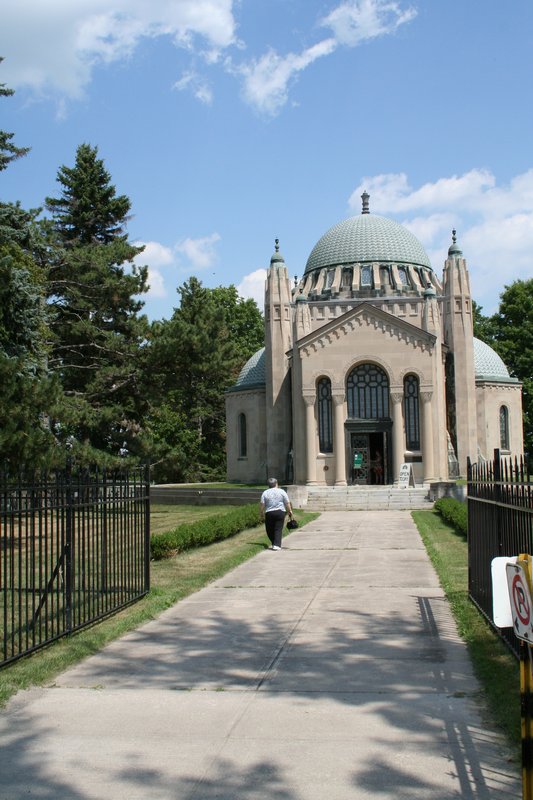
Today, I went out with my friends P-Doug and G to the east end of the GTA, partly to continue putting the camera through its paces. In Uxbridge, there's a gorgeous mausoleum build by, and for, Thomas Foster, one-time federal MP and Mayor of Toronto in the 1920s. It resembles the Hagia Sophia in Istanbul.

Approaching the Thomas Foster Mausoleum.
Here is G approaching the entrance to the mausoleum.

Beneath the entrance.
An up-shot from the lower right. I decided to shoot this in black and white, red filter, to make it a little moodier and more dramatic.

Floor detail of the mausoleum.
This is directly under the dome. I was invited by the curators to lie down on this spot to photograph the dome... which I did.

The dome of the mausoleum.
...And this is the result. I couldn't get all this in one shot; this is actually two photographs, mated in Photoshop. The colour quality and lighting were so consistent between them that this took only a couple of minutes to stitch.
If you can't read the gold lettering, it says, "Take this my body for it is done and I have gained a new life glorious and eternal."

Wall detail.
The tile work in the mausoleum is truly beautiful; intricate and a real credit to whomever the artists were who inlaid it.

The pretentious NYC condos at Bayview and Sheppard.
And, just as a change of pace to wrap things up, here are the NYC condos to be seen as one drives along the 401 between Bayview Avenue and Leslie Street. This shot was taken at a mall exit on Sheppard Avenue, just east of Bayview, and faces south. The buildings occupy the narrow strip between Sheppard and the 401.

First portrait victim: Bonnie.
This is one of my cats, Bonnie, a sweet tortie. She patiently endured about a half-dozen camera flashes in order for me to secure a shot I liked.

Second victim: Max.
Max, my other cat. This shot was taken with the Tamron 70-300mm telephoto/macro lens that came in the camera bundle deal. It was set on macro, obviously.

Product placement?
A no-name brand of diet cola, if you're curious. I've wanted to take shots like this for years. Across the span of just a couple of inches, the image is out of focus, comes into focus, and goes out of focus again. Look at the detail... you can see the etching of the brushed aluminum. This shot was also taken with the Tamron lens, at a distance of about three feet from the can.
Tribute to Jody.
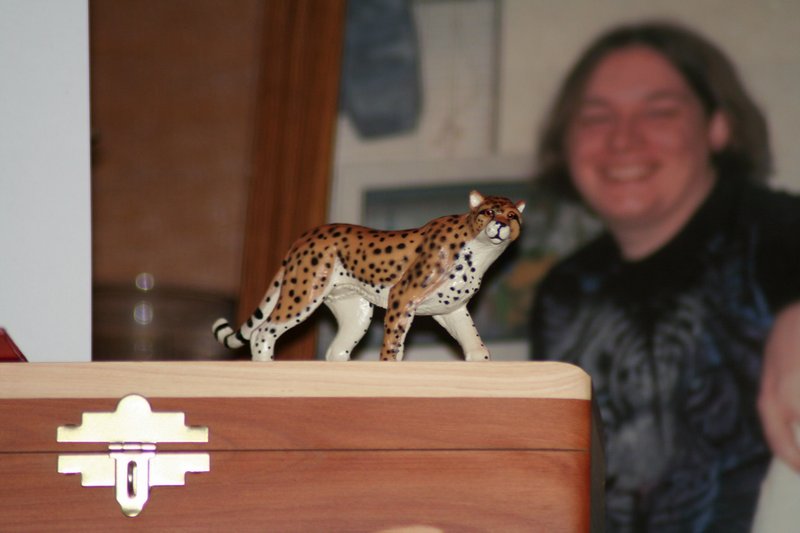
Jody is a net friend I had for ten years, first in Albuquerque and later in Dallas. He died fourteen months ago today. We never met face to face, but I talked to him just about every day, and he came to be something like a brother to me. Unfortunately for so many people, a rare form of cancer came into his life a few years ago, and finally ended it. The little cedar chest holds a small share of his ashes, given to me by his roommates when I went to Dallas for his memorial. The cheetah figure is meant to be iconic of him, and was sent to me by a young woman he went to college with. The portrait behind is, as you might guess, a picture of Jody himself in happier times.

Big Dipper, little plane, dark field.
Friday night I decided to test the camera's nighttime abilities. Even with my still very limited knowledge, I got some shots I was happy with. I went out to the flood plain where Old Cummer bridge is (if you remember it from an earlier posting; the bridge is about 30 yards away, just off to the right in this shot). This picture was taken at a crook in the East Don River, which is just behind me, as is the beaver dam that diverts its course. This view faces north, and was taken from a tripod; a 17-second exposure at f3.5/ISO 1600. The one thing I bought with the camera that wasn't bundled with it was a $29 infrared remote. With the camera set on "bulb", one click on the remote would open the shutter, and the next would close it again. What I was trying to do was see if I could actually photograph the constellations, down in valley where the light pollution is minimal. What you see here is the Big Dipper — so happily, the answer is yes, it can photograph the skies. The streak near the bottom is a plane, travelling right to left, for the 17-second duration of the shot (basically, I closed the shutter when it reached the tree).
Today, I went out with my friends P-Doug and G to the east end of the GTA, partly to continue putting the camera through its paces. In Uxbridge, there's a gorgeous mausoleum build by, and for, Thomas Foster, one-time federal MP and Mayor of Toronto in the 1920s. It resembles the Hagia Sophia in Istanbul.
Approaching the Thomas Foster Mausoleum.
Here is G approaching the entrance to the mausoleum.
Beneath the entrance.
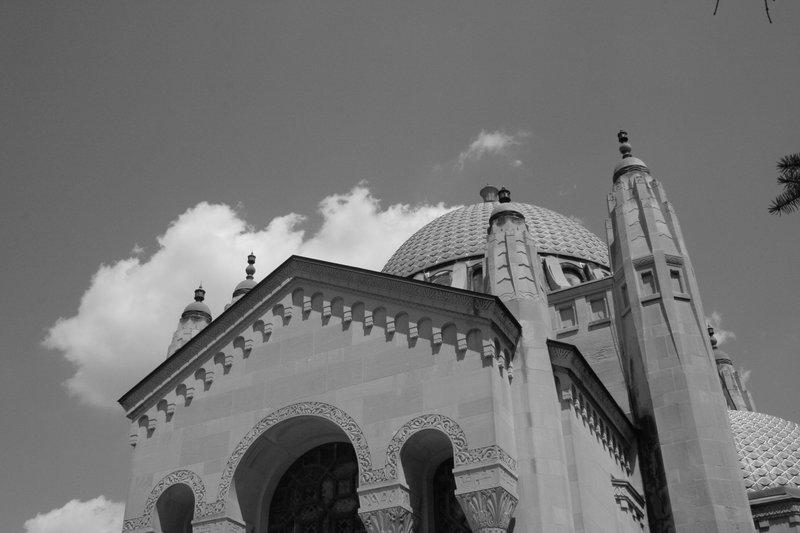
An up-shot from the lower right. I decided to shoot this in black and white, red filter, to make it a little moodier and more dramatic.

Floor detail of the mausoleum.
This is directly under the dome. I was invited by the curators to lie down on this spot to photograph the dome... which I did.
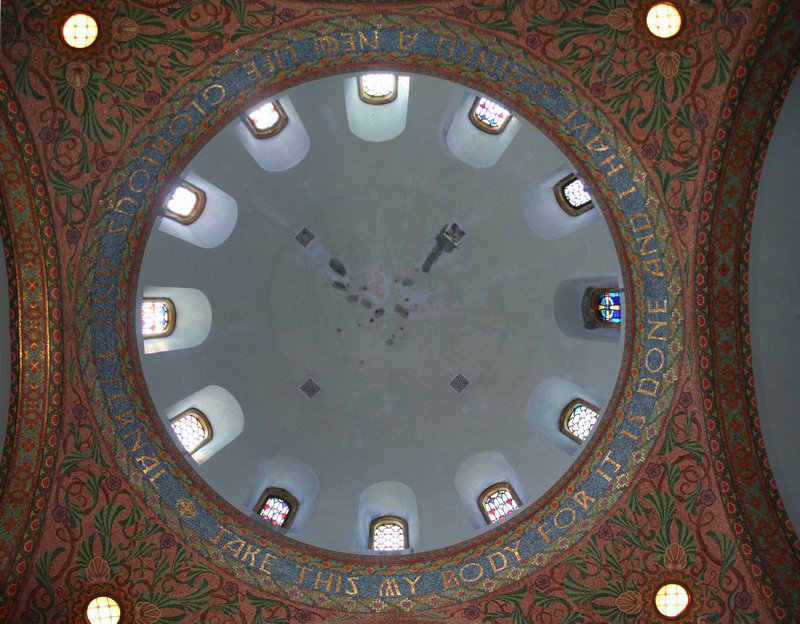
The dome of the mausoleum.
...And this is the result. I couldn't get all this in one shot; this is actually two photographs, mated in Photoshop. The colour quality and lighting were so consistent between them that this took only a couple of minutes to stitch.
If you can't read the gold lettering, it says, "Take this my body for it is done and I have gained a new life glorious and eternal."

Wall detail.
The tile work in the mausoleum is truly beautiful; intricate and a real credit to whomever the artists were who inlaid it.

The pretentious NYC condos at Bayview and Sheppard.
And, just as a change of pace to wrap things up, here are the NYC condos to be seen as one drives along the 401 between Bayview Avenue and Leslie Street. This shot was taken at a mall exit on Sheppard Avenue, just east of Bayview, and faces south. The buildings occupy the narrow strip between Sheppard and the 401.
Friday, August 05, 2005
Rex mortuus est, vivat rex!
For years and years now I've been pining for the day we'd finally have affordable digital single-lens reflex cameras... not these little point and shoot toys that are more often used these days by people to make little AVIs of their grandchild singing the alphabet or the dog chasing a stick. Years ago I actually had a decent SLR camera, but that was the days of film. That meant paying to buy the film. Paying to develop the film. Paying to print the shots. And never knowing if they were any good at all till all this expensive nonsense was out of the way.
When digital cameras started coming out in the mid-90s, I was a quick adopter. I got a Kodak DC25 in February of 1997. It was just this tiny little thing; had a built-in flash, an LCD review, and held 17 or so 320x240 shots of low quality. But it was digital! No more buying film or getting it developed! I was hooked.
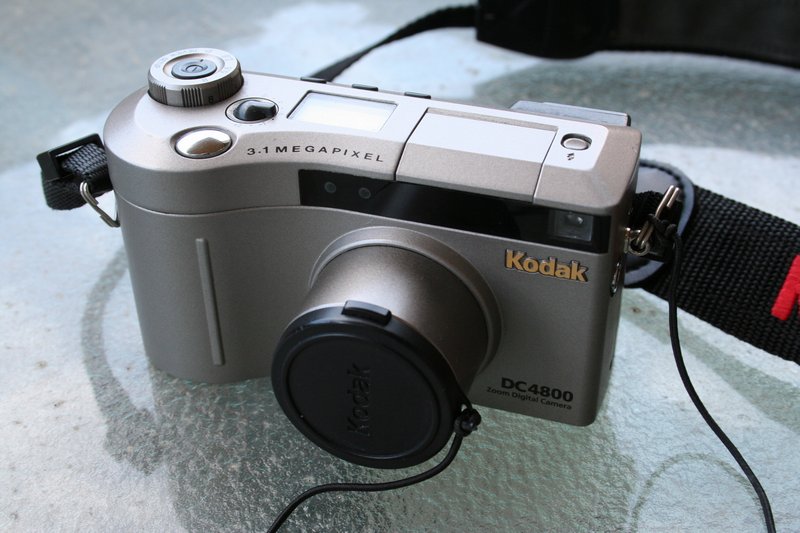
In fairly short order I blew through Kodak cameras (and money), moving on to the DC40 (held 24 good shots), the DC50 (had a zoom and you could plug in extra memory), and finally, about four years ago, the DC4800 I've been using ever since.
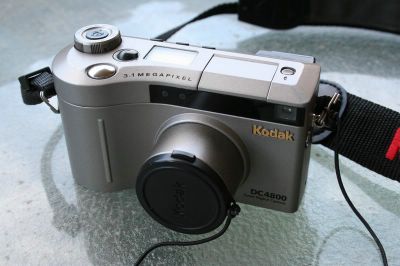
The outgoing king, the Kodak DC4800. Photographed using the Canon 350D.
The DC4800's a good camera. With a 256MB card in it, it produced about 260 decent photos at 3.1 megapixel size. It's been a superlative camera for capturing casual shots of places I've been. But I want to start experimenting and taking some shots that are outside the ordinary and the everyday, like the ones you'll see on daily dose of imagery. And so, today, I acquired the Canon 350D Rebel XT, the camera that takes the shots on that site. I don't mean to suggest I have that photographer's eye, and I certainly don't have his experience, but now I mean to start learning. From here on in, the shots you see here will be taken with the Rebel XT.
For you sentimentalists, fear not. The DC4800 is going to a good home; that of my friend P-Doug, who worked as a photographer and developer for 25 years before becoming an archivist; in exchange for a 1G CF card for the Rebel XT.
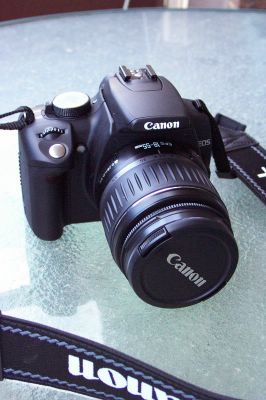
The incoming king, the Canon 350D Rebel XT. Photographed using the Kodak DC4800.
When digital cameras started coming out in the mid-90s, I was a quick adopter. I got a Kodak DC25 in February of 1997. It was just this tiny little thing; had a built-in flash, an LCD review, and held 17 or so 320x240 shots of low quality. But it was digital! No more buying film or getting it developed! I was hooked.
In fairly short order I blew through Kodak cameras (and money), moving on to the DC40 (held 24 good shots), the DC50 (had a zoom and you could plug in extra memory), and finally, about four years ago, the DC4800 I've been using ever since.
The outgoing king, the Kodak DC4800. Photographed using the Canon 350D.
The DC4800's a good camera. With a 256MB card in it, it produced about 260 decent photos at 3.1 megapixel size. It's been a superlative camera for capturing casual shots of places I've been. But I want to start experimenting and taking some shots that are outside the ordinary and the everyday, like the ones you'll see on daily dose of imagery. And so, today, I acquired the Canon 350D Rebel XT, the camera that takes the shots on that site. I don't mean to suggest I have that photographer's eye, and I certainly don't have his experience, but now I mean to start learning. From here on in, the shots you see here will be taken with the Rebel XT.
For you sentimentalists, fear not. The DC4800 is going to a good home; that of my friend P-Doug, who worked as a photographer and developer for 25 years before becoming an archivist; in exchange for a 1G CF card for the Rebel XT.
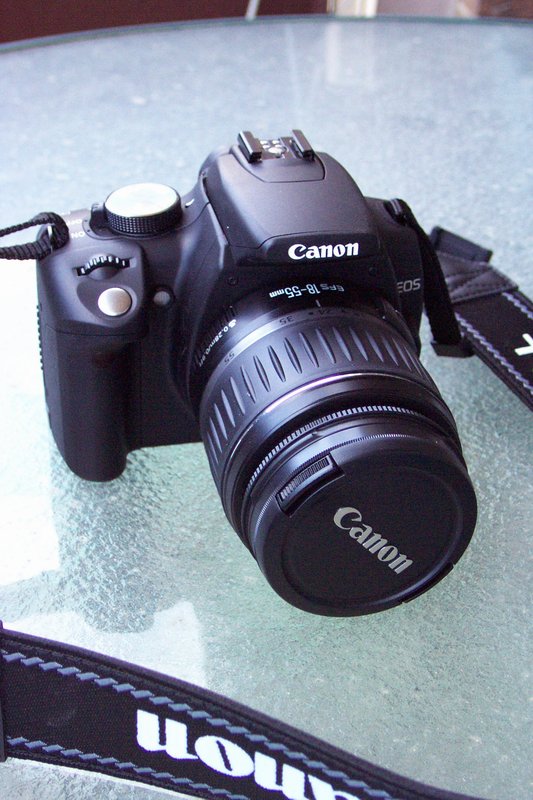
The incoming king, the Canon 350D Rebel XT. Photographed using the Kodak DC4800.
Thursday, August 04, 2005
"First of all, she's black..."
Fans of WKRP In Cincinnati will remember this as the punchline to a joke Bailey told about the nature of God. Well, it's now the honest-to-goodness truth about Canada's next viceroy. The next Governor-General (the Queen's representative in Canada) is a black woman, Michaelle Jean. Born in Haiti, she's been living in Quebec most of her life and is a well-known journalist on CBC (as was Adrienne Clarkson, the current GG). On the one hand, I want to congratulate Canada for toppling another barrier. But on the other hand, is it something praiseworthy? Isn't it only the due of any Canadian citizen of notable achievement, regardless of race, sex, or religion?
Friday, July 29, 2005
Under Highway 401
Wednesday night I went for a walk down the Betty Sutherland Trail. The path takes you under Highway 401. At that point, the 401 is something like 16 or 18 lanes wide. I can remember when, as a boy, I moved to Ontario from Nova Scotia... coming over some rise heading into Scarborough and suddenly seeing the 401 spread across the land in front of me, more than a dozen lanes wide. We'd had highways in Nova Scotia, but I'd never seen the like. As long as I live, I'll remember that moment. For me, that was when we arrived in Ontario. I wonder what I was thinking as I passed over the very spot you now see in these pictures, a quarter century later.
Some of the graffiti was interesting. Here's some of what I saw.

The way down into the valley
This isn't the way I meant to take, but I discovered a way down into the valley off George Henry Blvd. It doesn't lead straight to the path like I expected; it actually takes you through about a quarter mile of brush, forest, and flood plain first...
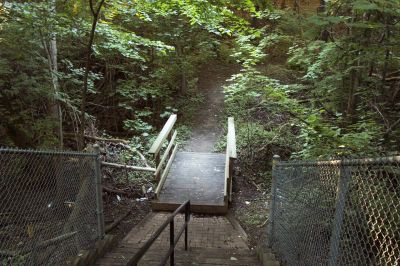
The bridge at the bottom of the stairs
You can't quite see it in this shot, but there's a very steep rise on the far side of the bridge. I expected the main trail to be at the bottom of the steps, and then the other side of the rise. By this point, I was walking the route barefoot, so I was all at once challenged by the (as then) uncertain distance and terrain and delighted by the wonderful textures of nature to be experienced right inside the city.

We Love You
Eventually I found the main trail, which, among other things, takes you under the 401. In this shot, I've passed southbound under the Leslie Street offramp of the 401 West, and am looking at the first support pillar of the westbound collector lanes. The 401 here was built in the early 1950s, but this pillar and collectors weren't built until the mid-1960s.
You can see that someone has taken considerable time to cut out and paste up several dozen of these rather unsettling creatures, and captioned it all with something that has been changed from "We Kill You" to "We Love You". I wish I knew what the motivation was. I like to think the idea is that we judge too much by appearances, and that we can miss the message due to our preconceptions.
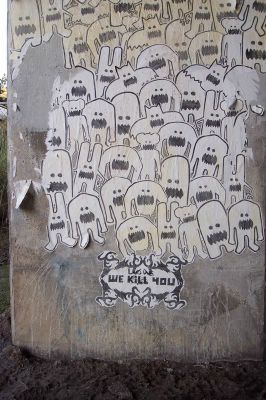
Detail of We Love You

Sit By a River
It might be a little hard to read this one, so I'll quote it. It says, "Sit by a river to find peace in the rhythm of the lifeblood of the Earth". To my back is the East Don River, about thirty feet away and twenty feet down.

Environmental advocacy
Just to the right of the last message are these ones. The one in red isn't too difficult to read; it says, "Only dead fish swim in the Don River". As it turns out, I personally made a lie of that about half an hour later, but that's another story.
There is also a message in silver beneath it, which is virtually impossible to read in this shot. It says, "We labour long for peace cause war threatens our survival. It's time we fight with equal passion to protect our environment. A polluted stream is just as deadly as a bullet!"
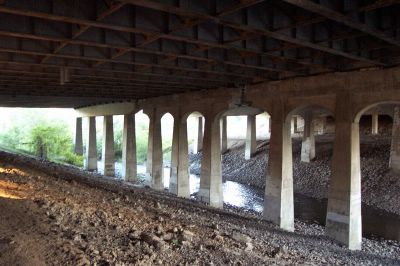
The Don River passing under Highway 401
This shot really does not do the setting justice. I guess nothing short of being there, or a 3D camera of some kind, really could. It takes just about a minute to pass under the 401 at this point. Where I'm walking is under the busiest highway in North America. Just a few miles to the west at Hogg's Hollow is the most travelled commercial set of highway bridges on the continent, and just west of that, at the 401-400 interchange, the volume of traffic is 415,000 vehicles per day. What you're seeing here, standing over the "lifeblood of the Earth", are the pillars that uphold the lifeblood of central Canada and the northern Midwestern United States.
Some of the graffiti was interesting. Here's some of what I saw.
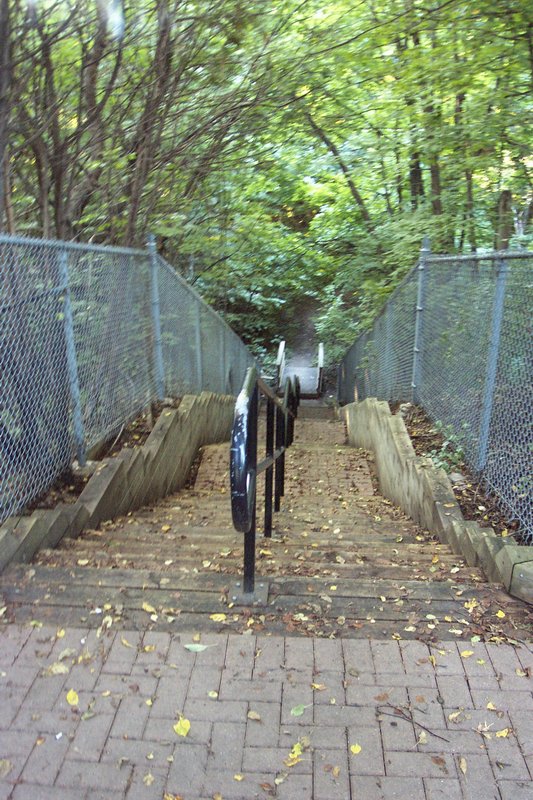
The way down into the valley
This isn't the way I meant to take, but I discovered a way down into the valley off George Henry Blvd. It doesn't lead straight to the path like I expected; it actually takes you through about a quarter mile of brush, forest, and flood plain first...

The bridge at the bottom of the stairs
You can't quite see it in this shot, but there's a very steep rise on the far side of the bridge. I expected the main trail to be at the bottom of the steps, and then the other side of the rise. By this point, I was walking the route barefoot, so I was all at once challenged by the (as then) uncertain distance and terrain and delighted by the wonderful textures of nature to be experienced right inside the city.
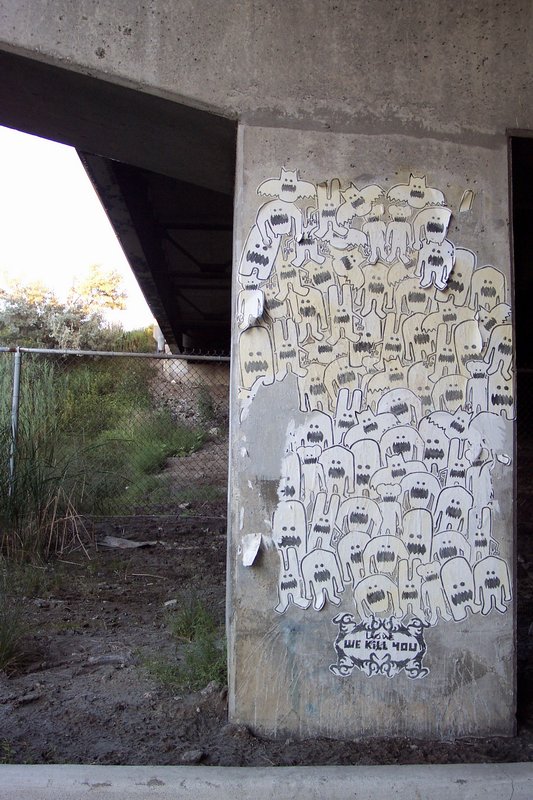
We Love You
Eventually I found the main trail, which, among other things, takes you under the 401. In this shot, I've passed southbound under the Leslie Street offramp of the 401 West, and am looking at the first support pillar of the westbound collector lanes. The 401 here was built in the early 1950s, but this pillar and collectors weren't built until the mid-1960s.
You can see that someone has taken considerable time to cut out and paste up several dozen of these rather unsettling creatures, and captioned it all with something that has been changed from "We Kill You" to "We Love You". I wish I knew what the motivation was. I like to think the idea is that we judge too much by appearances, and that we can miss the message due to our preconceptions.
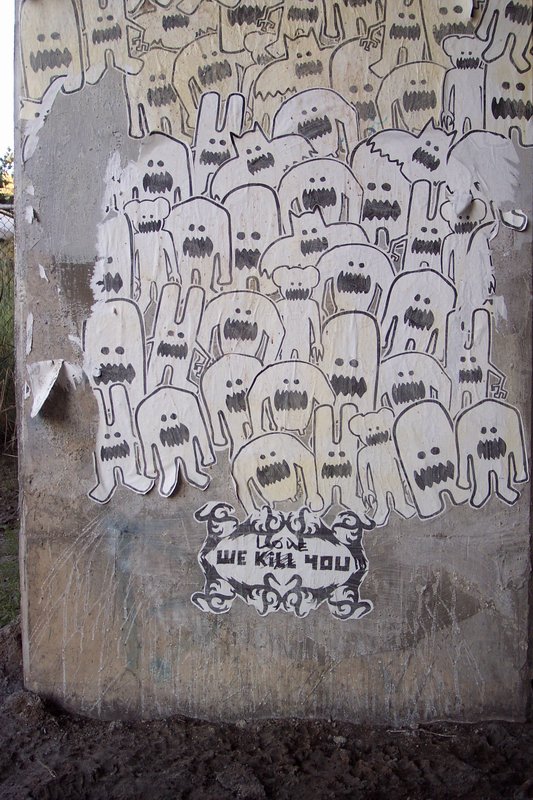
Detail of We Love You
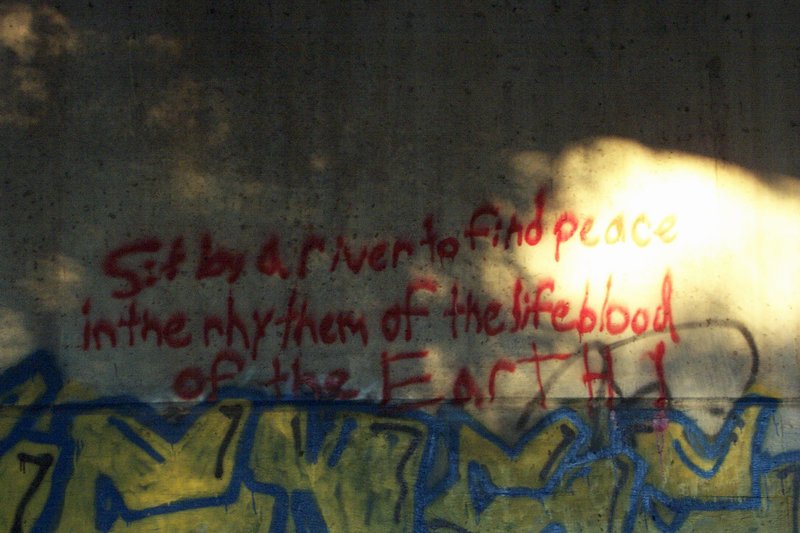
Sit By a River
It might be a little hard to read this one, so I'll quote it. It says, "Sit by a river to find peace in the rhythm of the lifeblood of the Earth". To my back is the East Don River, about thirty feet away and twenty feet down.
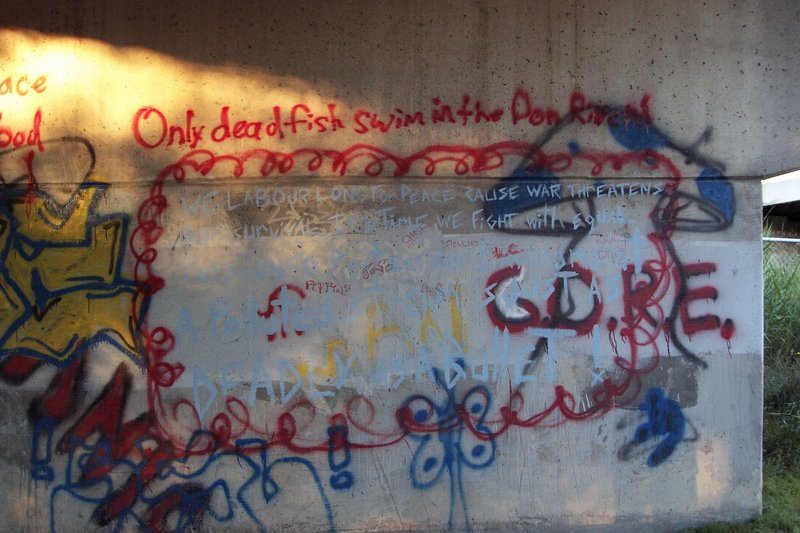
Environmental advocacy
Just to the right of the last message are these ones. The one in red isn't too difficult to read; it says, "Only dead fish swim in the Don River". As it turns out, I personally made a lie of that about half an hour later, but that's another story.
There is also a message in silver beneath it, which is virtually impossible to read in this shot. It says, "We labour long for peace cause war threatens our survival. It's time we fight with equal passion to protect our environment. A polluted stream is just as deadly as a bullet!"
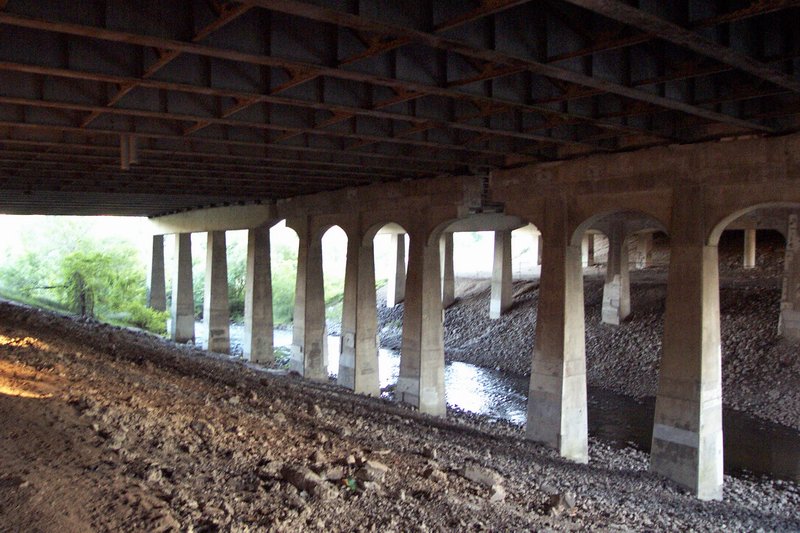
The Don River passing under Highway 401
This shot really does not do the setting justice. I guess nothing short of being there, or a 3D camera of some kind, really could. It takes just about a minute to pass under the 401 at this point. Where I'm walking is under the busiest highway in North America. Just a few miles to the west at Hogg's Hollow is the most travelled commercial set of highway bridges on the continent, and just west of that, at the 401-400 interchange, the volume of traffic is 415,000 vehicles per day. What you're seeing here, standing over the "lifeblood of the Earth", are the pillars that uphold the lifeblood of central Canada and the northern Midwestern United States.
Why the West has lost goodwill of Muslims
From today's Toronto Star, brought to my attention by a non-blogging friend...
Why the West has lost goodwill of Muslims
JAVED AKBAR
These are treacherous times. Peace seems to have become ever more elusive and we are all traumatized, as if an impending danger is lurking over our heads. The victims, who are falling to acts of either individual or state-sponsored terrorism, have mainly been innocent civilians.
This vicious cycle of tit-for-tat madness must stop. Every innocent life lost is too precious, too great.
To honour the souls ofthe more than 50 people who died in a planned and pathologically-motivated attack in London, people the world over did stop in solemn silence and paid their respects by adopting the slogan: "Today we are all British."
It was a poignant way to express solidarity with the bereaving families and nation. Paradoxically, when more than 200,000 people were killed in attacks on Iraq and Afghanistan, no one said: "Today we are all Iraqis or Afghanis."
What hypocrisy. What gall.
The horror of 9/11 and now the aftermath of the London bombings reveal, more than anything else, the discord between the true nature of Islam, as religion, culture and civilization, and the way it is projected in the current palpable cloud of Islamophobia. Islam is relentlessly portrayed as an obscurantist, unethical enterprise. Muslims now actually wear the garb of the very demons that the media have been projecting as a collective profile for an entire community and a whole faith.
Is it fair to compare the worst of Islam to the best of everyone else?
Muslims, by far, are the greatest victims of such brutalities, as their faith is continually and recklessly branded and cruelly tied to violence. Much time is spared to proffer, within an aura of intense demagoguery and downright ignorance, flawed definitions and interpretations about a whole religion and civilization.
The ultimate result of such an exercise in misinformation is not to enlighten but to inflame the audience's indignant passion. Lost in the midst of this hallucinogenic haze is the fact that religion, any religion, like any other lofty aspect of human life, can be abused.
Is there a hierarchy in pain, torture and death? Can the word "innocent" be used selectively and the word "terrorist" be assigned mainly for Muslims?
Instead of getting carried away with passions stirred by the media, we in the West need to summon the moral courage to examine, and reflect on, the root causes of this horrendous reality and take swift action to address the concerns of the Muslim world. This does not mean giving in to the demands of Osama bin Laden and his ilk, but rather a master-stroke of statesmanship for winning an enduring world peace.
Such a move requires courageous leadership. But who among world leaders can rise to the occasion and seize this opportunity to help stem the tide of individual and state-sponsored terrorism once and for all?
Fighting violence with more violence has proven disastrous in prosecuting the "war on terror."
How long do we have to suffer the rising death toll in Iraq, Afghanistan and the revenge attacks elsewhere? The occupation of the Muslim lands must end. It is illegal and morally reprehensible.
For their part, what can Muslims do to get beyond the current impasse? They must stop waiting for the messiah to come and deliver them on a silver platter.
Their faith provides an ethical and moral perspective within which Muslims must exert their energies to find answers to all human ills. The way forward to a fresh, contemporary appreciation of Islam requires a multi-dimensional understanding of Islam that demands from them to "enjoin what is good and forbid what is evil."
Author Karen Armstrong makes a telling comment on this present state of affairs: "At the beginning of the 20th century," she says, "nearly every single Muslim intellectual was in love with the West, admired its modern society, and campaigned for democracy and constitutional government in their own countries.
"Instead of seeing the West as their enemy, they recognized it as compatible with their own traditions. We should ask ourselves why we have lost this goodwill."
--------------------------------------------------------------------------------
Javed Akbar is director of outreach at Pickering Islamic Centre.
Why the West has lost goodwill of Muslims
JAVED AKBAR
These are treacherous times. Peace seems to have become ever more elusive and we are all traumatized, as if an impending danger is lurking over our heads. The victims, who are falling to acts of either individual or state-sponsored terrorism, have mainly been innocent civilians.
This vicious cycle of tit-for-tat madness must stop. Every innocent life lost is too precious, too great.
To honour the souls ofthe more than 50 people who died in a planned and pathologically-motivated attack in London, people the world over did stop in solemn silence and paid their respects by adopting the slogan: "Today we are all British."
It was a poignant way to express solidarity with the bereaving families and nation. Paradoxically, when more than 200,000 people were killed in attacks on Iraq and Afghanistan, no one said: "Today we are all Iraqis or Afghanis."
What hypocrisy. What gall.
The horror of 9/11 and now the aftermath of the London bombings reveal, more than anything else, the discord between the true nature of Islam, as religion, culture and civilization, and the way it is projected in the current palpable cloud of Islamophobia. Islam is relentlessly portrayed as an obscurantist, unethical enterprise. Muslims now actually wear the garb of the very demons that the media have been projecting as a collective profile for an entire community and a whole faith.
Is it fair to compare the worst of Islam to the best of everyone else?
Muslims, by far, are the greatest victims of such brutalities, as their faith is continually and recklessly branded and cruelly tied to violence. Much time is spared to proffer, within an aura of intense demagoguery and downright ignorance, flawed definitions and interpretations about a whole religion and civilization.
The ultimate result of such an exercise in misinformation is not to enlighten but to inflame the audience's indignant passion. Lost in the midst of this hallucinogenic haze is the fact that religion, any religion, like any other lofty aspect of human life, can be abused.
Is there a hierarchy in pain, torture and death? Can the word "innocent" be used selectively and the word "terrorist" be assigned mainly for Muslims?
Instead of getting carried away with passions stirred by the media, we in the West need to summon the moral courage to examine, and reflect on, the root causes of this horrendous reality and take swift action to address the concerns of the Muslim world. This does not mean giving in to the demands of Osama bin Laden and his ilk, but rather a master-stroke of statesmanship for winning an enduring world peace.
Such a move requires courageous leadership. But who among world leaders can rise to the occasion and seize this opportunity to help stem the tide of individual and state-sponsored terrorism once and for all?
Fighting violence with more violence has proven disastrous in prosecuting the "war on terror."
How long do we have to suffer the rising death toll in Iraq, Afghanistan and the revenge attacks elsewhere? The occupation of the Muslim lands must end. It is illegal and morally reprehensible.
For their part, what can Muslims do to get beyond the current impasse? They must stop waiting for the messiah to come and deliver them on a silver platter.
Their faith provides an ethical and moral perspective within which Muslims must exert their energies to find answers to all human ills. The way forward to a fresh, contemporary appreciation of Islam requires a multi-dimensional understanding of Islam that demands from them to "enjoin what is good and forbid what is evil."
Author Karen Armstrong makes a telling comment on this present state of affairs: "At the beginning of the 20th century," she says, "nearly every single Muslim intellectual was in love with the West, admired its modern society, and campaigned for democracy and constitutional government in their own countries.
"Instead of seeing the West as their enemy, they recognized it as compatible with their own traditions. We should ask ourselves why we have lost this goodwill."
--------------------------------------------------------------------------------
Javed Akbar is director of outreach at Pickering Islamic Centre.
Tenth planet!!!!!!
Oh, to be ten years old again.
NASA has announced, today, the discovery of a tenth planet in our solar system; the first new planet discovered in about 70 years. When I was a kid, I was fascinated by the planets. Back then, during or just prior to the Pioneer and Voyager missions to the outer planets, they were remote and utterly mysterious. The famous Nine. But now it seems we've identified a tenth. I can hardly wait to learn what the new planet's name will be.
Apparently, the new planet may be called Sedna, after an Inuit goddess of the sea.
NASA has announced, today, the discovery of a tenth planet in our solar system; the first new planet discovered in about 70 years. When I was a kid, I was fascinated by the planets. Back then, during or just prior to the Pioneer and Voyager missions to the outer planets, they were remote and utterly mysterious. The famous Nine. But now it seems we've identified a tenth. I can hardly wait to learn what the new planet's name will be.
Apparently, the new planet may be called Sedna, after an Inuit goddess of the sea.
It's the Oil, Stupid
Laura K over at we move to canada, one of the Lone Primate's essential daily reads, brought this cogent article to her readers' attention, from yesterday's New York Times. I copy it here because it's reasonably brief, and the NYT is notorious for quickly moving articles out of the reach of URLs.
Oil and Blood
By BOB HERBERT
Published: July 28, 2005
It is now generally understood that the U.S.-led war in Iraq has become a debacle. Nevertheless, Iraqis are supposed to have their constitution ratified and a permanent government elected by the end of the year. It's a logical escape hatch for George W. Bush. He could declare victory, as a senator once suggested to Lyndon Johnson in the early years of Vietnam, and bring the troops home as quickly as possible.
His mantra would be: There's a government in place. We won. We're out of there.
But don't count on it. The Bush administration has no plans to bring the troops home from this misguided war, which has taken a fearful toll in lives and injuries while at the same time weakening the military, damaging the international reputation of the United States, serving as a world-class recruiting tool for terrorist groups and blowing a hole the size of Baghdad in Washington's budget.
A wiser leader would begin to cut some of these losses. But the whole point of this war, it seems, was to establish a long-term military presence in Iraq to ensure American domination of the Middle East and its precious oil reserves, which have been described, the author Daniel Yergin tells us, as "the greatest single prize in all history."
You can run through all the wildly varying rationales for this war: the weapons of mass destruction (that were never found), the need to remove the unmitigated evil of Saddam (whom we had once cozied up to), the connection to Al Qaeda (which was bogus), and one of President Bush's favorites, the need to fight the terrorists "over there" so we won't have to fight them here at home.
All the rationales have to genuflect before "The Prize," which was the title of Mr. Yergin's Pulitzer-Prize-winning book.
It's the oil, stupid.
What has so often gotten lost in all the talk about terror and weapons of mass destruction is the fact that for so many of the most influential members of the Bush administration, the obsessive desire to invade Iraq preceded the Sept. 11 attacks. It preceded the Bush administration. The neoconservatives were beating the war drums on Iraq as far back as the late 1990's.
Iraq was supposed to be a first step. Iran was also in the neoconservatives' sights. The neocons envisaged U.S. control of the region (and its oil), to be followed inevitably by the realization of their ultimate dream, a global American empire. Of course it sounds like madness, which is why we should have been paying closer attention from the beginning.
The madness took a Dr. Strangelovian turn in the summer of 2002, before the war with Iraq was launched. As The Washington Post first reported, an influential Pentagon advisory board was given a briefing prepared by a Rand Corporation analyst who said the U.S. should consider seizing the oil fields and financial assets of Saudi Arabia if it did not stop its support of terrorism.
Mercifully the briefing went nowhere. Defense Secretary Donald Rumsfeld said it did not represent the "dominant opinion" within the administration.
The point here is that the invasion of Iraq was part of a much larger, long-term policy that had to do with the U.S. imposing its will, militarily when necessary, throughout the Middle East and beyond. The war has gone badly, and the viciousness of the Iraq insurgency has put the torch to the idea of further pre-emptive adventures by the Bush administration.
But dreams of empire die hard. American G.I.'s are dug into Iraq, and the bases have been built for a long stay. The war may be going badly, but the primary consideration is that there is still a tremendous amount of oil at stake, the second-largest reserves on the planet. And neocon fantasies aside, the global competition for the planet's finite oil reserves intensifies by the hour.
Lyndon Johnson ignored the unsolicited advice of Senator George Aiken of Vermont - to declare victory in Vietnam in 1966. The war continued for nearly a decade. Many high-level government figures believe that U.S. troops will be in Iraq for a minimum of 5 more years, and perhaps 10.
That should be understood by the people who think that the formation of a permanent Iraqi government will lead to the withdrawal of American troops. There is no real withdrawal plan. The fighting and the dying will continue indefinitely.
E-mail: bobherb@nytimes.com
Oil and Blood
By BOB HERBERT
Published: July 28, 2005
It is now generally understood that the U.S.-led war in Iraq has become a debacle. Nevertheless, Iraqis are supposed to have their constitution ratified and a permanent government elected by the end of the year. It's a logical escape hatch for George W. Bush. He could declare victory, as a senator once suggested to Lyndon Johnson in the early years of Vietnam, and bring the troops home as quickly as possible.
His mantra would be: There's a government in place. We won. We're out of there.
But don't count on it. The Bush administration has no plans to bring the troops home from this misguided war, which has taken a fearful toll in lives and injuries while at the same time weakening the military, damaging the international reputation of the United States, serving as a world-class recruiting tool for terrorist groups and blowing a hole the size of Baghdad in Washington's budget.
A wiser leader would begin to cut some of these losses. But the whole point of this war, it seems, was to establish a long-term military presence in Iraq to ensure American domination of the Middle East and its precious oil reserves, which have been described, the author Daniel Yergin tells us, as "the greatest single prize in all history."
You can run through all the wildly varying rationales for this war: the weapons of mass destruction (that were never found), the need to remove the unmitigated evil of Saddam (whom we had once cozied up to), the connection to Al Qaeda (which was bogus), and one of President Bush's favorites, the need to fight the terrorists "over there" so we won't have to fight them here at home.
All the rationales have to genuflect before "The Prize," which was the title of Mr. Yergin's Pulitzer-Prize-winning book.
It's the oil, stupid.
What has so often gotten lost in all the talk about terror and weapons of mass destruction is the fact that for so many of the most influential members of the Bush administration, the obsessive desire to invade Iraq preceded the Sept. 11 attacks. It preceded the Bush administration. The neoconservatives were beating the war drums on Iraq as far back as the late 1990's.
Iraq was supposed to be a first step. Iran was also in the neoconservatives' sights. The neocons envisaged U.S. control of the region (and its oil), to be followed inevitably by the realization of their ultimate dream, a global American empire. Of course it sounds like madness, which is why we should have been paying closer attention from the beginning.
The madness took a Dr. Strangelovian turn in the summer of 2002, before the war with Iraq was launched. As The Washington Post first reported, an influential Pentagon advisory board was given a briefing prepared by a Rand Corporation analyst who said the U.S. should consider seizing the oil fields and financial assets of Saudi Arabia if it did not stop its support of terrorism.
Mercifully the briefing went nowhere. Defense Secretary Donald Rumsfeld said it did not represent the "dominant opinion" within the administration.
The point here is that the invasion of Iraq was part of a much larger, long-term policy that had to do with the U.S. imposing its will, militarily when necessary, throughout the Middle East and beyond. The war has gone badly, and the viciousness of the Iraq insurgency has put the torch to the idea of further pre-emptive adventures by the Bush administration.
But dreams of empire die hard. American G.I.'s are dug into Iraq, and the bases have been built for a long stay. The war may be going badly, but the primary consideration is that there is still a tremendous amount of oil at stake, the second-largest reserves on the planet. And neocon fantasies aside, the global competition for the planet's finite oil reserves intensifies by the hour.
Lyndon Johnson ignored the unsolicited advice of Senator George Aiken of Vermont - to declare victory in Vietnam in 1966. The war continued for nearly a decade. Many high-level government figures believe that U.S. troops will be in Iraq for a minimum of 5 more years, and perhaps 10.
That should be understood by the people who think that the formation of a permanent Iraqi government will lead to the withdrawal of American troops. There is no real withdrawal plan. The fighting and the dying will continue indefinitely.
E-mail: bobherb@nytimes.com
The auld Scots ken
This is by Ian Goldie, in today's Scots Independent.
These are not happy days for anyone living in Britain. The dreadful events in London, the deaths of so many innocent civilians, the number of police, guns, ambulances, police sirens going off everywhere give the impression of a city, if not yet of a country, under siege.
And all the while our personal liberties are being eroded in the name of this war against terror.
There is little hope of solutions in the short term. Tony Blair will remain in power, the very personification of all that has led to the present catastrophic events.
Comment in the newspapers mostly concerns Islamic nutters, home-grown terrorists, and other emotive phrases which will only serve to increase antagonism between religions and peoples.
Lots of questions are asked: What? Where? When? Who? How?
All are important, but the key question, as always, and the most difficult one to answer is: Why? - the very question which is most seldom asked.
Yet almost inevitably, those who make the attempt to understand why these events are taking place are attacked as being soft on terrorism.
But the why? question is the one that will yield, in the end, the most important psychological intelligence. That is the question which will really get to the roots of the terrorists¹ way of thinking and will enable our societies to take counter-measures - even if these counter-measures involve looking into the policies of our own governments.
----------------------------------------
Another article from the Scots Independent on the matter:
Tuesday 19 July 2005
SALMOND ON TERROR POLL
Commenting on a Guardian poll that shows two-thirds of Britons believe there is a link between Tony Blair's decision to invade Iraq and the London bombings, despite government claims to the contrary, SNP Leader Alex Salmond said:
As night follows day, the invasion of Iraq has created fertile conditions for the terrorists and their sympathisers to fundraise and recruit and the black hole that is now much of Iraq provides the ideal hiding place for many of the extremists.
The government was warned that this would be the case by their own intelligence chiefs. If the Prime Minister didn't believe it then, the public certainly believe it now. The reality is the Iraq war is now a primary recruiter for the jihadists.
These are not happy days for anyone living in Britain. The dreadful events in London, the deaths of so many innocent civilians, the number of police, guns, ambulances, police sirens going off everywhere give the impression of a city, if not yet of a country, under siege.
And all the while our personal liberties are being eroded in the name of this war against terror.
There is little hope of solutions in the short term. Tony Blair will remain in power, the very personification of all that has led to the present catastrophic events.
Comment in the newspapers mostly concerns Islamic nutters, home-grown terrorists, and other emotive phrases which will only serve to increase antagonism between religions and peoples.
Lots of questions are asked: What? Where? When? Who? How?
All are important, but the key question, as always, and the most difficult one to answer is: Why? - the very question which is most seldom asked.
Yet almost inevitably, those who make the attempt to understand why these events are taking place are attacked as being soft on terrorism.
But the why? question is the one that will yield, in the end, the most important psychological intelligence. That is the question which will really get to the roots of the terrorists¹ way of thinking and will enable our societies to take counter-measures - even if these counter-measures involve looking into the policies of our own governments.
----------------------------------------
Another article from the Scots Independent on the matter:
Tuesday 19 July 2005
SALMOND ON TERROR POLL
Commenting on a Guardian poll that shows two-thirds of Britons believe there is a link between Tony Blair's decision to invade Iraq and the London bombings, despite government claims to the contrary, SNP Leader Alex Salmond said:
As night follows day, the invasion of Iraq has created fertile conditions for the terrorists and their sympathisers to fundraise and recruit and the black hole that is now much of Iraq provides the ideal hiding place for many of the extremists.
The government was warned that this would be the case by their own intelligence chiefs. If the Prime Minister didn't believe it then, the public certainly believe it now. The reality is the Iraq war is now a primary recruiter for the jihadists.
Meanwhile, back in Belfast...
Seems like just as one campaign is firing up, another one is winding down. Yesterday, the Irish Republican Army announced it would be putting its weapons beyond use in front of representatives from the Protestant and Catholic communities of Northern Ireland, and renouncing violence as a means to achieve political ends...
The leadership of Óglaigh na hÉireann has formally ordered an end to the armed campaign. This will take effect from 4pm this afternoon.
All IRA units have been ordered to dump arms.
All Volunteers have been instructed to assist the development of purely political and democratic programmes through exclusively peaceful means. Volunteers must not engage in any other activities whatsoever.
The IRA leadership has also authorised our representative to engage with the IICD to complete the process to verifiably put its arms beyond use in a way which will further enhance public confidence and to conclude this as quickly as possible. We have invited two independent witnesses, from the Protestant and Catholic churches, to testify to this...
Speaking as someone with roots in Ulster who hopes to live to see a united Ireland, I greet the news with hope and joy. The refusal of IRA to take these steps has always been used by Unionists and Loyalists in Ulster to frustrate the progress and implementation of the Good Friday Agreement. That excuse is removed. Now the world must turn to them and demand an end to obfuscation.
As Sinn Fein, the only cross-border political party in Ireland and thus the only one with any claim to speak for the whole people of the island, grows in popularity in both sections of the country, the time when a united Ireland could be democratically realized draws closer. But at the same time, Unionists turn, increasingly, to Ian Paisley's Democratic Unionist Party. They are like King Canute, both in clinging to royalty and attempting to command the tide back from the shore alike. Time is not on their side. And now that the IRA has announced its intention to take these unprecidented steps, I don't believe history will be, either.
Here is a link to the full text of the announcement.
And here is a link to a video presentation of the announcement as read by a former IRA prisoner.
The leadership of Óglaigh na hÉireann has formally ordered an end to the armed campaign. This will take effect from 4pm this afternoon.
All IRA units have been ordered to dump arms.
All Volunteers have been instructed to assist the development of purely political and democratic programmes through exclusively peaceful means. Volunteers must not engage in any other activities whatsoever.
The IRA leadership has also authorised our representative to engage with the IICD to complete the process to verifiably put its arms beyond use in a way which will further enhance public confidence and to conclude this as quickly as possible. We have invited two independent witnesses, from the Protestant and Catholic churches, to testify to this...
Speaking as someone with roots in Ulster who hopes to live to see a united Ireland, I greet the news with hope and joy. The refusal of IRA to take these steps has always been used by Unionists and Loyalists in Ulster to frustrate the progress and implementation of the Good Friday Agreement. That excuse is removed. Now the world must turn to them and demand an end to obfuscation.
As Sinn Fein, the only cross-border political party in Ireland and thus the only one with any claim to speak for the whole people of the island, grows in popularity in both sections of the country, the time when a united Ireland could be democratically realized draws closer. But at the same time, Unionists turn, increasingly, to Ian Paisley's Democratic Unionist Party. They are like King Canute, both in clinging to royalty and attempting to command the tide back from the shore alike. Time is not on their side. And now that the IRA has announced its intention to take these unprecidented steps, I don't believe history will be, either.
Here is a link to the full text of the announcement.
And here is a link to a video presentation of the announcement as read by a former IRA prisoner.
Thursday, July 28, 2005
On the nature of the London bombings
Here's part of a piece by Gilad Atzmon, at CounterPunch.
According to several UK polls, most Britons do realise that the recent London attacks are the outcome of Blair's grave policies in the Middle East. Seemingly, they understand better than their Prime Minister what the message of terror is all about.
Martyrdom is the outcome of a community which has been humiliated and oppressed. Unfortunately, and it is hard to admit, we are the oppressors in this story. In fact, martyrdom is a message addressed to each of us. It is about time we try to confront this message. If we want to confront suicidal terror, we are obligated to attempt to understand it. We must learn what really motivates young people to sacrifice their lives. If we want to challenge it, first we must recognise and respect it. As long as we have locked ourselves within a scientific technological discourse we will never be able to get to the bottom of this emerging problem. Millions of CCTV cameras won't let us into other people's minds. Three million cameras won't help us to grasp the extent of the humiliation that leads human beings to take other people's lives as well as their own. If we want to tackle those who are determined to kill us, we must look in the mirror first. Blair's rhetoric is all about stopping us from doing just that.
Read the rest of the article here.
According to several UK polls, most Britons do realise that the recent London attacks are the outcome of Blair's grave policies in the Middle East. Seemingly, they understand better than their Prime Minister what the message of terror is all about.
Martyrdom is the outcome of a community which has been humiliated and oppressed. Unfortunately, and it is hard to admit, we are the oppressors in this story. In fact, martyrdom is a message addressed to each of us. It is about time we try to confront this message. If we want to confront suicidal terror, we are obligated to attempt to understand it. We must learn what really motivates young people to sacrifice their lives. If we want to challenge it, first we must recognise and respect it. As long as we have locked ourselves within a scientific technological discourse we will never be able to get to the bottom of this emerging problem. Millions of CCTV cameras won't let us into other people's minds. Three million cameras won't help us to grasp the extent of the humiliation that leads human beings to take other people's lives as well as their own. If we want to tackle those who are determined to kill us, we must look in the mirror first. Blair's rhetoric is all about stopping us from doing just that.
Read the rest of the article here.
Wednesday, July 27, 2005
What's next?
Somebody needs to straighten out the meaning of "next", I think. Particularly in reference to time.
What does "next" mean? To me, it means whatever follows immediately after the current instance of something.
Next year: 2006 (as I write this). Correct?
Next century: the 22nd. No?
Next week: today is July 27th, so next week begins on Sunday, the 31st. Is it not so?
Here's what Webster has to say:
See that? IMMEDIATELY adjacent. Not EVENTUALLY. IMMEDIATELY. Okay... so why is it when I say "next weekend", so many people hear, "not the weekend immediately coming up, but the weekend after that"? That's not next weekend, that's next next weekend. To me, "this weekend" and "next weekend" mean the same thing. The one that just passed is "last weekend". The one we haven't arrived at is "next weekend". "This weekend", on Monday or Tuesday, means the one we just experienced and are likely discussing, whereas by Thursday or Friday, it means the one coming up we're making plans for. Or better yet, the one we're currently in, if it is the weekend.
If "next" means "next" to all of us in nearly ever other instance, why do some people insist on inserting an extra instance in there when we're discussing weekends?
Is "next" year 2006 or 2007? "Next" Tuesday August 2nd, or August 9th? The "next" potato chip the one you're about to take out of the bag, or the second one?
Come on, folks. Get it together. "Next" weekend starts at the end of the week.
What does "next" mean? To me, it means whatever follows immediately after the current instance of something.
Next year: 2006 (as I write this). Correct?
Next century: the 22nd. No?
Next week: today is July 27th, so next week begins on Sunday, the 31st. Is it not so?
Here's what Webster has to say:
Main Entry:next
Pronunciation:*nekst
Function:adjective
immediately adjacent (as in place, rank, or time)
See that? IMMEDIATELY adjacent. Not EVENTUALLY. IMMEDIATELY. Okay... so why is it when I say "next weekend", so many people hear, "not the weekend immediately coming up, but the weekend after that"? That's not next weekend, that's next next weekend. To me, "this weekend" and "next weekend" mean the same thing. The one that just passed is "last weekend". The one we haven't arrived at is "next weekend". "This weekend", on Monday or Tuesday, means the one we just experienced and are likely discussing, whereas by Thursday or Friday, it means the one coming up we're making plans for. Or better yet, the one we're currently in, if it is the weekend.
If "next" means "next" to all of us in nearly ever other instance, why do some people insist on inserting an extra instance in there when we're discussing weekends?
Is "next" year 2006 or 2007? "Next" Tuesday August 2nd, or August 9th? The "next" potato chip the one you're about to take out of the bag, or the second one?
Come on, folks. Get it together. "Next" weekend starts at the end of the week.
Thursday, July 14, 2005
It's the empire, stupid
Once again, a much-needed dose of reality from CounterPunch, this time in the form of Robert Jensen, who writes, in part:
Read the article here.In U.S. political mythology, we were either a well-intentioned giant that simply misunderstood the nature of Vietnamese society (the liberal view), or a well-intentioned giant kept from victory by a fifth column at home (the reactionary view).
In the mythology of U.S. journalism, the news media played the role of tough critic, holding the powerful accountable for their mistakes. In this story, reporters and editors are either heroes for their courage (the liberal view) or traitors for their contribution to defeat (the reactionary view).
The problem is that both myths are myths. The U.S. assault on Vietnam, Laos and Cambodia was part of a wider attack on independent movements in the Third World, which U.S. policymakers were eager to destroy. And the U.S. press was mostly boosterish about the war, especially in the early years, becoming skeptical only when larger forces in society turned critical......most central to the imperial enterprise: "America Is a Fair and Noble Superpower." It is this American exceptionalism -- the belief that unlike other great powers, the United States is motivated not by the self-interest of some set of elites but by benevolence -- which allows policymakers to sell wars that are designed to extend and deepen U.S. power as a kind of international community service. In the words of pundit Charles Krauthammer, "We run a uniquely benign imperium," a claim that is regarded as absurd around the world but is shamefully easy to peddle to the U.S. public.
Because we are this benign power, "Our Leaders Will Do Everything They Can to Avoid War." Solomon methodically goes through the evidence for the opposite conclusion: U.S. leaders often strive to make war inevitable...
Subscribe to:
Posts (Atom)