

About seven months ago I bought a Canon Pixma MP510 printer/scanner for a hundred bucks. Not quite three months later, it fatally fucked up when a page I was printing fed back into it and jammed it. It was a very minor jam, but the printer never recovered from it. I kept it around for a while on the hopes I could at least salvage the ink tanks when I replaced it, but I finally had to throw it out a couple of weeks ago.
So, I was without a printer for several months, but, more importantly, without a scanner for the first time in well over a decade, and that I particularly missed. Well, today, I finally decided to do something about so I looked around online and found as close a match as I could: a Canon Pixma MP540. Most places in Canada seem to be selling it for $125-130 at the moment, but Canada Computers was selling it for $80. The store nearest to me had just one left, so I snagged it. For what it's worth, I can now print photos, maps, and email, and scan old prints and text for OCR again. And I'm going to try my damnedest NOT to jam this one!
Friday, September 18, 2009

Take off your dust jacket, whoo-hoo!!
Check this out. This is a book a friend of mine is hoping to scoop once the price comes down or it comes out in soft cover. I had a rare charitable urge come over me to look at it on eBay and order it and maybe surprise him. There are some bargains out there but once you factor in the cost of shipping, they're not bargains by much. But this one really blew me away... check this out:
 ...The book they're selling for a buck... but to ship it costs nearly thirty-two dollars!! How the hell is it being delivered, by strip-o-gram? Talk about your high-end imports. :)
 ...The book they're selling for a buck... but to ship it costs nearly thirty-two dollars!! How the hell is it being delivered, by strip-o-gram? Talk about your high-end imports. :)
Thursday, September 17, 2009
C'est fini, penses-tu?
Lately I've been noticing these Tory attack ads that go after Liberal leader Michael Ignatieff. There are some things they say that hit the mark. It still doesn't sit well with me that this man could live pretty much my entire life in the United States, have referred to it as "my country", and then presume to parachute back here after decades, scoop the Grit leadership, and presume to run the country. Fair enough.
But the foul against him is the complaint he was ready to form a coalition with other parties (namely, the New Democrats and the Bloc Quebecois). It's disturbing because it assumes -- or worse, actually speaks to -- a profound ignorance on the part of average Canadians of our own system of government. Coalition governments are typical in parliamentary democracies; in other less staid and boring than our own, they're often the norm.
The crux of the matter is the suggestion that Ignatieff was ready to form a coalition with the Bloc, a party whose platform technically includes seeking the eventual separation of Quebec from Canada by peaceful, democratic means. This is especially galling given that the Bloc flowered directly from the deal with the devil the Tories made in the 1980s to get Mulroney elected twice. They wrangled these people into the Progressive Conservatives by issuing a flurry of constitutional cheques their right-wing asses couldn't cash, and when those formerly soft separatist in particular and Quebeckers in general realized it, the blowback was fearsome. Anyone over 10 in 1995 remembers what I'm talking about.
And so this morning, the sweetest tidbit of all. Facing a non-confidence vote in the Commons that would have defeated their government and forced an election (yet another), the Tories have had their bacon pulled from the fire by...? Guess who. You guessed right! The Bloc Quebecois, who have agreed to support the government in the upcoming confidence vote.
I'm counting the seconds until those "Ignatieff wanted to form a coalition with the Bloc" ads evaporate from the airwaves. How about you?
But the foul against him is the complaint he was ready to form a coalition with other parties (namely, the New Democrats and the Bloc Quebecois). It's disturbing because it assumes -- or worse, actually speaks to -- a profound ignorance on the part of average Canadians of our own system of government. Coalition governments are typical in parliamentary democracies; in other less staid and boring than our own, they're often the norm.
The crux of the matter is the suggestion that Ignatieff was ready to form a coalition with the Bloc, a party whose platform technically includes seeking the eventual separation of Quebec from Canada by peaceful, democratic means. This is especially galling given that the Bloc flowered directly from the deal with the devil the Tories made in the 1980s to get Mulroney elected twice. They wrangled these people into the Progressive Conservatives by issuing a flurry of constitutional cheques their right-wing asses couldn't cash, and when those formerly soft separatist in particular and Quebeckers in general realized it, the blowback was fearsome. Anyone over 10 in 1995 remembers what I'm talking about.
And so this morning, the sweetest tidbit of all. Facing a non-confidence vote in the Commons that would have defeated their government and forced an election (yet another), the Tories have had their bacon pulled from the fire by...? Guess who. You guessed right! The Bloc Quebecois, who have agreed to support the government in the upcoming confidence vote.
I'm counting the seconds until those "Ignatieff wanted to form a coalition with the Bloc" ads evaporate from the airwaves. How about you?
Sunday, August 16, 2009
District 9
I saw District 9 with P-Doug and G yesterday. I was impressed with it and enjoyed it thoroughly. Aside from Disney/Pixar's Up, it's one of the few movies I've seen this year that wasn't disappointing.
Set in 2010, District 9 postulates an alternate history, in which aliens arrive at Earth in the early 1980s, at Johannesburg in South Africa (a nice change from the typical L.A. or Washington, and the movie itself makes a point of saying so, provoking a smile and a wink from me). Like in the movie Alien Nation (which was, of course, set in California), the beings on the ship are workers. Unlike Alien Nation, these aliens don't look especially human and don't simply merge into the community to become slick and enthusiastic wanna-be Americans (or in this case, South Africans). They become just what one would really expect: slum-dwelling refugees eking out a crude living, barely suffered to live by the humans around them and authorities over them (in some cases, not suffered to live at all).
The aliens are portrayed as, by and large, uneducated and unsophisticated, either easily duped by human authorities or fearful and suspicious of them. Not unintelligent, just out of their depths. Humans, wondering at the disparity between the advanced technology of the aliens (called by the epithet "prawns" throughout the movie) and the relative simpleness of the aliens themselves, speculate that a ruling class on the ship had somehow been lost. Despite the fact that they are larger than humans and physically stronger, it becomes clear that they have become a form of prey for humanity: they have a biologically-keyed weapons technology that humanity cannot operate but, of course, covets.
Enter Wikus van der Merwe, played deftly by Sharlto Copley. Wikus is a young administrator, obviously in over his head, put in charge of the forced relocation of the alien population of 1.8 million because he is the boss's son-in-law. Wikus is a bumbler; a nice guy who's deliberately not quite as sharp as the audience, who quickly see the convenient holes in his moral fabric (and by extension, that of the society in which he lives). The audience is witness to some appalling acts of cruelty on the part of Wikus, which he himself, in his ignorance, sees as simple light-hearted hi-jinx. In the course of the movie, a transformation comes over him — one aspect of it physical, one spiritual — that ironically make him both less, and more, fully human. This is at the heart of the movie. There's no missing that this is, at the bottom of it all, a comment on the rot that Apartheid set into the soul of white South Africa.
Wikus first persecutes, and then later befriends (at first provisionally, then finally sincerely), an alien re-dubbed Christoper by the authorities. Christopher, it turns out, has a far better grasp of things than most of his fellow aliens; he is portrayed as more sophisticated and sensitive, somewhat unprepared for what he is forced to learn about humanity during the movie. He and his young son become the key to the full blossoming of Wikus's humanity — but only after Wikus breaks faith with Christopher on more than one occasion. The movie times Wikus's redemption perfectly: it occurs at the very moment the audience finally gaves up on Wikus and is about to lose all sympathy for him. Only at this moment does Wikus finally come to understand what he can and cannot do.
The movie ends with appropriate question marks, as it should, leaving the audience to draw its own conclusions and speculate about the consequences. I really hope they don't make a sequel; the movie makes its points forcefully and effectively, and anything more would honestly be gratuitous.
Set in 2010, District 9 postulates an alternate history, in which aliens arrive at Earth in the early 1980s, at Johannesburg in South Africa (a nice change from the typical L.A. or Washington, and the movie itself makes a point of saying so, provoking a smile and a wink from me). Like in the movie Alien Nation (which was, of course, set in California), the beings on the ship are workers. Unlike Alien Nation, these aliens don't look especially human and don't simply merge into the community to become slick and enthusiastic wanna-be Americans (or in this case, South Africans). They become just what one would really expect: slum-dwelling refugees eking out a crude living, barely suffered to live by the humans around them and authorities over them (in some cases, not suffered to live at all).
The aliens are portrayed as, by and large, uneducated and unsophisticated, either easily duped by human authorities or fearful and suspicious of them. Not unintelligent, just out of their depths. Humans, wondering at the disparity between the advanced technology of the aliens (called by the epithet "prawns" throughout the movie) and the relative simpleness of the aliens themselves, speculate that a ruling class on the ship had somehow been lost. Despite the fact that they are larger than humans and physically stronger, it becomes clear that they have become a form of prey for humanity: they have a biologically-keyed weapons technology that humanity cannot operate but, of course, covets.
Enter Wikus van der Merwe, played deftly by Sharlto Copley. Wikus is a young administrator, obviously in over his head, put in charge of the forced relocation of the alien population of 1.8 million because he is the boss's son-in-law. Wikus is a bumbler; a nice guy who's deliberately not quite as sharp as the audience, who quickly see the convenient holes in his moral fabric (and by extension, that of the society in which he lives). The audience is witness to some appalling acts of cruelty on the part of Wikus, which he himself, in his ignorance, sees as simple light-hearted hi-jinx. In the course of the movie, a transformation comes over him — one aspect of it physical, one spiritual — that ironically make him both less, and more, fully human. This is at the heart of the movie. There's no missing that this is, at the bottom of it all, a comment on the rot that Apartheid set into the soul of white South Africa.
Wikus first persecutes, and then later befriends (at first provisionally, then finally sincerely), an alien re-dubbed Christoper by the authorities. Christopher, it turns out, has a far better grasp of things than most of his fellow aliens; he is portrayed as more sophisticated and sensitive, somewhat unprepared for what he is forced to learn about humanity during the movie. He and his young son become the key to the full blossoming of Wikus's humanity — but only after Wikus breaks faith with Christopher on more than one occasion. The movie times Wikus's redemption perfectly: it occurs at the very moment the audience finally gaves up on Wikus and is about to lose all sympathy for him. Only at this moment does Wikus finally come to understand what he can and cannot do.
The movie ends with appropriate question marks, as it should, leaving the audience to draw its own conclusions and speculate about the consequences. I really hope they don't make a sequel; the movie makes its points forcefully and effectively, and anything more would honestly be gratuitous.
Hallucinating Pluto Neptune
I had this weird dream this morning about them using neptunium to make frying pans; I think on the dream-sensible notion that, as a radioactive element, such a frying pan could cook without needing to be put on a stove.
I also remember trying to convince myself — in the dream — that this was a nonsensical notion. I decided that the half-life of neptunium was something in the range of about 1800 seconds or so — something approximating 20 minutes (yeah, I actually did math in a dream!) — so in a couple of hours, the frying pan would no longer be made of neptunium anyway (not to mention that anything in its vicinity would be dead of radiation poisoning).
Turns out I'm wrong about the half-life anyway... its stable isotopes seem to have half-lives ranging from about 13 months to just over two million years. Ah, well. There goes my Nobel Prize, I guess.
Thursday, August 06, 2009
Where I want to go next...
Jim over at the stellar Down the Road blog has a fascination with photography, and in particular photographic technology, that always rejuvenates my wonder at the science behind the fun. He puts a spin on it that often emphasizes the history of the craft that's important to remember, and often intriguing, completely apart from the products that come out of such contraptions.
My own emphasis seems to be at the other end of the spectrum. :)
I consider myself a true early adopter of digital photography. I bought one of the first digital cameras available to the public, Kodak's DC25, for about $500 back in early 1997. It was awful, and I knew it. The pictures were way under a single megapixel (the word "megapixel" hadn't even entered the language yet), looked like they'd been shot through a Vaseline-smeared lens, and (the camera having no facility for expanding its memory) at best roughly a dozen "high quality" images could be stored at a time. The camera ate up expensive, non-rechargeable "N" batteries and had to be connected to the computer through the serial port to transfer images. I knew all that... but I loved it anyway. It was a digital camera! No more getting film developed, no more waiting around to see what worked and what didnt'! You took a shot and you could review it right away and if it was garbage, you could delete it... it was like getting back a frame of film, instantly. Aside from those bloody N batteries, once you'd paid for the system, taking pictures was essentially free, and the results were instantaneous. For me, that's when photography first became a viable hobby. And I knew the technology would get better over time.
And wow, did it. I honestly hadn't anticipated just how fast the technology would advance. I went through a few different models of Kodak point-and-shoots, none of them really quite a "real" camera in my mind, till we arrived at the 3-megapixel DC4800. To me, that was my first "real" digital camera. It was still a bit too bulky to carry around — still not a camera eligible for digital lomography (shooting from the hip; "don't think, just shoot"; "Kodak moment") — but as far as I could see, it could do anything a film P&S model could and give results every bit as good. I used that camera for years. I moved on to much more sophisiticated Canon models after that, which I still favour.
One of the things I most cherish about photography, though, is its ability to make the past real. In particular, I absolutely love looking at old photos of places familiar to me. I like to imagine what it would have been like to be there. Even better when I can recreate the shot today and compare and contrast them. The one thing I regret about all that is the limitations of the day. Photos taken before about 1965 are nearly always black and white. And the further back you go, the less detail the photos tend to depict. And in most cases, much before about 1890, photographically, you're out of luck. How I wish people back then had had something like the technology available to us now.
But even today I find the technology lacking in one respect: dimensionality. Even after all this time, we're still dealing with two-dimensional images that fail to adequately convey a sense of expanse, volume, placement in a physical space. I've had this idea of spending time just wandering around, shooting this and that around here, with the vague notion of cataloging it all and maybe one day handing it off to some repository where, someday, someone like me in the future will be able to look at what I saw and compare it with what he or she knows "today"... who knows. Digital photography is great for that, especially combined with geotagging, but it still falls flat where giving a sense of place in the world is concerned. For me, the last great hurdle is providing that third dimension... bringing it all together; colour, quality, and visceral depth.
And now it seems like we're at the threshold at last. Last year Fujifilm announced they'd be marketing a system to take and display (and even print) photographs in three dimensions, as well as to shoot 3D video, and to furnish photographers with a host of other interesting abilities that accrue from having two identical lenses in communication with each other in the same camera. And that camera is the FinePix Real 3D W1. Just as the Kodak DC25 was the camera I was waiting for to begin my hobby as a shutterbug, this camera is the one I've been waiting for to really start recording what it's like to be living in this time and place for people who could never see it otherwise.
Followers of this blog (both of you :) ) will know that I've been dabbling in makeshift 3D photography for two or three years now. One version of this attempt was a split lens for my Rebel XT, which gave good results in some aspects but had two drawbacks... one, the effective width of the shots was akin to shooting through an open door, and two, it relied on having the DSLR with me, which I had to plan for. The other version consisted of what P-Doug refers to as the "cha-cha" method; that is, taking one shot, shifting the camera, and taking another. This has been the method I've relied on most of the time and when it works, gives shots of fairly consistent quality. But the drawbacks here are legion: too large a paralax results in strange exaggerations of depth that must be akin to an acid flashback; some pairs, inexplicably, don't seem to "work" in a believable and satisfying way; and, most limiting of all, any movement whatsoever between the shots renders the pair essentially worthless. This has meant that the technique is effectively useless in any urban setting. There's no point trying to use this technique to show someone living in 2110 what the corner of Yonge and Dundas looked like in 2010. But now, with this camera, that's going to be possible. People walking, cars crossing intersections, even water leaping from fountains, will no longer represent impediments to recording a scene in three dimenions. If anything, they will only enhance the experience.
Some people have, not without reason, expressed reservations concerning the technology. The 3D formats are new, proprietary (which means they may not become universally or even widely usable), and technology-dependent (at least for the moment). These are valid objections, but they're not ones that concern me so long as the images and videos the 3D W1 takes can be exported as paired 2D files. It'll be nice having something in the new format (particularly for archival purposes), but so long as I can still combine two images the way I've been doing it for the past couple of years, that's all I'm worried about. I've gotten some pretty satisfying results from the cha-cha with the S80 and G9 (and even the infrared S70)... imagine how much better the results would be if the two images are simultaneously recorded, and exactly the right paralax.
Aside from shooting real 3D, the 3D W1 offers other intriging abilities: shooting colour and B&W at the same time, videoing and shooting still images of the same scene at the same time, and taking two simultaneous images to be stitched together into a single, extreme wide-angle shot. These are all things I've wanted to do in the past, and now they become possible.
The word is that this system (camera, viewer, and send-away printing) will be available in September for something in the neighbourhood of a thousand dollars US, which, at a guess, with the exchange and inevitable mark-up, will probably price it around $1200-1250 Canadian. This is something I'd really like to get my hands on. I haven't really wanted a particular system in this way since back in the days I was waiting for the first DSRL — a real real REAL digital camera — to make its debut. I want to put some money aside and get this thing and start really recording southern Ontario in all its spontaneity and full aspect. This is where I've wanted to go all along, and they've finally built me a road.
My own emphasis seems to be at the other end of the spectrum. :)
I consider myself a true early adopter of digital photography. I bought one of the first digital cameras available to the public, Kodak's DC25, for about $500 back in early 1997. It was awful, and I knew it. The pictures were way under a single megapixel (the word "megapixel" hadn't even entered the language yet), looked like they'd been shot through a Vaseline-smeared lens, and (the camera having no facility for expanding its memory) at best roughly a dozen "high quality" images could be stored at a time. The camera ate up expensive, non-rechargeable "N" batteries and had to be connected to the computer through the serial port to transfer images. I knew all that... but I loved it anyway. It was a digital camera! No more getting film developed, no more waiting around to see what worked and what didnt'! You took a shot and you could review it right away and if it was garbage, you could delete it... it was like getting back a frame of film, instantly. Aside from those bloody N batteries, once you'd paid for the system, taking pictures was essentially free, and the results were instantaneous. For me, that's when photography first became a viable hobby. And I knew the technology would get better over time.
And wow, did it. I honestly hadn't anticipated just how fast the technology would advance. I went through a few different models of Kodak point-and-shoots, none of them really quite a "real" camera in my mind, till we arrived at the 3-megapixel DC4800. To me, that was my first "real" digital camera. It was still a bit too bulky to carry around — still not a camera eligible for digital lomography (shooting from the hip; "don't think, just shoot"; "Kodak moment") — but as far as I could see, it could do anything a film P&S model could and give results every bit as good. I used that camera for years. I moved on to much more sophisiticated Canon models after that, which I still favour.
One of the things I most cherish about photography, though, is its ability to make the past real. In particular, I absolutely love looking at old photos of places familiar to me. I like to imagine what it would have been like to be there. Even better when I can recreate the shot today and compare and contrast them. The one thing I regret about all that is the limitations of the day. Photos taken before about 1965 are nearly always black and white. And the further back you go, the less detail the photos tend to depict. And in most cases, much before about 1890, photographically, you're out of luck. How I wish people back then had had something like the technology available to us now.
But even today I find the technology lacking in one respect: dimensionality. Even after all this time, we're still dealing with two-dimensional images that fail to adequately convey a sense of expanse, volume, placement in a physical space. I've had this idea of spending time just wandering around, shooting this and that around here, with the vague notion of cataloging it all and maybe one day handing it off to some repository where, someday, someone like me in the future will be able to look at what I saw and compare it with what he or she knows "today"... who knows. Digital photography is great for that, especially combined with geotagging, but it still falls flat where giving a sense of place in the world is concerned. For me, the last great hurdle is providing that third dimension... bringing it all together; colour, quality, and visceral depth.
And now it seems like we're at the threshold at last. Last year Fujifilm announced they'd be marketing a system to take and display (and even print) photographs in three dimensions, as well as to shoot 3D video, and to furnish photographers with a host of other interesting abilities that accrue from having two identical lenses in communication with each other in the same camera. And that camera is the FinePix Real 3D W1. Just as the Kodak DC25 was the camera I was waiting for to begin my hobby as a shutterbug, this camera is the one I've been waiting for to really start recording what it's like to be living in this time and place for people who could never see it otherwise.
Followers of this blog (both of you :) ) will know that I've been dabbling in makeshift 3D photography for two or three years now. One version of this attempt was a split lens for my Rebel XT, which gave good results in some aspects but had two drawbacks... one, the effective width of the shots was akin to shooting through an open door, and two, it relied on having the DSLR with me, which I had to plan for. The other version consisted of what P-Doug refers to as the "cha-cha" method; that is, taking one shot, shifting the camera, and taking another. This has been the method I've relied on most of the time and when it works, gives shots of fairly consistent quality. But the drawbacks here are legion: too large a paralax results in strange exaggerations of depth that must be akin to an acid flashback; some pairs, inexplicably, don't seem to "work" in a believable and satisfying way; and, most limiting of all, any movement whatsoever between the shots renders the pair essentially worthless. This has meant that the technique is effectively useless in any urban setting. There's no point trying to use this technique to show someone living in 2110 what the corner of Yonge and Dundas looked like in 2010. But now, with this camera, that's going to be possible. People walking, cars crossing intersections, even water leaping from fountains, will no longer represent impediments to recording a scene in three dimenions. If anything, they will only enhance the experience.
Some people have, not without reason, expressed reservations concerning the technology. The 3D formats are new, proprietary (which means they may not become universally or even widely usable), and technology-dependent (at least for the moment). These are valid objections, but they're not ones that concern me so long as the images and videos the 3D W1 takes can be exported as paired 2D files. It'll be nice having something in the new format (particularly for archival purposes), but so long as I can still combine two images the way I've been doing it for the past couple of years, that's all I'm worried about. I've gotten some pretty satisfying results from the cha-cha with the S80 and G9 (and even the infrared S70)... imagine how much better the results would be if the two images are simultaneously recorded, and exactly the right paralax.
Aside from shooting real 3D, the 3D W1 offers other intriging abilities: shooting colour and B&W at the same time, videoing and shooting still images of the same scene at the same time, and taking two simultaneous images to be stitched together into a single, extreme wide-angle shot. These are all things I've wanted to do in the past, and now they become possible.
The word is that this system (camera, viewer, and send-away printing) will be available in September for something in the neighbourhood of a thousand dollars US, which, at a guess, with the exchange and inevitable mark-up, will probably price it around $1200-1250 Canadian. This is something I'd really like to get my hands on. I haven't really wanted a particular system in this way since back in the days I was waiting for the first DSRL — a real real REAL digital camera — to make its debut. I want to put some money aside and get this thing and start really recording southern Ontario in all its spontaneity and full aspect. This is where I've wanted to go all along, and they've finally built me a road.
Wednesday, August 05, 2009
Canadian, Please
You don't see much of this kind of thing in this country, but I thought it was a hoot. I didn't know it was possible to boast in a self-deprecating way, but here it is. :) Yeah, another Canadian innovation: the un-boast. :D
Wednesday, July 29, 2009
The way back is the way forward
The saying goes that those who forget history are doomed to repeat it. To that I would add: or to forget how to. History can be a liberation.
I read a column today in The Globe and Mail... I forget who it was by, but the gist of it was a maudlin retreading of that tired old saw that it really didn’t matter how right we might be doing things in Canada, we’re joined at the hip by Fate to the United States and we’ll only be as well as it is sick.
Is that what we fought for as separate colonies in two continental wars? Is this why we finally came together to forge a new nation and common nationality a hundred and forty years ago? To imagine we have no future, no destiny, but that of the nation we’ve had to work so hard to remain distinct from?
A couple of weeks ago, I was in a used bookstore in rural Ontario. I came across a nice softcover book of Ontario’s history from 1610 to 1985. For the past week or so I’ve been reading it about half an hour in the mornings. And I came across some figures that were truly eye-opening.
In the middle of the 19th Century, before Confederation, the United Province of Canada (what had been Upper Canada and Lower Canada, and would become Ontario and Quebec respectively in Confederation) had a reciprocity agreement with the United States. Partly because they were sore at Britain for its conduct during the Civil War, and partly because they believed Canada’s separation from the US and adherence to the British Empire “unnatural” and only encouraged by reciprocity, the US unilaterally terminated the arrangement in 1866. And do you know what happened?
Canada promptly and obligingly curled up and died. Right?
Wrong.
Canada found other markets. And prospered.
In an age before the first prop-engine freighter ever took the skies, before refrigeration and air conditioning, when rail and sail were still the only ways to get it from here to there, this country (or what was to become this country) turned away from the easy, lazy continental trade we’ve decided is the centre of the universe, and actually hustled and found markets elsewhere.
In 1870, 51% of all Canadian exports were going to the US, and only 38% was going to the United Kingdom (the balance going pretty much to the rest of the Empire). But by 1916, 61% of our export trade was going to the UK and only 27% to the US. Even by 1937, the figures were about even: 41% to the US and 38% to the UK.
Now I’m not suggesting we can simply fall back on Mother England as our alternate to trade with the United States. But let’s remember... there’s a whole lot more to the world than just the United States, and if they’ve been rich and they’ve been close-by, that’s been convenient. But times change, and as they did before, so we must adapt. Our own history shows us what’s possible. If they could do it back then, with the incredible obstacles that time and distance represented for them, what right have we to fall back whining that the end of all good things is upon us? The EU is well-heeled, has nearly twice the number of consumers as the US, and looks upon us favourably (seal-clubbing notwithstanding; and we'll reserve comment here on fox hunting and bullfighting). China, India, and even much of South America are on the rise. These are places that will need our resources and can easily absorb the excess manufacturing output of a relatively smaller nation like ours. What I mean is, it really wouldn’t take that much of the world to pick up the slack the US is leaving behind for a country the size of Canada – if we’ll just get up off our asses and get in the game instead of moaning on the sidelines.
We did it before, and we can do it again. By all means, let’s wish the US well, but let’s not consign ourselves to the role of some Roman slave obliged to open his veins to share the fate of a humbled master. We have our own national life to lead, and our own stars to follow.
After all, wasn’t that the point in 1776, 1812, and 1867?
I read a column today in The Globe and Mail... I forget who it was by, but the gist of it was a maudlin retreading of that tired old saw that it really didn’t matter how right we might be doing things in Canada, we’re joined at the hip by Fate to the United States and we’ll only be as well as it is sick.
Is that what we fought for as separate colonies in two continental wars? Is this why we finally came together to forge a new nation and common nationality a hundred and forty years ago? To imagine we have no future, no destiny, but that of the nation we’ve had to work so hard to remain distinct from?
A couple of weeks ago, I was in a used bookstore in rural Ontario. I came across a nice softcover book of Ontario’s history from 1610 to 1985. For the past week or so I’ve been reading it about half an hour in the mornings. And I came across some figures that were truly eye-opening.
In the middle of the 19th Century, before Confederation, the United Province of Canada (what had been Upper Canada and Lower Canada, and would become Ontario and Quebec respectively in Confederation) had a reciprocity agreement with the United States. Partly because they were sore at Britain for its conduct during the Civil War, and partly because they believed Canada’s separation from the US and adherence to the British Empire “unnatural” and only encouraged by reciprocity, the US unilaterally terminated the arrangement in 1866. And do you know what happened?
Canada promptly and obligingly curled up and died. Right?
Wrong.
Canada found other markets. And prospered.
In an age before the first prop-engine freighter ever took the skies, before refrigeration and air conditioning, when rail and sail were still the only ways to get it from here to there, this country (or what was to become this country) turned away from the easy, lazy continental trade we’ve decided is the centre of the universe, and actually hustled and found markets elsewhere.
In 1870, 51% of all Canadian exports were going to the US, and only 38% was going to the United Kingdom (the balance going pretty much to the rest of the Empire). But by 1916, 61% of our export trade was going to the UK and only 27% to the US. Even by 1937, the figures were about even: 41% to the US and 38% to the UK.
Now I’m not suggesting we can simply fall back on Mother England as our alternate to trade with the United States. But let’s remember... there’s a whole lot more to the world than just the United States, and if they’ve been rich and they’ve been close-by, that’s been convenient. But times change, and as they did before, so we must adapt. Our own history shows us what’s possible. If they could do it back then, with the incredible obstacles that time and distance represented for them, what right have we to fall back whining that the end of all good things is upon us? The EU is well-heeled, has nearly twice the number of consumers as the US, and looks upon us favourably (seal-clubbing notwithstanding; and we'll reserve comment here on fox hunting and bullfighting). China, India, and even much of South America are on the rise. These are places that will need our resources and can easily absorb the excess manufacturing output of a relatively smaller nation like ours. What I mean is, it really wouldn’t take that much of the world to pick up the slack the US is leaving behind for a country the size of Canada – if we’ll just get up off our asses and get in the game instead of moaning on the sidelines.
We did it before, and we can do it again. By all means, let’s wish the US well, but let’s not consign ourselves to the role of some Roman slave obliged to open his veins to share the fate of a humbled master. We have our own national life to lead, and our own stars to follow.
After all, wasn’t that the point in 1776, 1812, and 1867?
Thursday, July 02, 2009
A study in contrasts
In the past week, P-Doug and I have been back twice to a nice place on the Humber we had kind of forgotten about since last summer. Even though only three days separated the two visits, the difference in conditions was astounding.
Saturday we arrived around noon. The river was shallower than it had been the previous time I'd visited (a couple of weekends earlier, by myself), and the riverbed was clear and visible. When we stepped in and wandered down the river to our bathing spot, it barely even wet the hems of my shorts. When we arrived, we undressed and sat under the overhanging shade tree. The day was hot and humid, the water was quite warm for this early in the summer, and the sun was blazing. Even in the shade, you could feel its might.
A couple of summers ago, we had gone nude hiking into the hills there. That side of the river is on a large isthmus that is very nearly an island, and will be soon, I think. P-Doug wasn't game for it this time, fearing the bugs, but I set off on my own and climbed the hill, made my way down the far side, and crossed the river. A climbed the far bank and sat for a while on a bleached white log left in the grass by some long-ago flood, and watched the river. After I bit I crossed back over to the isthmus side and settled back in the grass to lie in the sun. Eventually I made my way back up into the forest and down to where he was still enjoying the water. The bugs had never bothered me. We both got a bit of a burn that day, though; his worse than mine because I spent about an hour of it in the forest.
Wednesday was Canada Day so we decided to go back. It was overcast and only warm, rather than hot. When we got to the river, it was the colour of hot chocolate, and obviously far deeper, even to look at. It had rained quite a bit in the previous two days and we had to undress before even stepping in. The current was surprisingly fast, and it was deeper than we'd even guessed, not to mention somewhat cooler. I was still wearing my shirt and eventually even the bottom of that was soaked. By the time we got to our usual spot and I could take it off, we were at parts that were armpit deep. I've never seen the river as deep as that at that spot. It was anytime we turned to work against the current that we realized just how strong it was; it was hard even to take a step against it. I decided to be prudent with my backpack and put it on road side of the river rather than the isthmus side so I wouldn't have to carry it back across. We spotted a flat, muddy landing on the isthmus side and struggled to reach it, and ended up spending most of our time there, half in and half out of the river. There was really no place shallow enough to actually sit down in the river itself this time. We spent some time there before fighting our way back to the road side where our clothes and food were, and ate sandwiches and oranges on the grassy side of the bank. We sat briefly under the tarp I carry on hikes when it started raining, just enough to give the day another interesting detail.
Eventually we decided to drift off. I prevailed upon P-Doug not to attempt wading back to the initial landing against the current on this day, but suggested instead climbing the steep valley wall behind us back to the old road. He was eventually persuaded, and I spotted what looked like a deer trail and made my way towards it. He gathered his things and followed, and ended up doing a few minutes of nude hiking in spite of things. When we reached the top, we dressed, checked out the trail a bit, and headed back. It was the nicest way to spend Canada Day and really celebrate the great outdoors of this country that I could think of. :)
Saturday we arrived around noon. The river was shallower than it had been the previous time I'd visited (a couple of weekends earlier, by myself), and the riverbed was clear and visible. When we stepped in and wandered down the river to our bathing spot, it barely even wet the hems of my shorts. When we arrived, we undressed and sat under the overhanging shade tree. The day was hot and humid, the water was quite warm for this early in the summer, and the sun was blazing. Even in the shade, you could feel its might.
A couple of summers ago, we had gone nude hiking into the hills there. That side of the river is on a large isthmus that is very nearly an island, and will be soon, I think. P-Doug wasn't game for it this time, fearing the bugs, but I set off on my own and climbed the hill, made my way down the far side, and crossed the river. A climbed the far bank and sat for a while on a bleached white log left in the grass by some long-ago flood, and watched the river. After I bit I crossed back over to the isthmus side and settled back in the grass to lie in the sun. Eventually I made my way back up into the forest and down to where he was still enjoying the water. The bugs had never bothered me. We both got a bit of a burn that day, though; his worse than mine because I spent about an hour of it in the forest.
Wednesday was Canada Day so we decided to go back. It was overcast and only warm, rather than hot. When we got to the river, it was the colour of hot chocolate, and obviously far deeper, even to look at. It had rained quite a bit in the previous two days and we had to undress before even stepping in. The current was surprisingly fast, and it was deeper than we'd even guessed, not to mention somewhat cooler. I was still wearing my shirt and eventually even the bottom of that was soaked. By the time we got to our usual spot and I could take it off, we were at parts that were armpit deep. I've never seen the river as deep as that at that spot. It was anytime we turned to work against the current that we realized just how strong it was; it was hard even to take a step against it. I decided to be prudent with my backpack and put it on road side of the river rather than the isthmus side so I wouldn't have to carry it back across. We spotted a flat, muddy landing on the isthmus side and struggled to reach it, and ended up spending most of our time there, half in and half out of the river. There was really no place shallow enough to actually sit down in the river itself this time. We spent some time there before fighting our way back to the road side where our clothes and food were, and ate sandwiches and oranges on the grassy side of the bank. We sat briefly under the tarp I carry on hikes when it started raining, just enough to give the day another interesting detail.
Eventually we decided to drift off. I prevailed upon P-Doug not to attempt wading back to the initial landing against the current on this day, but suggested instead climbing the steep valley wall behind us back to the old road. He was eventually persuaded, and I spotted what looked like a deer trail and made my way towards it. He gathered his things and followed, and ended up doing a few minutes of nude hiking in spite of things. When we reached the top, we dressed, checked out the trail a bit, and headed back. It was the nicest way to spend Canada Day and really celebrate the great outdoors of this country that I could think of. :)
Monday, June 15, 2009
Conquering Richardson Road
This Saturday, P-Doug and I made our way to the other Nottawasaga River access we were interested in, Richardson Road. Actually, it was the one I spotted first and brought to his attention. He suggested McKinnon (where we went three weeks ago) as an alternate. But this weekend, we made our way to the river down the first road.
Seen from above, the road looks very open. Even with the trees crowding in, there's a definite space between them. And the road was, indeed, unmistakable nearly all the way down. But it wasn't really what I expected.
It was a bit after noon when we arrived. We parked at the end of the maintained road. We probably could have driven further, but first all, we came for the hike, and secondly, I really didn't want to bust an axel or something just to save ten minutes of walking. The road continued on down between two fields, till it came at last to a thick forest. It was overcast, so I wasn't all that concerned about the sun, but given that we were heading into wetlands, we got well set-up with bug repellent as we set out.


The forest trail was blocked off by a steel gate to keep out ATVs (thank you!!), but the way was also strewn with fallen trees every so often that would have made the trip impossible for them... some of them were troublesome even on foot. And they would have had to stay scrupulously on the trail. The nature of the road was unlike any I'd seen before. It was cut through a swamp reminiscent of things I've seen of the Everglades or the bayou in Louisiana. It had obviously been artificially raised above the swamp, with culverts cut into it that the swamp itself had seen fit to supersede with its own methods of transference over time. P-Doug was particularly impressed with what he called the high water marks on the trunks of the trees; they were at eye-height for us, even standing on the road.


As I said, there were a number of places where the swamp had taken it upon itself to balance the water on either side of the road. There were so many fords of water, streaming northeasterly, that I lost count of them. Six, maybe seven, and every one of them different in some aspect. Some were simply one foot in, one foot out; others were fifty feet wide. Some were deep with slippery clay bottoms; others were rafts of plants where I barely got my ankles wet. They were all a challenge, and one I would have delighted in wholly if it were not for the fact that I was carrying two of my cameras with me... and one of them had already been expensively repaired last fall after getting soaked in the Grand River. Otherwise I wouldn't have cared much at all about falling in. But as it was, I was concerned about the cameras, so I put them in the backpack for what little protection that would offer; at least they wouldn't be out, swinging around to potentially put me off-balance.


The road surface changed enormously as we went. It started off as dry gravel, became soft grass, and then in the forest, cool clay and earth. There were places where it was running wet. Mosquitoes were around, but they didn't seem really pronounced until we came to the strangest part of the road of all – completely overgrown with grasses, and ones that grew taller and thicker the further we went. In these places, great swarms of mosquitoes emerged to challenge us for our blood. Most were dissuaded by the bug spray, and those that weren't were often martyred to a quick slap. Even though they largely left us alone, the whining in the ears was highly disconcerting.


The grass on the road was so thick and full that I started wondering if we'd even know the river when we saw it, or would just fall in! Finally I could sunlit trees beyond the gloomy ones, and I knew we'd reached the river. But nature wasn't done with making it tricky yet. We encountered our big nemesis of the past couple of summers there as we approached the water's edge – stinging nettles. These saw-edged, stinging plants that are sheer torture. The slightest contact with them is like having a sharp blade run against your skin, combined with an itch. They really seem to concentrate near the edge of rivers, so for us, the last minute or two of getting to the Nottawasga was an ordeal that the mosquitoes couldn't hold a tiny candle to. They were raking my feet, my shins, my hands when I'd try to brush them aside. And just as we reached the river, we realized we were at the edge of a steep bank... with a very nice broad bank about fifty feet away to our right... through more of the forest. What could we do? We fought on through the nettles and finally reached the bank... where we stood on the clay, panting and cursing and waiting for the pain to subside.
This part of the river was strewn with old fallen trees and logs. There were plenty of places to sit down, so we did. We could finally look around. For all the trouble it took to get to it, it was glorious, and I got to see all the things I really love to see on these hikes. Everything natural. We had the river, places to sit, the bank to wander, the trees all around, and a sky that was first sheltering and then opened up the sun to us when we were ready to receive it.


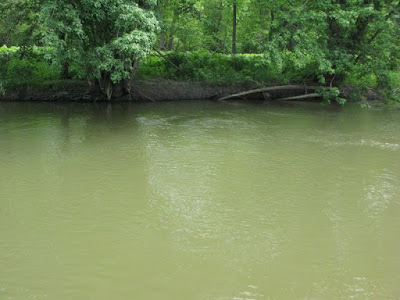
We decided to try out the river, even though we knew it was too cool yet to really get far. Upper thigh depth seemed to be the prudent place to stop. P-Doug did find a fallen tree that was just exactly positioned to allow him to sit but not get too immersed in the cool water; I reclined on the bank. The bank itself was clay that would support us in some places, but swallow us to the knees in others. I developed a habit of crawling, which seemed to work far better than having to step, sink, haul myself out, and repeat over and over. We covered the place in footprints before we settled back to just enjoy the place.


After a while, we got hungry and wandered back to where we'd left all our stuff and took on the tuna and cracker snack packs he'd brought with him, and the navel oranges. P-Doug had seen evidence of a previous visitor, probably a local fisherman, and he told the sort of tale Tonto might have told the Lone Ranger as he interpreted the missteps, falls, and foibles he read in the clay. After we'd been there an hour and a half or so, we washed in the river, suited up, and prepared ourselves to run the gauntlet of stinging nettles, smothering grasses, tripping hazards, mosquito clouds, and camera-eating fords again. He picked a course that was mercifully sparse of stinging nettles, and off we went.


The trip back seemed considerably shorter to me than the trip down. I think I enjoyed it more. I measured it all out this morning and it was about two-and-a-quarter miles, about half of it the most challenging course I think we've undertaken. But it's exactly what I miss whenever the weather gets cold. So here's to summer.

Seen from above, the road looks very open. Even with the trees crowding in, there's a definite space between them. And the road was, indeed, unmistakable nearly all the way down. But it wasn't really what I expected.
It was a bit after noon when we arrived. We parked at the end of the maintained road. We probably could have driven further, but first all, we came for the hike, and secondly, I really didn't want to bust an axel or something just to save ten minutes of walking. The road continued on down between two fields, till it came at last to a thick forest. It was overcast, so I wasn't all that concerned about the sun, but given that we were heading into wetlands, we got well set-up with bug repellent as we set out.


The forest trail was blocked off by a steel gate to keep out ATVs (thank you!!), but the way was also strewn with fallen trees every so often that would have made the trip impossible for them... some of them were troublesome even on foot. And they would have had to stay scrupulously on the trail. The nature of the road was unlike any I'd seen before. It was cut through a swamp reminiscent of things I've seen of the Everglades or the bayou in Louisiana. It had obviously been artificially raised above the swamp, with culverts cut into it that the swamp itself had seen fit to supersede with its own methods of transference over time. P-Doug was particularly impressed with what he called the high water marks on the trunks of the trees; they were at eye-height for us, even standing on the road.


As I said, there were a number of places where the swamp had taken it upon itself to balance the water on either side of the road. There were so many fords of water, streaming northeasterly, that I lost count of them. Six, maybe seven, and every one of them different in some aspect. Some were simply one foot in, one foot out; others were fifty feet wide. Some were deep with slippery clay bottoms; others were rafts of plants where I barely got my ankles wet. They were all a challenge, and one I would have delighted in wholly if it were not for the fact that I was carrying two of my cameras with me... and one of them had already been expensively repaired last fall after getting soaked in the Grand River. Otherwise I wouldn't have cared much at all about falling in. But as it was, I was concerned about the cameras, so I put them in the backpack for what little protection that would offer; at least they wouldn't be out, swinging around to potentially put me off-balance.


The road surface changed enormously as we went. It started off as dry gravel, became soft grass, and then in the forest, cool clay and earth. There were places where it was running wet. Mosquitoes were around, but they didn't seem really pronounced until we came to the strangest part of the road of all – completely overgrown with grasses, and ones that grew taller and thicker the further we went. In these places, great swarms of mosquitoes emerged to challenge us for our blood. Most were dissuaded by the bug spray, and those that weren't were often martyred to a quick slap. Even though they largely left us alone, the whining in the ears was highly disconcerting.


The grass on the road was so thick and full that I started wondering if we'd even know the river when we saw it, or would just fall in! Finally I could sunlit trees beyond the gloomy ones, and I knew we'd reached the river. But nature wasn't done with making it tricky yet. We encountered our big nemesis of the past couple of summers there as we approached the water's edge – stinging nettles. These saw-edged, stinging plants that are sheer torture. The slightest contact with them is like having a sharp blade run against your skin, combined with an itch. They really seem to concentrate near the edge of rivers, so for us, the last minute or two of getting to the Nottawasga was an ordeal that the mosquitoes couldn't hold a tiny candle to. They were raking my feet, my shins, my hands when I'd try to brush them aside. And just as we reached the river, we realized we were at the edge of a steep bank... with a very nice broad bank about fifty feet away to our right... through more of the forest. What could we do? We fought on through the nettles and finally reached the bank... where we stood on the clay, panting and cursing and waiting for the pain to subside.
This part of the river was strewn with old fallen trees and logs. There were plenty of places to sit down, so we did. We could finally look around. For all the trouble it took to get to it, it was glorious, and I got to see all the things I really love to see on these hikes. Everything natural. We had the river, places to sit, the bank to wander, the trees all around, and a sky that was first sheltering and then opened up the sun to us when we were ready to receive it.


We decided to try out the river, even though we knew it was too cool yet to really get far. Upper thigh depth seemed to be the prudent place to stop. P-Doug did find a fallen tree that was just exactly positioned to allow him to sit but not get too immersed in the cool water; I reclined on the bank. The bank itself was clay that would support us in some places, but swallow us to the knees in others. I developed a habit of crawling, which seemed to work far better than having to step, sink, haul myself out, and repeat over and over. We covered the place in footprints before we settled back to just enjoy the place.


After a while, we got hungry and wandered back to where we'd left all our stuff and took on the tuna and cracker snack packs he'd brought with him, and the navel oranges. P-Doug had seen evidence of a previous visitor, probably a local fisherman, and he told the sort of tale Tonto might have told the Lone Ranger as he interpreted the missteps, falls, and foibles he read in the clay. After we'd been there an hour and a half or so, we washed in the river, suited up, and prepared ourselves to run the gauntlet of stinging nettles, smothering grasses, tripping hazards, mosquito clouds, and camera-eating fords again. He picked a course that was mercifully sparse of stinging nettles, and off we went.


The trip back seemed considerably shorter to me than the trip down. I think I enjoyed it more. I measured it all out this morning and it was about two-and-a-quarter miles, about half of it the most challenging course I think we've undertaken. But it's exactly what I miss whenever the weather gets cold. So here's to summer.

Wednesday, June 10, 2009
I Buried Star Trek
Warning: spoilers.
I must be the only person on Earth who didn't think much of the new Star Trek movie. But, okay, I'll say it – I don't. The more time goes by, the less I like it.
I went in there expecting... well, hoping for... a look back at the characters we've all known and loved since before most of us were born. I anticipated young actors, steeped in the history of the show, working with reverence and love to really nail their parts, to put in performances that were tributes to the older actors who laid the groundwork in the 60s, and beyond. But we didn't get anything like that.
I'd heard through the grapevine that the movie was actually going to be an "alternate history". I was disappointed to hear that, because I knew that was Klingonese for "we're going to disregard anything inconvenient in the timeline you love to free ourselves to do whatever strikes us as cool". But, I had similar feelings when they started ST:TNG and the other spin-offs, and yet I found something to admire in every one of them (yes, even Voyager – now stop interrupting). What I mean is, I tried to go in with an open mind.
But they were throwing interstellar babies out with the galactic bathwater right from blast-off. What's the first thing that happens? Kirk's father dies. Now, I'm not the shrewdest guy in the world at picking upon where a plotline's heading, but even I got the message being telescoped here: Jim Kirk's going to be the Archetypal Troubled Kid (trademark, patent pending). You could smell it coming like a Ferrengi. And Kirk was born in space... not Iowa, as we heard time and time again in the TV spots for Star Trek IV... as well as from anyone you've ever met from Iowa (the rebuttal is, of course, "Yeah, but Bill Shatner was born in Canada!"). And I happen to remember that Jim Kirk had a brother named Sam who died in that episode of ST:TOS with the giant flying brain cells. So in the first three minutes of the movie, they had basically told me, "Oh, that guy you loved watching on TV as a kid? He doesn't exist. We've replaced him with this guy." Yeah, a smug, arrogant asshole. The traditional Jim Kirk was self-confident and kind of a pussy hound, but he was almost never what you'd call insufferable. But the one in the movie was. He was the guy in high school you just wanted to pound in the face with a stop sign so at least he'd get the message, one way or the other. I COULD NOT STAND THIS GUY AND WANTED HIM TO DIE... BADLY. Now is that any way to feel about Jim Kirk?
Scotty was completely someone else. I've liked Simon Pegg in the things I've seen him in... loved him Shaun of the Dead, and in Hot Fuzz (till it completely went off the rails half way through and started thinking it was The Wicker Man). But he just was not the Scotty I cared about. Scotty had his quirks, but he oozed professionalism and even a certain degree of stubborn, bullheaded military decorum. This Scotty was an anarchistic, addle-minded, goofy fuck-up with just enough brilliance to get by. He was almost the anti-Scotty.
Leonard McCoy was at least... well, you could glean where it was coming from. He seemed to have his roots in the original character. They never said much about Bones's past, but I still don't get the feeling it was as wild as they put it out to be. That seemed forced. He also seemed too old. He came across as being about 40, when Kirk was barely into his 20s. If there was a ten-year gap between their ages in ST:TOS, I'd be surprised.
Now Spock, on the other hand... his portrayal was for me the only really redeeming feature of the movie. I thought it was spot-on. The new version looked like Spock, acted like Spock (even the kid version had me nodding, yeah, that's him), sounded like Spock... yeah, he was Spock. That one they got right, and really nicely, too. Even so... Spock and Uhura?? Okay, I won't say "no way", but it feels really out of character for Spock, and gratuitous as well. Spock's had romances with human women, but... why another member of the bridge crew? Like we can't see where this is taking us in one of the inevitable upcoming sequels...
So I was largely disappointed in the (mis)treatment of the characters. But where they really lost me is when they blew up Vulcan. This is like doing a retelling of the American Revolution in which the British nuke Philadelphia and kill off poor Ben Franklin, just to make you FEEL something. And it worked: I felt fucking angry — at them. To be honest, once they did that, they'd crossed the line. This was not Star Trek... this was your hyperactive cousin's version of Star Trek on the living room rug, just before he crowns you with the fire engine that's standing in for a Romulan Bird of Prey. After that, I didn't give a shit what they did in the movie anymore. I'd checked out. I was just sitting there because I'd A) paid twelve bucks for the privilege and B) was there with a friend. Otherwise, I honestly think I would have been inclined to walk out.
To me, the overall sensation I have coming away from it is that it was hollow. Far too much history was packed into far too little movie. Kirk went up the ladder faster than Derek Wildstar in Star Blazers, which was laughable even when I was nine — and that was a cartoon. Forgive me for thinking one or two movies about Ensign Kirk that show him learning his craft instead of being born to it might have been preferable. But people don't have time for that these days. Hatch the Kirk, let it dry its wings, then get it killing people! Yeah!
Puke.
I won't be attending any of the sequels. If I skip the next two, twenty-four bucks buys a bottle of hooch I can use to forget about the first one for a while...
I must be the only person on Earth who didn't think much of the new Star Trek movie. But, okay, I'll say it – I don't. The more time goes by, the less I like it.
I went in there expecting... well, hoping for... a look back at the characters we've all known and loved since before most of us were born. I anticipated young actors, steeped in the history of the show, working with reverence and love to really nail their parts, to put in performances that were tributes to the older actors who laid the groundwork in the 60s, and beyond. But we didn't get anything like that.
I'd heard through the grapevine that the movie was actually going to be an "alternate history". I was disappointed to hear that, because I knew that was Klingonese for "we're going to disregard anything inconvenient in the timeline you love to free ourselves to do whatever strikes us as cool". But, I had similar feelings when they started ST:TNG and the other spin-offs, and yet I found something to admire in every one of them (yes, even Voyager – now stop interrupting). What I mean is, I tried to go in with an open mind.
But they were throwing interstellar babies out with the galactic bathwater right from blast-off. What's the first thing that happens? Kirk's father dies. Now, I'm not the shrewdest guy in the world at picking upon where a plotline's heading, but even I got the message being telescoped here: Jim Kirk's going to be the Archetypal Troubled Kid (trademark, patent pending). You could smell it coming like a Ferrengi. And Kirk was born in space... not Iowa, as we heard time and time again in the TV spots for Star Trek IV... as well as from anyone you've ever met from Iowa (the rebuttal is, of course, "Yeah, but Bill Shatner was born in Canada!"). And I happen to remember that Jim Kirk had a brother named Sam who died in that episode of ST:TOS with the giant flying brain cells. So in the first three minutes of the movie, they had basically told me, "Oh, that guy you loved watching on TV as a kid? He doesn't exist. We've replaced him with this guy." Yeah, a smug, arrogant asshole. The traditional Jim Kirk was self-confident and kind of a pussy hound, but he was almost never what you'd call insufferable. But the one in the movie was. He was the guy in high school you just wanted to pound in the face with a stop sign so at least he'd get the message, one way or the other. I COULD NOT STAND THIS GUY AND WANTED HIM TO DIE... BADLY. Now is that any way to feel about Jim Kirk?
Scotty was completely someone else. I've liked Simon Pegg in the things I've seen him in... loved him Shaun of the Dead, and in Hot Fuzz (till it completely went off the rails half way through and started thinking it was The Wicker Man). But he just was not the Scotty I cared about. Scotty had his quirks, but he oozed professionalism and even a certain degree of stubborn, bullheaded military decorum. This Scotty was an anarchistic, addle-minded, goofy fuck-up with just enough brilliance to get by. He was almost the anti-Scotty.
Leonard McCoy was at least... well, you could glean where it was coming from. He seemed to have his roots in the original character. They never said much about Bones's past, but I still don't get the feeling it was as wild as they put it out to be. That seemed forced. He also seemed too old. He came across as being about 40, when Kirk was barely into his 20s. If there was a ten-year gap between their ages in ST:TOS, I'd be surprised.
Now Spock, on the other hand... his portrayal was for me the only really redeeming feature of the movie. I thought it was spot-on. The new version looked like Spock, acted like Spock (even the kid version had me nodding, yeah, that's him), sounded like Spock... yeah, he was Spock. That one they got right, and really nicely, too. Even so... Spock and Uhura?? Okay, I won't say "no way", but it feels really out of character for Spock, and gratuitous as well. Spock's had romances with human women, but... why another member of the bridge crew? Like we can't see where this is taking us in one of the inevitable upcoming sequels...
So I was largely disappointed in the (mis)treatment of the characters. But where they really lost me is when they blew up Vulcan. This is like doing a retelling of the American Revolution in which the British nuke Philadelphia and kill off poor Ben Franklin, just to make you FEEL something. And it worked: I felt fucking angry — at them. To be honest, once they did that, they'd crossed the line. This was not Star Trek... this was your hyperactive cousin's version of Star Trek on the living room rug, just before he crowns you with the fire engine that's standing in for a Romulan Bird of Prey. After that, I didn't give a shit what they did in the movie anymore. I'd checked out. I was just sitting there because I'd A) paid twelve bucks for the privilege and B) was there with a friend. Otherwise, I honestly think I would have been inclined to walk out.
To me, the overall sensation I have coming away from it is that it was hollow. Far too much history was packed into far too little movie. Kirk went up the ladder faster than Derek Wildstar in Star Blazers, which was laughable even when I was nine — and that was a cartoon. Forgive me for thinking one or two movies about Ensign Kirk that show him learning his craft instead of being born to it might have been preferable. But people don't have time for that these days. Hatch the Kirk, let it dry its wings, then get it killing people! Yeah!
Puke.
I won't be attending any of the sequels. If I skip the next two, twenty-four bucks buys a bottle of hooch I can use to forget about the first one for a while...
Monday, June 08, 2009
Fusebox magic copier?
I had this weird dream this morning about moving things around in the basement of the house I used to live in a long time ago. There was someone there with me, but I don't know who. I wasn't even quite me, if you know what I mean. Anyway, there was this fuse box sort of in the middle of the floor, and we realized that anything you leaned up against it, you could get it to make copies of for you. We were doing this with small appliances, things like cell phones and laptop computers and that kind of thing. We tried it with a grandfather clock, but the copies we got were half-assed, like only partially varnished, with parts missing from the face, or with some of the gearworkings missing. That's about all I remember. Oddly enough, when I was dwelling on it getting ready for work this morning, I realized that this probably meant there were limits to how big or extensive the object to be copied could be. I know it sounds trivial, but it just seemed so weird to be working out the dream logic while I was awake, rather than in the course of the dream. I think it might make a good basis for some kind of story, if I can work out what the gimmick is.
Sunday, May 31, 2009
The things you hear when there's nobody around...
I'm here at work on a Sunday because there are things I need to get out of the way, and I'm listening to an online instrumental jazz station. Every so often, they run an ad. I just heard one for — believe it or not — the CIA. They just ran an ad for the US Central Intelligence Agency. I always thought these guys recruited by watching the universities for signs of brainiacism or something. But radio ads aimed at upright, pipe-smoking, slipper-wearing William F. Buckley types? No wonder the collapse of the Soviet Union came as such a surprise. :)
Wednesday, May 27, 2009
McKinnon at last
P-Doug and I have been intending to make a trek up a closed road called McKinnon Road since early this spring. It’s a bit west of Barrie and runs alongside the Nottawasaga River. We actually undertook the trip early in April, but the weather was against us. By the time we got there, it was actually snowing! Pretty much every weekend since then that it’s been proposed, the weather’s been cold and wet. Finally, this weekend past, we got decent weather and gave it a shot on Sunday.
P-Doug picked me up a little after 10 in the morning, and we were at the end of the driveable road a bit before noon. That in and of itself is further than we got last time, when the road just beyond the pavement was flooded and closed to cars.
It wasn’t a promising start. Immediately after the closure of the road was a huge, swampy puddle, and visible beyond that was another. Much as I enjoy wet, soft soil underfoot on our explorations, even I thought that a mile or more of that would be slow going and not very enjoyable. Nevertheless, we decided to give it a go. I was on the point of tucking my sandals into the cargo pocket of my shorts, but at the last moment I elected to leave them in the car and undertake the trek without recourse to them, come what may.


The further we went, the more amenable the path became. We emerged from the swampiness after about twenty minutes. We saw some interesting things… a patch of trees standing in water that reminded us of the Louisiana bayou, where P-Doug spotted a raccoon washing some grub and then swimming away… snowmobile paths marked off with tall orange stakes… a couple of guys speaking French as they sat beside the river, possibly fishing (they were the only other people we actually saw that day, though there were plenty of boot prints on the path)...

We took out time, but after about an hour, we saw one of the things we’d really come to see. It was a bridge we’d seen in the Google Maps shots of the river. In those pictures, it seemed to both of us, we were looking at a crude wooden structure… something so rudimentary it seemed certain to me to be something private and long abandoned. Imagine our amazement when we found, instead, an elaborate and gorgeous steel bridge! Still in fine condition, with an intact concrete roadbed and aluminum paint, it seemed almost hilariously out of place, serving a road that by now is barely discernible even in aerial photos.


When we stood on it, P-Doug noticed that it had a rare feature: in the concrete along the north side was written the name of the bridge, the date of its construction (September, 1927), and the names of the men responsible for its construction. It was a rare, precise, personal connection with the past. Why it was built to serve a road in such a place with such hopeless drainage and unlikely future, we can only guess. But it was, and it seems a real shame it stands there alone, essentially useless.


We walked a little beyond it. We saw what looked like the remnants of the pillars of someone’s driveway gate. We shot the beautiful bend of the river, and then began our way back. Just east of the river, I broke off from P-Doug for a moment to try to reach the sandy banks. Stinging nettles finally defeated me and I came back to my friend on the bridge. We lingered for a bit, and then retraced our course.


I hope we go back. It really was a lovely, variable place, full of interesting sights and possibilities. Furthermore, for me, it was a fantastic hike, three hours and at least as many miles over just about every imaginable surface: swamp, mud, rocky streams, clay, sand, grass, forest floor, ferns, concrete… In Germany and Austria, they have the institution of “barefoot parks”. The idea behind them is related to reflexology, and in practical terms, they give people a chance to explore nature and its textures by walking barefoot over and through it. They seem a bit contrived to me. McKinnon Road, on the other hand, I think would serve that purpose magnificently, and naturally, without any sort of embellishment. If you’re amenable to that sort of hiking, and I know there are others who are, I’d encourage you to give McKinnon Road a try on some warm day.
P-Doug picked me up a little after 10 in the morning, and we were at the end of the driveable road a bit before noon. That in and of itself is further than we got last time, when the road just beyond the pavement was flooded and closed to cars.
It wasn’t a promising start. Immediately after the closure of the road was a huge, swampy puddle, and visible beyond that was another. Much as I enjoy wet, soft soil underfoot on our explorations, even I thought that a mile or more of that would be slow going and not very enjoyable. Nevertheless, we decided to give it a go. I was on the point of tucking my sandals into the cargo pocket of my shorts, but at the last moment I elected to leave them in the car and undertake the trek without recourse to them, come what may.


The further we went, the more amenable the path became. We emerged from the swampiness after about twenty minutes. We saw some interesting things… a patch of trees standing in water that reminded us of the Louisiana bayou, where P-Doug spotted a raccoon washing some grub and then swimming away… snowmobile paths marked off with tall orange stakes… a couple of guys speaking French as they sat beside the river, possibly fishing (they were the only other people we actually saw that day, though there were plenty of boot prints on the path)...

We took out time, but after about an hour, we saw one of the things we’d really come to see. It was a bridge we’d seen in the Google Maps shots of the river. In those pictures, it seemed to both of us, we were looking at a crude wooden structure… something so rudimentary it seemed certain to me to be something private and long abandoned. Imagine our amazement when we found, instead, an elaborate and gorgeous steel bridge! Still in fine condition, with an intact concrete roadbed and aluminum paint, it seemed almost hilariously out of place, serving a road that by now is barely discernible even in aerial photos.


When we stood on it, P-Doug noticed that it had a rare feature: in the concrete along the north side was written the name of the bridge, the date of its construction (September, 1927), and the names of the men responsible for its construction. It was a rare, precise, personal connection with the past. Why it was built to serve a road in such a place with such hopeless drainage and unlikely future, we can only guess. But it was, and it seems a real shame it stands there alone, essentially useless.


We walked a little beyond it. We saw what looked like the remnants of the pillars of someone’s driveway gate. We shot the beautiful bend of the river, and then began our way back. Just east of the river, I broke off from P-Doug for a moment to try to reach the sandy banks. Stinging nettles finally defeated me and I came back to my friend on the bridge. We lingered for a bit, and then retraced our course.


I hope we go back. It really was a lovely, variable place, full of interesting sights and possibilities. Furthermore, for me, it was a fantastic hike, three hours and at least as many miles over just about every imaginable surface: swamp, mud, rocky streams, clay, sand, grass, forest floor, ferns, concrete… In Germany and Austria, they have the institution of “barefoot parks”. The idea behind them is related to reflexology, and in practical terms, they give people a chance to explore nature and its textures by walking barefoot over and through it. They seem a bit contrived to me. McKinnon Road, on the other hand, I think would serve that purpose magnificently, and naturally, without any sort of embellishment. If you’re amenable to that sort of hiking, and I know there are others who are, I’d encourage you to give McKinnon Road a try on some warm day.
Thursday, May 14, 2009
The province of Turks and Caicos?
This is from the March 2nd, 2009 issue of The Ottawa Citizen. I've been hearing about this proposal since I was in high school. We want it, they seem to want it... why does it never bloody happen? Nova Scotia's legislature even passed a vote, in 2004, to let the Turks and Caicos join that province if they ever join Confederation, sidestepping the unanimity requirement for new provinces in the Constitution (besides, with a population of only 30,000, it's unlikely the Turks and Caicos could actually form a viable province on their own).
Read on...
-----------------------------------------
The province of Turks and Caicos?
MP champions special ties with Caribbean nation to boost trade, ability to deliver aid
By Donna Jacobs, Citizen Special
March 2, 2009
Suppose Canada built itself a deep-water port in the turquoise waters of the Caribbean.
Suppose that port opened up a new market for Canadian goods -- more than 120 million people live in the Caribbean and nearby Central and South America.
Suppose Canada enhanced the port with a regional free trade zone.
Suppose Canadian ships carried northward duty-free tropical produce and products from the Caribbean and Latin America. In some locations, food rots for lack of shipping and export markets.
Suppose these ships returned with Canadian durable goods -- now scarce on southern shelves.
Suppose the port, unaffordable for Caribbean countries, boosted their standard of living and bolstered hemispheric security.
Suppose the port doubled as a Canadian military operations base for countries wanting help to patrol their waters and to interdict the Caribbean's robust trade in smuggled arms, drugs and people.
Suppose Canada used the port as an aid base when hurricanes strike.
Suppose Canada fills a vacuum of influence where China, Cuba and -- bolstered by Iran -- Venezuela have stepped in with medical aid, cheap petroleum, schools and factory construction.
Suppose Canada did all this with its usual low-key, good-cop approach to world politics and regional strife, drawing on the goodwill that comes from its 100-year trading relationship in the Caribbean. (Canada's direct investment holdings in the Caribbean-Latin American market in 2007 totalled $87.2 billion.)
For years, Edmonton East Conservative MP Peter Goldring has been campaigning for this all-purpose "Canadian platform" on South Caicos Island. The Turks and Caicos lie north of the Dominican Republic and Haiti.
In the 1970s, Turks and Caicos knocked on Canada's front door.
The English-speaking nation asked to become Canada's 11th province. It was ultimately turned down. Strange in today's multicultural Canada, says Mr. Goldring, but concerns over racial and cultural integration figured in the decision.
In the late 1980s, with some 90 per cent of their population in favour, Turks and Caicos asked again for a "special relationship" with Canada. In 2003, with 60 per cent in favour, Turks and Caicos renewed its request.
The Turks and Caicos -- comprised of two groups of islands -- are independent, but remain a British overseas territory.
For many Canadians -- and everyone else -- Caribbean life is a beach holiday. But, says Mr. Goldring quietly, "the Caribbean can get away on itself, if you do not give it care and attention."
- - -
Indeed, he's taken a lot of kidding for championing the Turks and Caicos -- similar to Edmonton in distance from Ottawa -- as a Canadian territory.
"I'm concerned that the idea is being taken too lightly," he says. "People find a lot of humour in it."
Skeptics are concerned over the prospect of massive migration from the Caribbean or the risk that winter-weary Canadians would overwhelm the islands. Mr. Goldring says both concerns can be handled -- think of Hawaii and the U.S. or of Quebec's provincially-tailored immigration standards.
And the port proposal is not merely a matter for Turks and Caicos. Ambassadors to Canada from Barbados and Cuba, and politicians in Dominica and St. Lucia, have championed more deep-water trade with Halifax which, he says, after touring the Halifax port, has "lots of capacity."
Historically, he adds, two Canadian ships used to ply between the islands. And though Canada's presence has diminished, it staged its Haiti-bound UN troops in 2004 through Turks and Caicos.
"We could have an aid program, a DART unit, an emergency aid unit. I visited Granada after Hurricane Ivan came through and it was very evident we didn't have the capacity to help."
He's visited some 10 Caribbean countries over the years. In Haiti, he toured the Montreal-based Gildan Activewear plant, which pays about 5,000 people double the minimum wage to produce clothing.
In a post-9/11 world, now contracting with global recession, he says, Canada needs to realign its trading routes and methods.
"Too much attention has been focused on the Asian Giant," he says. "And it's getting harder to get products into the U.S. We should be looking at other alternatives."
Mr. Goldring's focus dovetails with Prime Minister Stephen Harper's policy, reinvigorated with last week's announcement of more Canadian aid, more trade and further political co-operation with the Caribbean and Latin America.
Foreign Affairs Minister Lawrence Cannon just returned from Brazil. Peter Kent, minister of state of Foreign Affairs for the Americas, just returned from Guyana, Suriname and Trinidad and Tobago, host of the Summit of the Americas in April.
Beyond Canada's burgeoning trade in the region, the Caribbean has strategic importance, Mr. Goldring says: "You have to be aware of what potentially could go wrong if places like Venezuela and Cuba were forced to align themselves with Communist China.
"Canada gives aid money to China (CIDA gave $37.2 million to Chinese organizations in 2008) and China turns around and builds the schools and hospitals and sports stadia -- with their name on it -- in the Caribbean," he says. "So we have to shake our head, because that is hugely influential."
In recent years, China built a duty-free zone in St. Lucia. (The island turned to Taiwan for help in 2007, angering China and halting its hospital construction.) And in Guyana, China built the headquarters of CARICOM, the Caribbean common market, along with a convention centre.
Canada's friendship with Cuba also carries strategic benefit. While Canada "walks a line with the U.S.," which has a trade embargo on the island, the U.S. appreciates Canada "as a stabilizing element," says Mr. Goldring
"When I visited Cuba two years ago, the Cuban people said, in no uncertain terms, that they believe they're still at war with the U.S. while Canadians are very, very well-liked."
As for the military, he says the Canadian Forces sends a frigate to the Caribbean for annual military manoeuvres, making a regional base there useful.
Mr. Goldring is right: Canada does need to take the Caribbean more seriously.
Read on...
-----------------------------------------
The province of Turks and Caicos?
MP champions special ties with Caribbean nation to boost trade, ability to deliver aid
By Donna Jacobs, Citizen Special
March 2, 2009
Suppose Canada built itself a deep-water port in the turquoise waters of the Caribbean.
Suppose that port opened up a new market for Canadian goods -- more than 120 million people live in the Caribbean and nearby Central and South America.
Suppose Canada enhanced the port with a regional free trade zone.
Suppose Canadian ships carried northward duty-free tropical produce and products from the Caribbean and Latin America. In some locations, food rots for lack of shipping and export markets.
Suppose these ships returned with Canadian durable goods -- now scarce on southern shelves.
Suppose the port, unaffordable for Caribbean countries, boosted their standard of living and bolstered hemispheric security.
Suppose the port doubled as a Canadian military operations base for countries wanting help to patrol their waters and to interdict the Caribbean's robust trade in smuggled arms, drugs and people.
Suppose Canada used the port as an aid base when hurricanes strike.
Suppose Canada fills a vacuum of influence where China, Cuba and -- bolstered by Iran -- Venezuela have stepped in with medical aid, cheap petroleum, schools and factory construction.
Suppose Canada did all this with its usual low-key, good-cop approach to world politics and regional strife, drawing on the goodwill that comes from its 100-year trading relationship in the Caribbean. (Canada's direct investment holdings in the Caribbean-Latin American market in 2007 totalled $87.2 billion.)
For years, Edmonton East Conservative MP Peter Goldring has been campaigning for this all-purpose "Canadian platform" on South Caicos Island. The Turks and Caicos lie north of the Dominican Republic and Haiti.
In the 1970s, Turks and Caicos knocked on Canada's front door.
The English-speaking nation asked to become Canada's 11th province. It was ultimately turned down. Strange in today's multicultural Canada, says Mr. Goldring, but concerns over racial and cultural integration figured in the decision.
In the late 1980s, with some 90 per cent of their population in favour, Turks and Caicos asked again for a "special relationship" with Canada. In 2003, with 60 per cent in favour, Turks and Caicos renewed its request.
The Turks and Caicos -- comprised of two groups of islands -- are independent, but remain a British overseas territory.
For many Canadians -- and everyone else -- Caribbean life is a beach holiday. But, says Mr. Goldring quietly, "the Caribbean can get away on itself, if you do not give it care and attention."
- - -
Indeed, he's taken a lot of kidding for championing the Turks and Caicos -- similar to Edmonton in distance from Ottawa -- as a Canadian territory.
"I'm concerned that the idea is being taken too lightly," he says. "People find a lot of humour in it."
Skeptics are concerned over the prospect of massive migration from the Caribbean or the risk that winter-weary Canadians would overwhelm the islands. Mr. Goldring says both concerns can be handled -- think of Hawaii and the U.S. or of Quebec's provincially-tailored immigration standards.
And the port proposal is not merely a matter for Turks and Caicos. Ambassadors to Canada from Barbados and Cuba, and politicians in Dominica and St. Lucia, have championed more deep-water trade with Halifax which, he says, after touring the Halifax port, has "lots of capacity."
Historically, he adds, two Canadian ships used to ply between the islands. And though Canada's presence has diminished, it staged its Haiti-bound UN troops in 2004 through Turks and Caicos.
"We could have an aid program, a DART unit, an emergency aid unit. I visited Granada after Hurricane Ivan came through and it was very evident we didn't have the capacity to help."
He's visited some 10 Caribbean countries over the years. In Haiti, he toured the Montreal-based Gildan Activewear plant, which pays about 5,000 people double the minimum wage to produce clothing.
In a post-9/11 world, now contracting with global recession, he says, Canada needs to realign its trading routes and methods.
"Too much attention has been focused on the Asian Giant," he says. "And it's getting harder to get products into the U.S. We should be looking at other alternatives."
Mr. Goldring's focus dovetails with Prime Minister Stephen Harper's policy, reinvigorated with last week's announcement of more Canadian aid, more trade and further political co-operation with the Caribbean and Latin America.
Foreign Affairs Minister Lawrence Cannon just returned from Brazil. Peter Kent, minister of state of Foreign Affairs for the Americas, just returned from Guyana, Suriname and Trinidad and Tobago, host of the Summit of the Americas in April.
Beyond Canada's burgeoning trade in the region, the Caribbean has strategic importance, Mr. Goldring says: "You have to be aware of what potentially could go wrong if places like Venezuela and Cuba were forced to align themselves with Communist China.
"Canada gives aid money to China (CIDA gave $37.2 million to Chinese organizations in 2008) and China turns around and builds the schools and hospitals and sports stadia -- with their name on it -- in the Caribbean," he says. "So we have to shake our head, because that is hugely influential."
In recent years, China built a duty-free zone in St. Lucia. (The island turned to Taiwan for help in 2007, angering China and halting its hospital construction.) And in Guyana, China built the headquarters of CARICOM, the Caribbean common market, along with a convention centre.
Canada's friendship with Cuba also carries strategic benefit. While Canada "walks a line with the U.S.," which has a trade embargo on the island, the U.S. appreciates Canada "as a stabilizing element," says Mr. Goldring
"When I visited Cuba two years ago, the Cuban people said, in no uncertain terms, that they believe they're still at war with the U.S. while Canadians are very, very well-liked."
As for the military, he says the Canadian Forces sends a frigate to the Caribbean for annual military manoeuvres, making a regional base there useful.
Mr. Goldring is right: Canada does need to take the Caribbean more seriously.
Tuesday, May 12, 2009
Ireland Park, Toronto
Matching a set of Rowan Gillespie's statues in Dublin, called "The Departure", this set in Toronto, called "The Arrival", commemorates the 38,000 Irish famine emigrants who arrived here in Toronto in 1847, at the foot of Bathurst Street, at what is now called Eireann Quay. The park was opened by Irish President Mary McAleese in 2007.
Wednesday, May 06, 2009
She's leaving
For nearly three and a half years now, I've lived in a house with a strong roof. No matter what kind of storm was going on high over my head, the torrent was funneled down a gutter to a rain barrel, where it was organized, useful, and all that chaos made sense. It was a good place to be.
My boss has resigned, effective near the end of the month. I'm losing that roof, the shelter, the way things came down making sense. I'm not looking forward to it.
She's got good reasons to go. Better than the garden variety, 'better opportunity' reasons you get 95% of the time. I can't fault her. I'm just depressed that it has to be this way. But it does.
There was a lot of patience, and a lot of learning. I came in here thinking I pretty much knew all there was to know about my job. I spent the first year messing up – barely even aware I was messing up – and didn't do well on my first review. But she took it upon herself to teach me the skills I needed to be more professional. I don't think I ever got proficient, but I'm better than I was. I check things now, I search deeper, I go back over things. Stuff still slips through the cracks, but a lot doesn't – I know, because I'm the one finding those mistakes. Anyway, I'm more aware now, and she's to thank for that.
I feel like I'm losing a friend. People can stay in touch, I know, but work was really what we had in common, and I'm not sure how to maintain that now. We didn't do much outside work... she was my boss, I was her report; there had to be some kind of distance just to maintain the working relationship. But still, there was more to it. I hadn't realized, quite, how much I looked forward to her coming in in the morning... how I tried to have one or two little things out of the way, just in case she asked. Even if we didn't chat long, she was here. Even if we only really went to lunch a few times a month, the option was there.
Most of what I found to look forward to in this place is going to disappear, and it's going to be what downstairs was... a job, in a sea of familiar-looking strangers. Part of the sense of home I've had here is going to disappear.
There are new opportunities, and maybe I will grow accustomed to them, and even eventually enjoy them. But I'm never going to like how they came about.
My boss has resigned, effective near the end of the month. I'm losing that roof, the shelter, the way things came down making sense. I'm not looking forward to it.
She's got good reasons to go. Better than the garden variety, 'better opportunity' reasons you get 95% of the time. I can't fault her. I'm just depressed that it has to be this way. But it does.
There was a lot of patience, and a lot of learning. I came in here thinking I pretty much knew all there was to know about my job. I spent the first year messing up – barely even aware I was messing up – and didn't do well on my first review. But she took it upon herself to teach me the skills I needed to be more professional. I don't think I ever got proficient, but I'm better than I was. I check things now, I search deeper, I go back over things. Stuff still slips through the cracks, but a lot doesn't – I know, because I'm the one finding those mistakes. Anyway, I'm more aware now, and she's to thank for that.
I feel like I'm losing a friend. People can stay in touch, I know, but work was really what we had in common, and I'm not sure how to maintain that now. We didn't do much outside work... she was my boss, I was her report; there had to be some kind of distance just to maintain the working relationship. But still, there was more to it. I hadn't realized, quite, how much I looked forward to her coming in in the morning... how I tried to have one or two little things out of the way, just in case she asked. Even if we didn't chat long, she was here. Even if we only really went to lunch a few times a month, the option was there.
Most of what I found to look forward to in this place is going to disappear, and it's going to be what downstairs was... a job, in a sea of familiar-looking strangers. Part of the sense of home I've had here is going to disappear.
There are new opportunities, and maybe I will grow accustomed to them, and even eventually enjoy them. But I'm never going to like how they came about.
Tuesday, May 05, 2009
Abandoned Ford Drive
Saturday morning, just for the grits and shins, I headed down to Oakville to shoot some more abandoned stretches over Joshua Creek. Many years ago, very early in the 90s, I had a penchant for studying maps of the GTA and I noticed a little gap in one of the roads, where it crossed a stream. When I went there, I found what I hoped I'd find: an old abandoned bridge, probably built in the 50s or 60s and abandoned in the 70s or 80s. I've blogged about it; it's here.
Just a little south of that, on what is actually the same road, there's another abandoned bridge over that same creek, and then another stretch just a few yards further south still. The first is recent enough that I can remember, vaguely, passing down that stretch early in the 90s. The other seems to have been officially out of action for a rather long time.
Named for the car plant it skirts, Ford Drive is more or less a southern extension of Ninth Line. When I got my license at the end of the 80s, it still cut straight south before making a gentle westerly swing to bridge Joshua Creek and then abruptly cross some railroad tracks and dive down Maple Grove Drive. Sometime in the 90s, it was rerouted to the east, completely avoiding the creek (and thus, abandoning the stretch with the bridge), and severing its connection with Maple Grove Drive, which now stops at the tracks and no longer crosses them – according the maps, anyway.
South of that stretch is another I noticed, with another bridge over Joshua Creek. I'm not 100% sure but I'm about 90% convinced that this was actually once the course of Royal Windsor Drive, back when it had a level crossing with those railroad lines. But that must have been a very long time ago. I have access to maps of that part of Oakville going back to 1970, and the huge bridge over the tracks that's there now was also already there back then. So this stretch must have been abandoned no later than when The Beatles were still sending hits up the charts; possibly earlier than that.
I explored the old stretch of (what I believe to be) Royal Windsor Drive first. It's still in surprisingly good shape; arguably, better than old Ford Drive, which hasn't even been off the grid 20 years yet. I think it's being routinely used to service the hydro lines and/or the rail tracks at its eastern end. Passing back, I saw a garter snake; the second snake I've seen in just a few weeks. Years and years go by between snake sightings for me. Maybe it's a good sign for the environment.
To get to old Ford Drive, I had to cross a few yards of marshy ground, but that was accomplished easily enough. I wandered up as far as I could, around the bend, to where Ford now has an upper parking lot that assumes what used to be the road. On my way back, I encountered a couple of dogs. One, a German shepherd, ran just about up to me before turning back. They both had collars and 'kerchiefs on, but I never saw or directly heard the person(s) I assume they must have been with... they turned around and headed back to someone; that's clear. Later I heard a few heavy twigs snap, and that's usually a good indication there's a human around. When I crossed back through the marsh to old Royal Windsor, I expected to see them all, but there was no one. It was weird.
A relatively minor excursion for me as these things go, but one I can now check off my list. :)
Just a little south of that, on what is actually the same road, there's another abandoned bridge over that same creek, and then another stretch just a few yards further south still. The first is recent enough that I can remember, vaguely, passing down that stretch early in the 90s. The other seems to have been officially out of action for a rather long time.
Named for the car plant it skirts, Ford Drive is more or less a southern extension of Ninth Line. When I got my license at the end of the 80s, it still cut straight south before making a gentle westerly swing to bridge Joshua Creek and then abruptly cross some railroad tracks and dive down Maple Grove Drive. Sometime in the 90s, it was rerouted to the east, completely avoiding the creek (and thus, abandoning the stretch with the bridge), and severing its connection with Maple Grove Drive, which now stops at the tracks and no longer crosses them – according the maps, anyway.
South of that stretch is another I noticed, with another bridge over Joshua Creek. I'm not 100% sure but I'm about 90% convinced that this was actually once the course of Royal Windsor Drive, back when it had a level crossing with those railroad lines. But that must have been a very long time ago. I have access to maps of that part of Oakville going back to 1970, and the huge bridge over the tracks that's there now was also already there back then. So this stretch must have been abandoned no later than when The Beatles were still sending hits up the charts; possibly earlier than that.
I explored the old stretch of (what I believe to be) Royal Windsor Drive first. It's still in surprisingly good shape; arguably, better than old Ford Drive, which hasn't even been off the grid 20 years yet. I think it's being routinely used to service the hydro lines and/or the rail tracks at its eastern end. Passing back, I saw a garter snake; the second snake I've seen in just a few weeks. Years and years go by between snake sightings for me. Maybe it's a good sign for the environment.
To get to old Ford Drive, I had to cross a few yards of marshy ground, but that was accomplished easily enough. I wandered up as far as I could, around the bend, to where Ford now has an upper parking lot that assumes what used to be the road. On my way back, I encountered a couple of dogs. One, a German shepherd, ran just about up to me before turning back. They both had collars and 'kerchiefs on, but I never saw or directly heard the person(s) I assume they must have been with... they turned around and headed back to someone; that's clear. Later I heard a few heavy twigs snap, and that's usually a good indication there's a human around. When I crossed back through the marsh to old Royal Windsor, I expected to see them all, but there was no one. It was weird.
A relatively minor excursion for me as these things go, but one I can now check off my list. :)
Sunday, May 03, 2009
Ellesmere Road 1952-2009
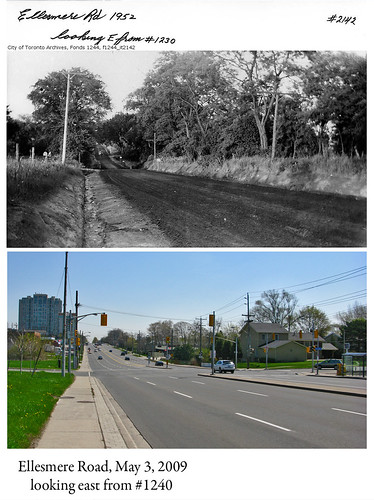
I was honestly slack-jawed when I saw the upper photo on the Toronto Public Library's website. If you're not familiar with Toronto, you probably won't think much of it... just a photo of a rural scene that's now urban Scarberia. But the thing is, Ellesemere Road is relatively mid-section in Toronto, and the view you see up top is the sort of thing I would have expected to see of the area from the 1920s or 1930s, not in the post-WWII boom. Not the way I imagined this part of town in the days of Leave It to Beaver.
The lower view is one I took this morning, from the same location, give or take a few yards. What was a farm fifty-some years ago is office space today, just off-screen to the left. Frankly, I'm not sure which view I prefer. They both have something to recommend them.
This one's for you, Jim. :)
Subscribe to:
Posts (Atom)