

I just picked up the latest issue of National Geographic. The cover article is about stem cell research. I only skimmed the article while I was in the check-out line, but what caught my attention was the "moral" opposition to the concept. The article pointed out that a five-day old fetus was smaller than the period at the end of the sentence that was making the point — and while it was printed at about 72 point size, it was still a dot smaller than an eighth of an inch — with no brain, no nervous system, no organs. There's no one "there" yet to feel pain or suffer. Yet some people are horrified.
These same people — or most of them, I'll wager — have no problem with other forms of suffering. Cows, sheep, pigs, even chickens, are all conscious beings who feel pain and fear. Evidence suggests they are distressed by the loss of their young, and their young by the loss of their parents; in other words, they mourn. Unfortunately, they're delicious, so our society stuffs them into pens where they can't turn around, tortures them with forced feedings, hormones, and antibodies, and as soon as it's feasible, kills them. They live, suffering in fear and pain, and die, all with barely a thought from us.
Meanwhile, at least — at least — 12,000 Iraqi civilians have been massacred by coalition forces since the invasion of Iraq began. Before that, half a million Iraqi children at least, by UN estimates not challenged by Madeleine Albright when they were put to her on 60 Minutes — have starved to death due to sanctions at the whim of Western nations. These were people who had brains, nervous systems, and organs. They were much more than mere dots at the end of a sentence, and yet their narratives were brought to a close with fiendish disregard.
But some people are going to save the world (although not the sufferers of any number of genetic diseases who might benefit) by banning stem cell research because it's inhumane, and an affront to human dignity.
Really.
Does a civilization so grossly hypocritcal as ours truly deserve to live?
Thursday, July 14, 2005

Tuesday, July 12, 2005
Through the looking glass
This is an absolutely brilliant, breathtaking statement from Gary Younge in July 11th's UK Guardian...
We know what took place. A group of people, with no regard for law, order or our way of life, came to our city and trashed it. With scant regard for human life or political consequences, employing violence as their sole instrument of persuasion, they slaughtered innocent people indiscriminately. They left us feeling unified in our pain and resolute in our convictions, effectively creating a community where one previously did not exist. With the killers probably still at large there is no civil liberty so vital that some would not surrender it in pursuit of them and no punishment too harsh that some might not sanction if we found them.
The trouble is there is nothing in the last paragraph that could not just as easily be said from Falluja as it could from London. The two should not be equated - with over 1,000 people killed or injured, half its housing wrecked and almost every school and mosque damaged or flattened, what Falluja went through at the hands of the US military, with British support, was more deadly. But they can and should be compared. We do not have a monopoly on pain, suffering, rage or resilience. Our blood is no redder, our backbones are no stiffer, nor our tear ducts more productive than the people in Iraq and Afghanistan. Those whose imagination could not stretch to empathise with the misery we have caused in the Gulf now have something closer to home to identify with. "Collateral damage" always has a human face: its relatives grieve; its communities have memory and demand action.
Read the article here.
Monday, July 11, 2005
The war on what, again?
This is interesting. I hadn't really thought of it this way.
In the aftermath of 9/11, writer Joan Didion critiqued "the wearying enthusiasm for excoriating anyone who suggested that it could be useful to bring at least a minimal degree of historical reference to bear on the event." Overwhelmingly, politicians and pundits were quick to get in a groove of condemning any sensible assertions "that events have histories, political life has consequences, and the people who led this country and the people who wrote and spoke about the way this country was led were guilty of trying to infantilize its citizens if they continued to pretend otherwise."...Read the rest here at CounterPunch.
Voices of reason, even when they've come from within the country's military establishment, have been shunted aside. In late November 2002, a retired U.S. Army general, William Odom, told C-SPAN viewers: "Terrorism is not an enemy. It cannot be defeated. It's a tactic. It's about as sensible to say we declare war on night attacks and expect we're going to win that war. We're not going to win the war on terrorism. And it does whip up fear. Acts of terror have never brought down liberal democracies. Acts of parliament have closed a few."
Faith, hope, and charity
Here’s a curious little thing that happened to me on Friday that I thought I should record while it’s still in my mind and the sense of wonder is still fresh.
Friday morning I decided to go down to the city archives to get the aerial photos you see in the Old Cummer Avenue posting. When I got to the end of the Allen (a.k.a., the ill-starred Spadina Expressway) at Eglinton, there was a young woman with a sign saying that she was in sincere need of help.
I don’t ordinarily carry cash. At all. None. Bad habit, I know, but by the time I was working seriously, ATMs and Interac were well-established, so I never got in the habit of carrying real money. So as I sat there, I was pretty sure I had nothing to offer. I’d dressed pretty lightly and thought I had only the essentials; cell, wallet, mechanical pencil, and keys. But I thought I’d search anyway, if only so I could offer her an honest ‘I’m sorry’ shrug. But lo and behold, there in my pocket was a toonie ($2 coin for those of you who don’t speak Canuck). So I rolled down the window and placed it in her hand. We talked over one another: her thanking me for this small gesture, and me apologizing for how paltry it was (it was, literally, every cent I had on me). And then the light changed, and I turned onto Eglinton and that was that.
It’s funny how I’m more bothered by the fact that I only had two dollars to give her than I would have been if I’d had no money at all and could have just said ‘sorry’. It’s as though in having nothing to give, I can imagine I’d have given her $5 or $10 or $20, if only. I guess is a would-be Andrew Carnegie if only their bank happens to be closed. Still, upon reflection, it occurs to me that if only ten or fifteen people stopped and gave her no more than me, then at least she would eat that day, and maybe the next. That’s not much, but it’s something. Here’s to her, and hopes for better times for her.
I guess the really interesting thing for me in all this is how that coin seemed to come right out of nowhere. Obviously it was there from the last time I’d worn those shorts; I’d simply neglected to take it out of my pocket. But in that split second the ‘certainty’ I’d had that I didn’t have any money on me turned into the realization I had something to give, it was something like a little miracle. Just for a second, it was like seeing the hand of God at work in the world.
Friday morning I decided to go down to the city archives to get the aerial photos you see in the Old Cummer Avenue posting. When I got to the end of the Allen (a.k.a., the ill-starred Spadina Expressway) at Eglinton, there was a young woman with a sign saying that she was in sincere need of help.
I don’t ordinarily carry cash. At all. None. Bad habit, I know, but by the time I was working seriously, ATMs and Interac were well-established, so I never got in the habit of carrying real money. So as I sat there, I was pretty sure I had nothing to offer. I’d dressed pretty lightly and thought I had only the essentials; cell, wallet, mechanical pencil, and keys. But I thought I’d search anyway, if only so I could offer her an honest ‘I’m sorry’ shrug. But lo and behold, there in my pocket was a toonie ($2 coin for those of you who don’t speak Canuck). So I rolled down the window and placed it in her hand. We talked over one another: her thanking me for this small gesture, and me apologizing for how paltry it was (it was, literally, every cent I had on me). And then the light changed, and I turned onto Eglinton and that was that.
It’s funny how I’m more bothered by the fact that I only had two dollars to give her than I would have been if I’d had no money at all and could have just said ‘sorry’. It’s as though in having nothing to give, I can imagine I’d have given her $5 or $10 or $20, if only. I guess is a would-be Andrew Carnegie if only their bank happens to be closed. Still, upon reflection, it occurs to me that if only ten or fifteen people stopped and gave her no more than me, then at least she would eat that day, and maybe the next. That’s not much, but it’s something. Here’s to her, and hopes for better times for her.
I guess the really interesting thing for me in all this is how that coin seemed to come right out of nowhere. Obviously it was there from the last time I’d worn those shorts; I’d simply neglected to take it out of my pocket. But in that split second the ‘certainty’ I’d had that I didn’t have any money on me turned into the realization I had something to give, it was something like a little miracle. Just for a second, it was like seeing the hand of God at work in the world.
Sunday, July 10, 2005
My sentiments exactly
Robert Fisk at CounterPunch is almost always the very voice of reason to me. Here's what he had to say on the London bombings...
Read, also:
Talking in London: Collateral Damage By STEPHEN WINSPEAR
Blowback Hits Britain: Londoners Pay Heavy Price for Blair's Deception By PAUL CRAIG ROBERTS
Blaming Galloway: Rhetoric vs. Reality in London By SHELDON RAMPTON
Read the rest here."If you bomb our cities," Osama bin Laden said in a recent videotape, "we will bomb yours."' It was clear Britain would be a target ever since British Prime Minister Tony Blair decided to join President Bush's "war on terror" and his invasion of Iraq. We had, as they say, been warned. The G-8 summit was obviously chosen, well in advance, as Attack Day.
It's no use Blair telling us, "They will never succeed in destroying what we hold dear." They are not trying to destroy "what we hold dear." They are trying to get public opinion to force Blair to withdraw from Iraq, out of his alliance with the United States, out of his adherence to Bush's policies in the Middle East. The Spanish paid the price for their support for Bush -- and Spain's subsequent retreat from Iraq proved that the Madrid bombings achieved their objectives -- while the Australians were made to suffer in Bali.
It is easy for Blair to call yesterday's bombings "barbaric"' -- they were -- but what were the civilian deaths of the Anglo American invasion of Iraq in 2003, the children torn apart by cluster bombs, the innocent Iraqis gunned down at American military checkpoints. When they die, it is "collateral damage"; when "we" die it is "barbaric terrorism."
If we are fighting insurgency in Iraq what makes us believe insurgency won't come to us? One thing is certain: If Blair really believes that by "fighting terrorism"' in Iraq we could more efficiently protect Britain, this argument is no longer valid.
Read, also:
Talking in London: Collateral Damage By STEPHEN WINSPEAR
Blowback Hits Britain: Londoners Pay Heavy Price for Blair's Deception By PAUL CRAIG ROBERTS
Blaming Galloway: Rhetoric vs. Reality in London By SHELDON RAMPTON
Selective grief
If you want an illustration of what I mean when I talk about Western exceptionalism, consider the following.
I was driving in East York today, and I happened to pass Centennial College. Their flag was at half-mast, presumably for the people who died in London on Thursday. Forty or fifty Westerners.
The United States and the United Kingdom, and others, have killed tens of thousands of Iraqi civilians since they invaded in March, 2003. All during that time, the flag of Centennial College, and every other flag atop every other pole in the Western world, has flown proudly at full mast.
Think about that, and what that says about us to the world, and generations unborn.
I was driving in East York today, and I happened to pass Centennial College. Their flag was at half-mast, presumably for the people who died in London on Thursday. Forty or fifty Westerners.
The United States and the United Kingdom, and others, have killed tens of thousands of Iraqi civilians since they invaded in March, 2003. All during that time, the flag of Centennial College, and every other flag atop every other pole in the Western world, has flown proudly at full mast.
Think about that, and what that says about us to the world, and generations unborn.
Saturday, July 09, 2005
More collective guilt
I made a comment elsewhere that's been removed by the blog owner, which is that person's prerogative, of course. I made the comment in the sincere misapprehension that the readers were being challenged to debate the author's position (it was, in truth, peppered with question marks). I lament the author's censorship, because it's when conventionally-held positions are challenged that we most vehemently need to guard against it. But, again, as I say, that's not my call to make in this case. I must respect the rights and wishes of others on their own home turf.
However, this is my home turf. :) I spent a lot of time considering my position and my words, and a lot of work setting them down, and I'm loathe to see them vanish into cybernothingness. And so, in fairness to myself, I repeat them here, and leave it to the Republic of Letters to judge.
--------------------------------------------------
For me, there's no contradiction between loathing Bush's imperialist policies, and feeling deep sympathy for the victims in London and the people who love them.
For me, there's no contradiction in a country sending its troops off to kill people in other countries, and having its own people killed as a result; it was obvious enough all during World War II; why suddenly not today? That's the nature of war; it doesn't play favourites; it provides no bulletproof vests to people of good will in either Baghdad or London. That's the very reason we need to stop appealing to it as a method of policy. But so far, we haven't.
The people of Iraq and Afghanistan have every right to live in peace, and to live in whatever kind of society they choose. The people of London have the same right...
I agree with you. But where your logic falls short for me is the hard, but honest truth, that as much as the people of London (and New York, and Madrid, and yes, Toronto) have the same right as the people of Iraq and Afghanistan to live in peace, then inasmuch as we have denied them that right, we morally incur the same risk as them to die by violence. When you punch someone in the nose, the obvious corollary is you're inviting them to punch you back — so if you're not willing to be punched, don't punch them. We never stopped to ask who among them was good and who was bad; we just dropped bombs on them. Why are they required to treat us more fairly? Only someone who can't see past Western exceptionalist could argue otherwise. Our society brought the war to them. We do not have the right to demand to be safe in our homes when we have denied that to them. Only when we cease to do so will we have the moral right to demand that; but by our actions as a society we have abrogated that in the eyes of the world and posterity. The obligation is first and foremost ours, because the power is ours.
It's ridiculous to say "this will keep happening until we demand an end to US imperialism," or the like.
It most certainly is not. Slavery existed for thousands of years until people en masse demanded an end to it, and not before. The objectification of women, likewise. The resistance to political equality among the races, likewise. These are instances of exceptionalism that fell by the wayside only once our society as a whole finally admitted they were morally unsupportable. Scattered individuals were not enough. Until our society, in general, reaches the psychological maturity or critical mass to demand that we will not send troops abroad to get what we want, and until we're willing to accept that less powerful nations have the right to say "no" to us and not be bombed, then we're going to keep behaving in ways to they are going to respond to in kind. That's simple, obvious logic. Or it will be, one day, in the manner that those other issues I mentioned are today.
The ordinary people killed by terror do not have the power to affect that change, and should not be made to suffer for it.
How do they get us to stop, then? If Western nations can do whatever they want to anyone else in the sure knowledge their home populations are unassailable, what is there to ever stop us? Obviously, not appeals to morality! Not conscience! The only means they have is fear; it seems to be the only thing that gets our attention. The big boast of democracy has always been that it's made by "ordinary people". We get together. Vote. Call the shots. The government does what the people want! Or so I've always been told. Okay, if we want to tell the world that's what we're all about, then what are we saying when the governments we elect send people off to take over other countries and kill thousands of people? What's the obvious conclusion about the key role of "ordinary people" in this?
And what makes the terror-apologists so sure that it would end?
Who's sure of anything? But we won't know till we try. What's the alternative? Keep the troops there and keep fighting? If that were the cure, those people in London would still be alive. I say, let's get out of Iraq, let's stop invading less powerful nations, and see how it goes. Unless Arabs actually are some race of being that gets mad at others for no reason, then ceasing to furnish them with provocations might be the answer. Let's find out!
By implying that the Islamist terrorists are merely reacting to Western policy, the apologists demean the very people they urge us to understand. Am I to believe that if only the US and Israel would leave them alone, the Islamic Fundamentalists would all be chanting peace prayers?
Well, follow the chain of evidence. They're not blowing things up in China or Sierra Leone or Sweden, are they? They're targeting the nations where people support the effort in Iraq, or places where those people congregate. And they haven't been doing it for all that long; only since the 1960s, really. So we can say it dates from roughly a generation after the US superseded the UK as the big hand of the Western world in the Middle East. I understand what you're saying about the arrogance of seeing everything as a reaction to the US and the West; I've made that point myself about Canadian politics. But sometimes, people do react to the policies of the US and the West, and there's every indication that this is the case. If you can interpret the evidence in some other way that makes as much sense, I'm all ears. But you'd need to explain why only the West, and why only recently. If it's not a reaction to Western policies towards the Middle East since roughly the creation of the state of Israel, then what is it?
The people on that London bus, the people in the World Trade Center, and the people of Falluja - none of them deserved it. It's all barbaric, it's all unjust, and it all must be condemned.
Condemnation's a start, but until people like us convince enough of our fellow Westerners that our modern-era Viking raids have to stop, the societies we target have a right to defend themselves, to do what it takes to compel us leave them alone. How can anyone who believes in human equality and justice deny that? So long as they are under threat, we are under threat. When we all finally get that, this will end.
However, this is my home turf. :) I spent a lot of time considering my position and my words, and a lot of work setting them down, and I'm loathe to see them vanish into cybernothingness. And so, in fairness to myself, I repeat them here, and leave it to the Republic of Letters to judge.
--------------------------------------------------
For me, there's no contradiction between loathing Bush's imperialist policies, and feeling deep sympathy for the victims in London and the people who love them.
For me, there's no contradiction in a country sending its troops off to kill people in other countries, and having its own people killed as a result; it was obvious enough all during World War II; why suddenly not today? That's the nature of war; it doesn't play favourites; it provides no bulletproof vests to people of good will in either Baghdad or London. That's the very reason we need to stop appealing to it as a method of policy. But so far, we haven't.
The people of Iraq and Afghanistan have every right to live in peace, and to live in whatever kind of society they choose. The people of London have the same right...
I agree with you. But where your logic falls short for me is the hard, but honest truth, that as much as the people of London (and New York, and Madrid, and yes, Toronto) have the same right as the people of Iraq and Afghanistan to live in peace, then inasmuch as we have denied them that right, we morally incur the same risk as them to die by violence. When you punch someone in the nose, the obvious corollary is you're inviting them to punch you back — so if you're not willing to be punched, don't punch them. We never stopped to ask who among them was good and who was bad; we just dropped bombs on them. Why are they required to treat us more fairly? Only someone who can't see past Western exceptionalist could argue otherwise. Our society brought the war to them. We do not have the right to demand to be safe in our homes when we have denied that to them. Only when we cease to do so will we have the moral right to demand that; but by our actions as a society we have abrogated that in the eyes of the world and posterity. The obligation is first and foremost ours, because the power is ours.
It's ridiculous to say "this will keep happening until we demand an end to US imperialism," or the like.
It most certainly is not. Slavery existed for thousands of years until people en masse demanded an end to it, and not before. The objectification of women, likewise. The resistance to political equality among the races, likewise. These are instances of exceptionalism that fell by the wayside only once our society as a whole finally admitted they were morally unsupportable. Scattered individuals were not enough. Until our society, in general, reaches the psychological maturity or critical mass to demand that we will not send troops abroad to get what we want, and until we're willing to accept that less powerful nations have the right to say "no" to us and not be bombed, then we're going to keep behaving in ways to they are going to respond to in kind. That's simple, obvious logic. Or it will be, one day, in the manner that those other issues I mentioned are today.
The ordinary people killed by terror do not have the power to affect that change, and should not be made to suffer for it.
How do they get us to stop, then? If Western nations can do whatever they want to anyone else in the sure knowledge their home populations are unassailable, what is there to ever stop us? Obviously, not appeals to morality! Not conscience! The only means they have is fear; it seems to be the only thing that gets our attention. The big boast of democracy has always been that it's made by "ordinary people". We get together. Vote. Call the shots. The government does what the people want! Or so I've always been told. Okay, if we want to tell the world that's what we're all about, then what are we saying when the governments we elect send people off to take over other countries and kill thousands of people? What's the obvious conclusion about the key role of "ordinary people" in this?
And what makes the terror-apologists so sure that it would end?
Who's sure of anything? But we won't know till we try. What's the alternative? Keep the troops there and keep fighting? If that were the cure, those people in London would still be alive. I say, let's get out of Iraq, let's stop invading less powerful nations, and see how it goes. Unless Arabs actually are some race of being that gets mad at others for no reason, then ceasing to furnish them with provocations might be the answer. Let's find out!
By implying that the Islamist terrorists are merely reacting to Western policy, the apologists demean the very people they urge us to understand. Am I to believe that if only the US and Israel would leave them alone, the Islamic Fundamentalists would all be chanting peace prayers?
Well, follow the chain of evidence. They're not blowing things up in China or Sierra Leone or Sweden, are they? They're targeting the nations where people support the effort in Iraq, or places where those people congregate. And they haven't been doing it for all that long; only since the 1960s, really. So we can say it dates from roughly a generation after the US superseded the UK as the big hand of the Western world in the Middle East. I understand what you're saying about the arrogance of seeing everything as a reaction to the US and the West; I've made that point myself about Canadian politics. But sometimes, people do react to the policies of the US and the West, and there's every indication that this is the case. If you can interpret the evidence in some other way that makes as much sense, I'm all ears. But you'd need to explain why only the West, and why only recently. If it's not a reaction to Western policies towards the Middle East since roughly the creation of the state of Israel, then what is it?
The people on that London bus, the people in the World Trade Center, and the people of Falluja - none of them deserved it. It's all barbaric, it's all unjust, and it all must be condemned.
Condemnation's a start, but until people like us convince enough of our fellow Westerners that our modern-era Viking raids have to stop, the societies we target have a right to defend themselves, to do what it takes to compel us leave them alone. How can anyone who believes in human equality and justice deny that? So long as they are under threat, we are under threat. When we all finally get that, this will end.
Treasures on the doorstep

Map of Cummer Ave. and Old Cummer Ave., MapArt (note: map dates from 1999; Old Cummer Ave. is no longer open to traffic as indicated here)
I find myself constantly surprised by just how quickly Nature recovers the things we presume to take from her. Surprised, too, by just how much there is to discover in the least likely places in the city. Case in point, the unfortunately named Cummer Avenue in central north Toronto.
I knew there was a Cummer Avenue; I've driven on it. I pass it often on Leslie Street. But I hadn't been aware of its older course.
After five years of living here, I finally decided to investigate the East Don Parklands just northwest of here last weekend. A footpath along the east side of the river leads you from Finch Avenue northward until you can cross the river at a small bridge, just wide enough for one car lane. I have to admit to you, I was somehow completely blinded to the significance of that when I saw the bridge. It just did not occur to me it had ever been part of the road system, even though it clearly did not match the other bridges in the park. It wasn't till I got home and looked on the map to try to see how far I'd gone that I realized the bridge had once carried Cummer Avenue.
Today Cummer Avenue is an unusually busy residential street. Since it crosses a large portion of the north end of town in a fairly straight line, it's used as an alternate to Finch Avenue to the south and Steeles Avenue to the north. It's really only had this facility since about 1968, however, when its course was changed thanks to two larger bridges having been built; one to carry it over the East Don and one overpassing it at what would have otherwise been a level crossing with the CNR. Before that, it was a quieter residential road running between Yonge Street and Leslie Street (as, actually, it still does). It had a certain importance because it bridged the East Don River. But like many such roads in their countryside youth, it didn't boldly cross the river where it encountered it, creeping instead down into the valley to find a narrow (read: cheap) place to bridge the gap. Unlike most, it did actually carry on straight from there, completing its journey to Leslie. This is reading it left to right (west to east), of course.
This photo (below) shows the road in 1953. It enters at the top left along the route it still follows today, and then suddenly heads south, curving down into the valley. You can make out the bridge at the centre left by the shadow it casts into the riverbed. From the bridge, you can see the road carries on straight eastward till it ends at Leslie Street, the north-south line at the right extreme of the shot. What's interesting to me is that there are houses on the stretch of Old Cummer that heads down into the valley on the west side. There are none there today and not a trace of them remains. I walked that path a few days ago and there was nothing there that ever got me thinking anyone might have lived there. Consider this: most of what you can see on the west side of this picture is a flood plain. 1953 was the year before Hurricane Hazel hit Toronto. I'm surprised to see these homes (especially the ones close to the bridge) still standing in later photos. Hurricane Hazel killed hundreds of people living in Toronto-area flood plains in October, 1954; it's the reason why we still have our river valleys in town — no one's been allowed to build there for fifty years.

Cummer Avenue crossing the East Don River valley to Leslie Street, 1953 — City of Toronto Archives, 1953, plate 20, detail
Here (below) is a similar view from sixteen years later, in 1969. Cummer Avenue now crosses a bridge where it meets the river, and heads off to the northeast. You can see where the railroad overpass and the new stretch of Cummer Avenue were under construction at the top of the picture. Again, the north-south street at centre-right is Leslie Street. You can see that the homes in the valley on Old Cummer Avenue are still there. The road is well-defined and in good shape, and obviously stil in use; notice, in fact, it's been extended across Leslie to some sort of facility at the bottom right. I'd like you to notice, too, how open the area opposite the homes on Old Cummer is, between the road and the river. There seem to be almost no trees, and no brush at all there. I'm almost sure these people could have looked out their living room windows and seen the river, maybe two hundred yards away. You might notice a curiously open, wide expanse that runs across the picture at the bottom, in which the bridge is found. This a hydro corridor; three high tension lines cross the city at this point. You can see the towers (or at least their shadows) in all three aerial shots, but here it's first clearly defined by the residential build-up crowding it above and below.
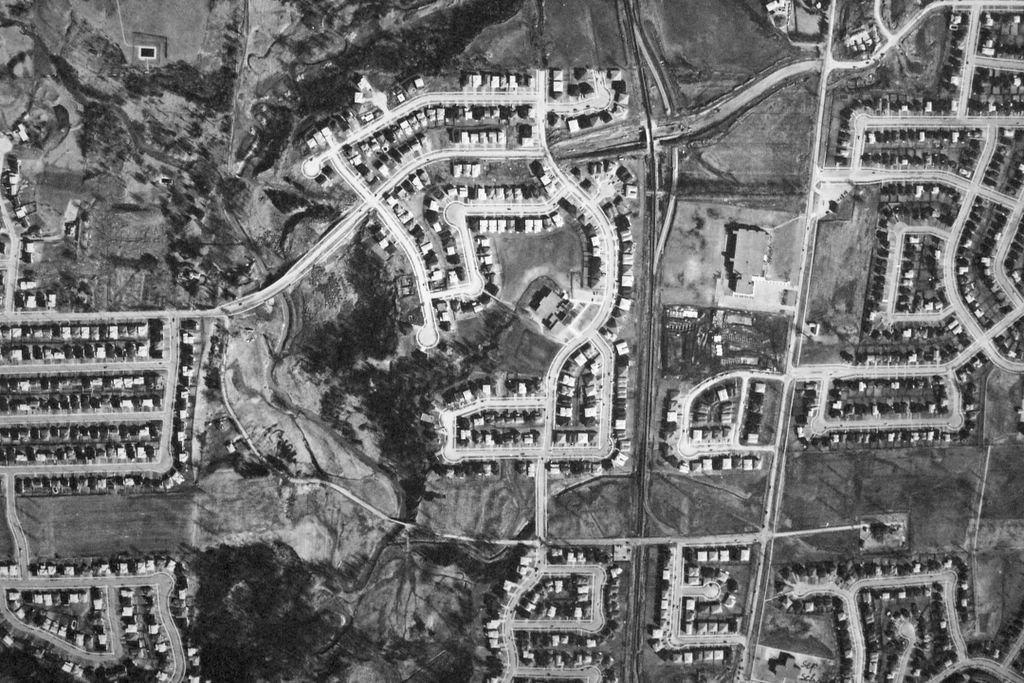
Construction of new track for Cummer Avenue, relegation of old route to Old Cummer Avenue — City of Toronto Archives, 1969, plate 247, detail
Finally, here's what the area looked like in 1985, about a year after Metro decided to turn the area into parkland (note: this view is a tighter shot and does not show Leslie; the north-south street at the right is Pineway Blvd.). East of the bridge (if not west of it), the road is clearly closed, and you can see the beginning of the modern paved footpath heading off due south from the east end of the bridge. There still seems to be one home up at the top at the old turn, judging from what looks to be a driveway with cars in it, but the other homes between it and the bridge are gone. Today, even that home is long gone, vanished without a trace — at least to this untrained eye. Glancing back down towards the turn eastward toward the bridge again; if you look carefully, you might make out a triangular patch in the road with a little streamer of a footpath or driveway wandering away from it to the southwest where one of the houses stood... Make a note of that, and hold that thought for a few moments.
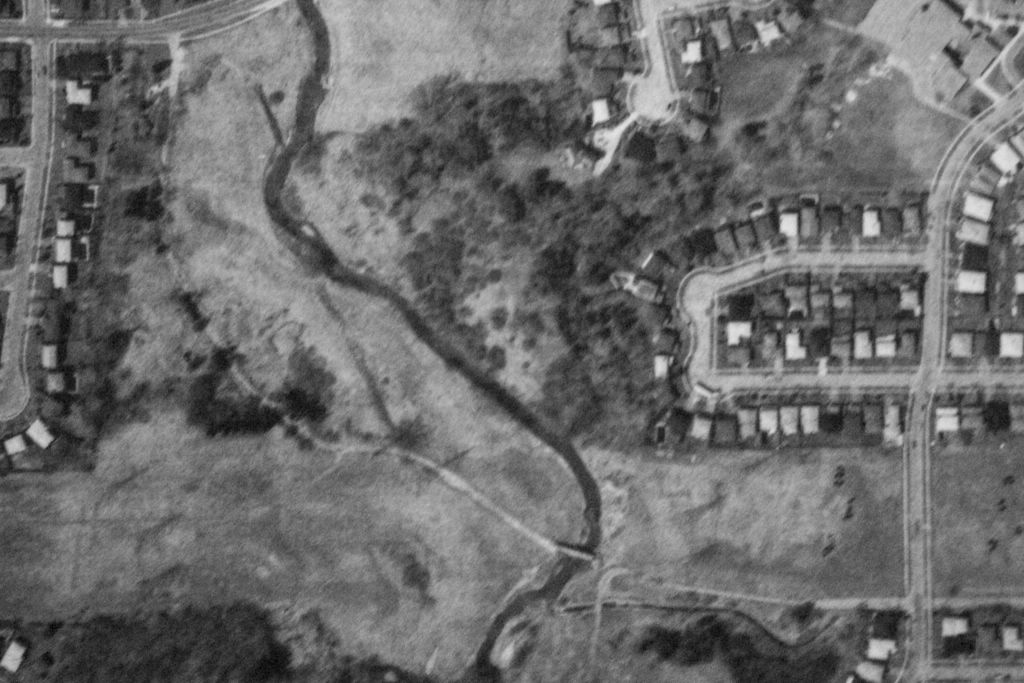
Closure of Old Cummer Avenue to traffic and demolition of its homes — City of Toronto Archives, 1985, plate 52Q, detail
Something I've noticed as I look at the aerial shots I'd like to remark on before moving along is the way the river changes course over time. If you look at the top left of the 1953 shot, you can see the river hugs the treeline and makes a wide curve. There's a farm at the turn in Cummer Avenue and you can see the shadow at the right side of it that probably marks the depression of an abandoned course of the river. In the 1969 and 1985 shots, the threeline is isolated and the river is back in the ancient course. Was this the river's choice, or did human beings move the river back to the old channel for the convenience of the road bridge built in 1968? I have a similar shot taken in 1968 just prior to the beginning of construction; the river follows the 1953 course. Sometime between the 1968 and 1969 overflights, the city forced the river down the more direct channel, it seems. Well, that settled, on to the modern era, ground-level...
A buddy of mine who works mornings joined me for an afternoon hike up the old road allowance (another was invited, but begged off for typical reasons and threatened us with "a 60% chance of rain"... this summer has been famous for promised rains that never came; I was not concerned, and as events turned out, my forecast was in fact the correct one, in spades). Today, a paved footpath (shown as a dotted line on the map) hugs the river course, but that's not all that interesting and there's nothing there to compare then-and-now. So once we crossed the bridge, we headed up what was once Cummer Avenue, later Old Cummer Avenue, and now just a narrow footpath itself.
Heading west from Pineway Blvd., you first glimpse the bridge at the lip of flood plain. This photo doesn't really do it justice; it's a rather steep drop. To give you some idea, notice that our horizon line runs pretty much along the tops of the trees beside the bridge. Standing here, you are about that much higher than the bridge. You can also see the power lines being carried across the valley. The solitary tower standing just right of centre is about fifty yards from the bridge, and stands approximately where one of the homes once stood. It seems to be more recent than the other towers, as I can't find evidence of it in earlier aerial photographs.

Looking west along Old Cummer Avenue road allowance to the bridge over the East Don River.
I've been to the bridge four times now but never under it until yesterday. What can I say, I'm nosy, and I've also found that some of the funniest and pithiest graffiti is to be found underneath bridges. I think it has something to do with the solitude. If you're going to deface public property to make a statement, it helps if you're sheltered from view, I guess. Graffiti on more accessible places tends to be more slap-dash, mostly tagging and other forms of territorial pissing. But underneath bridges, you'll often find the most impressive murals, some with fairly heavy and profound things to say. The words of the prophets are written on the subway walls and tenement halls, and whispered in the sounds of silence... Not this particular time, I'm afraid; the local spraypaint-wielding wags are as disappointingly uninspired below the bridge as upon it.
But to give you some idea, here's what the bridge looks like from below. I took these shots standing in the river, just south of the bridge. It's an elegant structure for something so utilitarian; at a guess, I'd say it dates from the 50s. It's hard to tell if this is the same bridge seen in the 1953 shot. It might, I suppose, be slightly older. There's no way to tell. If there was a date stamped anywhere on the bridge, my buddy and I couldn't find it. With regard to graffiti, though; the west side of the bridge (the darker shot of the two) bears, just legibly, the word FUCT... perhaps a Shawian attempt at restructuring the spelling of the English language. That seems to be as high as the artists who use this bridge as their canvas are prepared to aim.
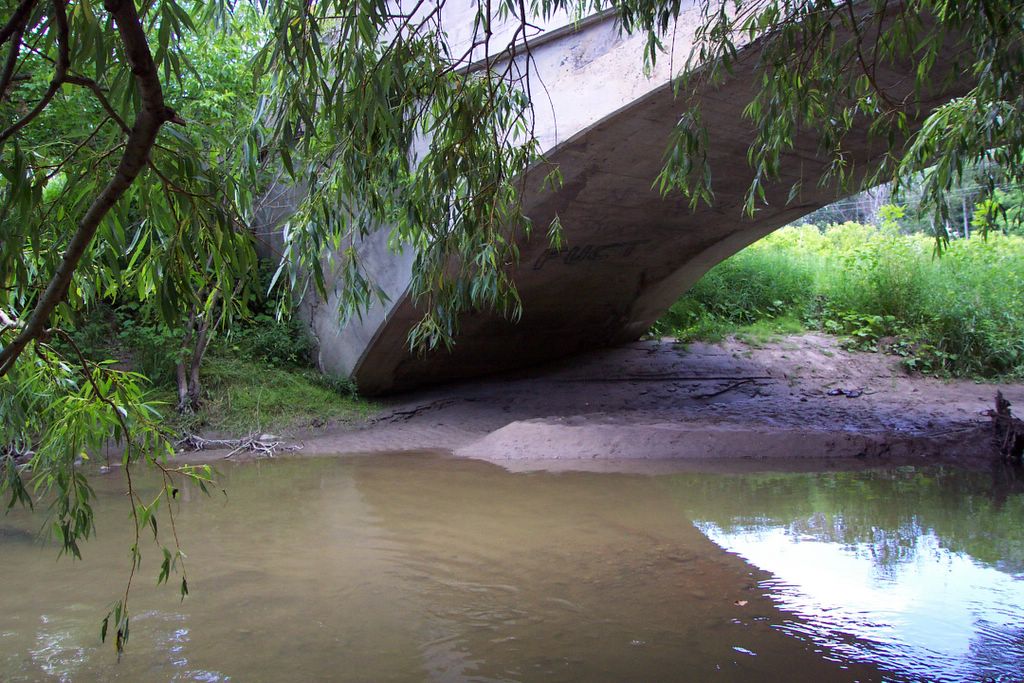
Under the bridge, west end.
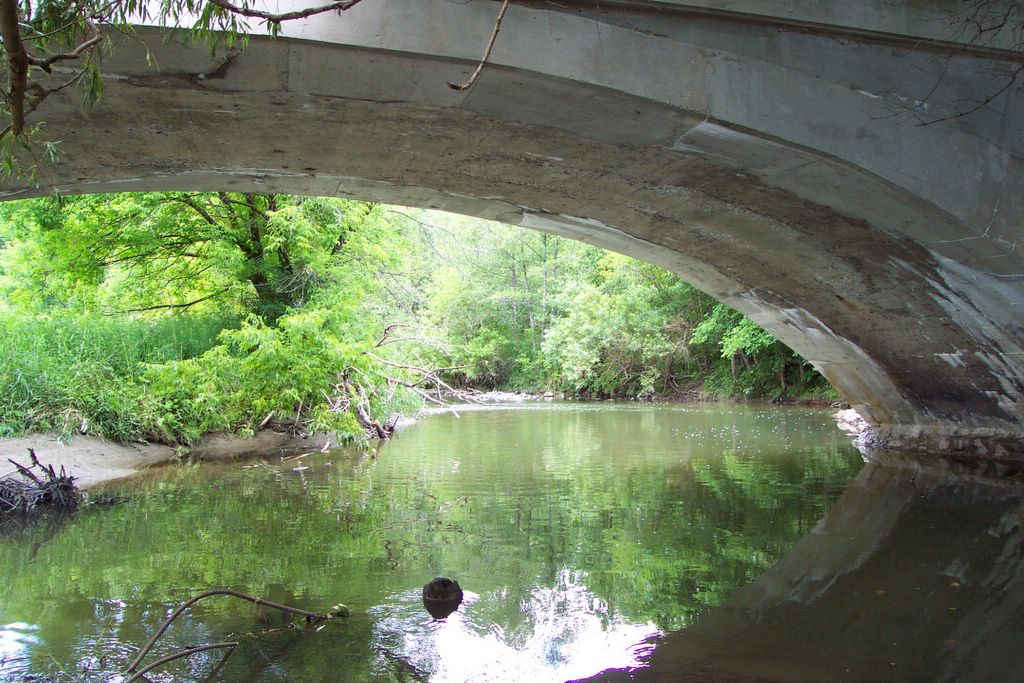
Under the bridge, east end.
Remember the triangular patch with the path I mentioned in the 1985 shot? Well, below is what that looks like today. This view is fifty or so yards west of the bridge and faces north, looking toward the river. The pathway you can see forming a "T" with this one is, in fact, the old road allowance. The path I was standing on to take the shot was likely once someone's driveway. The bush on the the far side of the road is, as you can tell, relatively young. There's little doubt in my mind that people living here in, say, 1960 or 1970 looking out their window from this vantage point would have had a relatively unobstructed view of the river, which is at the foot of the darker trees in the distance.

Current view from the approximate location of one of the homes at the eastward bend of Old Cummer Avenue, west of the bridge.
Below is a shot looking out across the flood plain toward the river, taken from the road. It's impossible for me to say with any accuracy where exactly I was on the road, and given that there really are no landmarks constant between even 1985 and 2005 in this view, it wouldn't make much difference if I could. Suffice it to say, I hope, that this was taken in the span between the arms of the big C-shaped clump of trees at the centre-left of the 1985 shot (um, I think). But this shot is at the heart of what I'm getting at in all this. Look how overgrown the place has become in only a generation since it was abandoned by human habitation and frequent passage. If no one told you that the photographer was standing on what had been only a little earlier a well-travelled suburban road and with his back to what was then a line of homes, you might suppose the shot was taken in a glade in the middle of a northern forest. But this shot was taken standing on a closed road in the heart of a metropolitan area of five million people. I wonder what I would have seen standing on this spot twenty years ago, or fifty. A hundred years ago, though, it probably looked just like this.
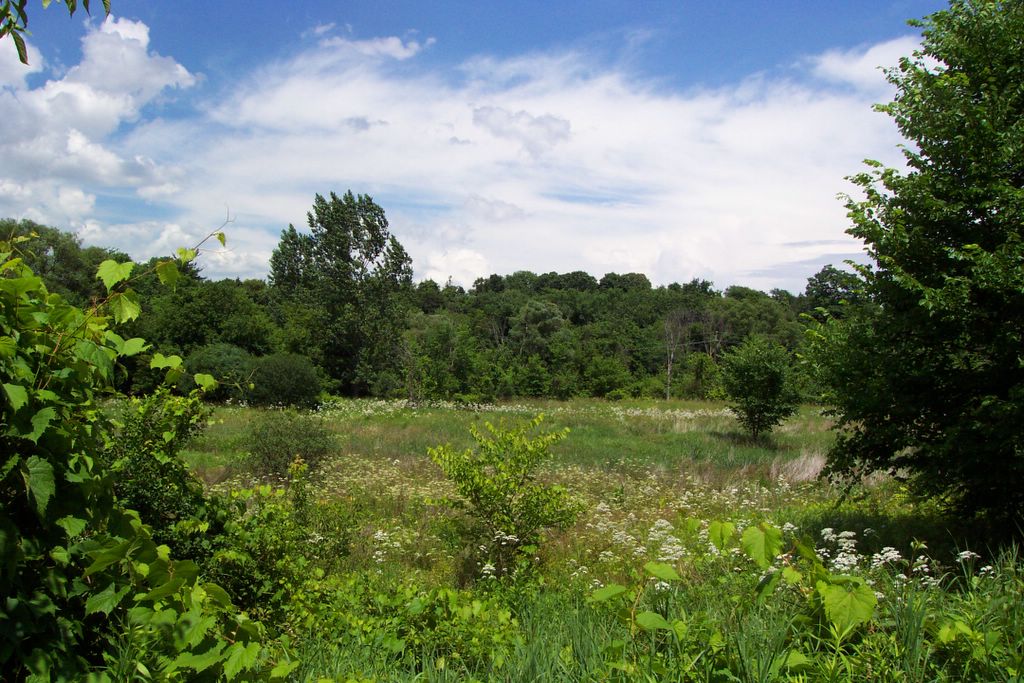
The flood plain, July, 2005.
This picture (below) is the rise to the old turn. In other words, the approach to Cummer Avenue as it stands today. This is probably under a minute's walk from a notable road where hundreds, maybe thousands of people pass by every day in cars, on bikes, and on foot. There are dozens of homes only twenty or thirty yards away on the left, and more just to the north, ahead. What you're looking at now was, around the time you were born or not long before, a cleared, paved roadway about twenty yards wide, with homes on the the west side of it (you can, in fact, see the broken pavement running in chunks up the middle of the eroded path). But could you imagine all that from this shot? That's how much this place has changed in just the little amount of time since we abandoned it; from a two lane road with homes to a footpath where you have to occasionally dodge tree branches. It makes me wonder what would survive our civilization after a thousand years, or a million. Would there be any evidence we were ever here? Anything at all?

The rise to the current course of Cummer Avenue.
After we reached Cummer Avenue, we decided to keep going north for a while. We crossed the road and picked up the official path on the other side of the 'new' four-lane bridge. Not far north of there is another footbridge that crosses the river to the east side. But just before you cross, there's an unofficial path leading off into the woods, that follows the west side of the river. We elected to take that path. It's just a natural path; overgrown and unpaved, marked only by the passage of people, and even then, didn't seem very frequently travelled. We came to a steep, slippery dip that crossed a drainage ditch; it was there I took off my sandals (on inclines, they're much more of a hazard than a help), and ended up keeping them off for the rest of the trip till we got back across Old Cummer bridge and had to walk back up gravel path to Pineway Blvd. I like to walk barefoot and in natural settings I need little prompting or excuse.
The journey took us about fifteen minutes north along the river, probably about half way to Steeles Avenue. We eventually heard something like a waterfall, and my friend discovered what apprears to be an aeration dam. I know that the conservation authority has been encouraging the re-establishment of fish in this part of the river, and I imagine this was built, at least in part, to facilitate that. Curiously, the drop also features four or five abutments. I know the official path runs along the river just the other side of this point. I can't help wondering if they plan to eventually build another bridge here, and maybe widen the path we were on.
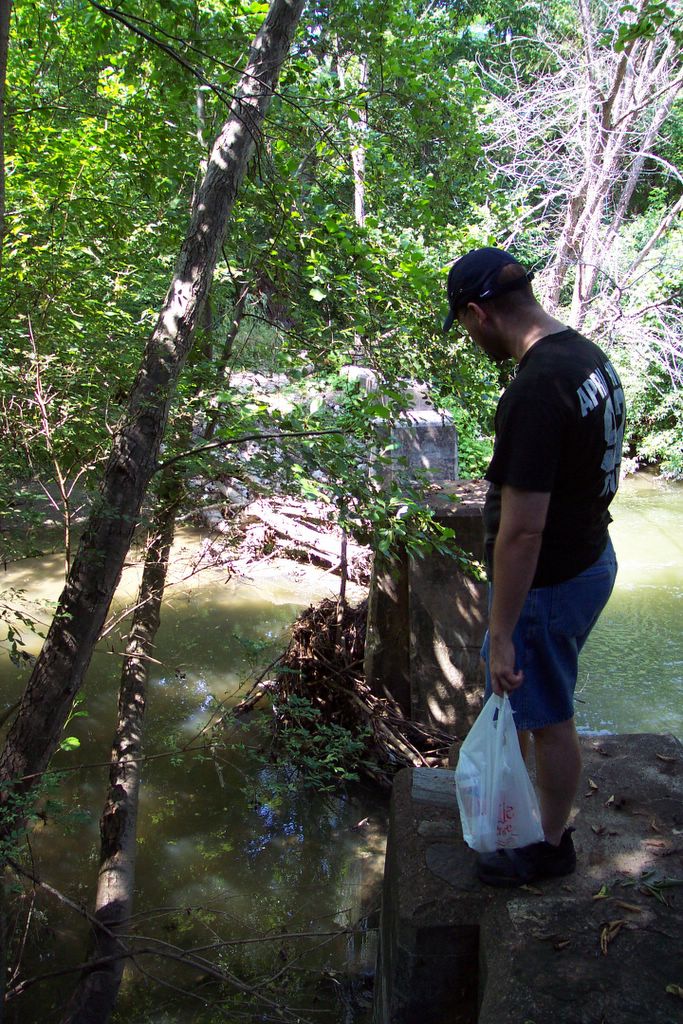
Aeration dam on the East Don River, north of Cummer Avenue.
It was more or less at this point that we decided to head back. Pausing for about half an hour on the bridge of the official pathway, we eventually took the open path (rather than the overgrown track of Old Cummer we'd used on the way up) to return to the Old Cummer bridge. The pavement was hot and rough and provided me with an interesting textural contrast to the clammy, smooth forest path. The trip back, as you might expect, was shorter and brisker.
There's a lot in this park that intrigues me and bears further investigation, both in person and combing the aerial shots to be found at the City Archives. Best of all, it's all within walking distance, unlike nearly all the other similar places I've explored over the years. I'm looking forward to getting to know the park better. I only wish I hadn't waited this long to start.
Oh, yes... and purely for your amusement, I present this. We were actually driving back to Leslie Street along the current track of Cummer Avenue in stop-and-go rush hour traffic, when my buddy drew my attention to the license plate of the Beamer in front of us. We hurried to snap a picture of it. Have you figured it out? It says "I see dead people." This person's either a big fan of The Sixth Sense, or has a really, really interesting internal life.

Oh? You don't say...
--------------------------------------------------------------
July 30th -- addendum
I'm adding the shot below to give you an idea of what the place looks like today. If you click on the shot to view the larger image, the decay of the old road course will become very obvious. The path that more closely follows the river is so much more obvious and better-defined that the first time I went down there in the knowledge that there had been a road there once, I mistook the footpath for the course of Old Cummer Avenue.

Old Cummer Ave. as it looked in 2002; composite of images supplied online by the Toronto Public Library and the City of Toronto.
Thursday, July 07, 2005
I Sing the Guilt Collective
I've committed the act of heresy in our society. I've dared to say our right to live free of terror does not trump that of others, and if we breach it, we open ourselves, justly, to reprisal.
We. You, and me. The people who benefit, day by day, hour by hour, from electing people willing to export terror to foreign lands, to visit horrors on distant peoples, so we can have gas for our SUVs.
William Lloyd Garrison said, in his condemnation of slavery, "I will not equivocate, I will not excuse..." I won't either.
I'm sick of Western exceptionalism. Understand: we are not special. We are not God's golden nugget. We are not right by dint of being white. And we have no more right to be safe and secure in our homes than the people of Baghdad. Whether we, as individuals, support or oppose the actions of Western society in the Middle East and elsewhere, is not the issue. These things are being done in our name, to our benefit. If we are a just society, we are not just enough to change our ways. If we are morally upstanding, we are not morally upstanding enough to elect governments who do not act in the same manner as our ancestors, who, whenever possessed of military superiority, visited whatever they pleased upon those too weak to stop them. Crusaders then. Crusaders now. The term is apt. We still go abroad, still storm the gates, still force what we believe upon others, still get what we want. Only the mantras change.
We are the armed thugs who kick in the door, blow off the father's head, and while helping ourselves to the silverware, declare, "The tyranny is ended! From now on, you will hold elections to decide who washes the dishes! Oh, and to make sure you get it right, we'll be sticking around a while..." For this, we expect to be thanked. We are offended by the ingratitude of the homes whose sanctity we violate. We are astonished to find the knives of the sons at our throats. Because we have learned to utter the sacred words "democracy" and "freedom", we imagine ourselves absolved in the eyes of God and man. Because in the end, we only acted for their own good. Right?
As a society, we are guilty. The British elected Tony Blair. The Americans elected George Bush. Put aside the clever hair-splitting of electoral niceties: they are no defense. The British, the Americans, and others elected MPs, congressmen, and senators who, in their hundreds, in their thousands, consented to the crimes now being committed in foreign lands. People are being murdered at the orders of governments we elected. We condemn the Germans for the Holocaust, for electing people who could do such things. We do this without regard for those who voted otherwise; we say "the Germans did this". But we are shocked when those we victimize strike back at us, without recognizing that we're not all bad... The double standard is appalling. Other societies must accept their collective guilt for the atrocities committed in their name, but not us. Oh, no. Never us. In our millions, we have elected governments who do these things. We have not, collectively, prevented this.
History does not judge us one by one. It judges us anonymously, as societies. A thousand years from now, you, gentle reader, you who oppose these actions, will be as guilty in the eyes of posterity as George Bush and Tony Blair, as will I. Western society had the power to do these things. It had the conceit and the arrogance to do these things. It had the will. It did them. What happened today in London was only a tiny shard of the pain we inflict daily in other lands around the world, and have for years and years. The best among us call those horrors elsewhere tragedies. But when they happen among us, it's as though some fundamental law of the universe has been violated. Apples refuse to fall to Earth! Up is down, white is black! We, we gods on Earth, we have been challenged, reminded we're mortal, treated by others as our society treats them! Our outrage is, in truth, our shame. We presume ourselves so advanced. But the last thousand years seem to have taught us so little.
We lament the deaths of those lost today. Well and good. They were human beings; they were murdered. They did no harm to anyone. They were just trying to get through the day when someone wicked who valued human life less than their own goals snuffed out their lives.
I am speaking of people in England? Or Iraq? Israel, or Palestine?
Does it matter?
Understand this, at last. We do not have the moral right to remake other societies in our own image against their will. We were furnished with the luxury of finding our own way. They deserve that same right, even when, especially when, we think they are wrong. We no more have the right today to force democracy on others in the certainty it’s “right” than we had the right to force Christianity on them, in what I assure you was the same certainty among our ancestors. If other societies are to become democratic, then they must choose that on their own. Who today would agree that the British, having abolished slavery in their empire in 1833, would have been right to invade the United States, wade through rivers of blood both white and black, to force emancipation on that country? The United States had to find its own way to that path. And it did. Differently from the British. In their own time, and in their own way. If we persist, as a society, in presuming our right to use terror to enforce our values on others, to slake our thirsts with the bounty of others, to ease our minds by destroying the peace of mind of others, we must expect as a society to live in fear of reprisal. We have no right to demand the security of our homes while we violate the security of others. We cannot demand that the people we outrage acquiesce and suffer humiliation and death without retribution. They are human beings, and yet we act as though they were dogs to be beaten, and beaten all the more for objecting to be beaten!
I am not eager to be on the bus when it blows up, believe me. This is one reason I so adamantly oppose Canada’s involvement in the war in Iraq. Not just because it’s morally egregious, but out of self-interest. If I run up and punch a weak man because my friends are doing it, do I have the right to expect he won’t remember my face, and burn to return the indignity? No, I do not. But even though my country is not involved, I live in the West, the society that benefits above all others from the arrangement of the world, made by force of arms in its image. If the day comes, what can I say? How can I, or you, claim a moral defense? It wasn’t us; we didn’t call the shots. We were just following orders…
If Bush had lost, would things be different? If the Tories had won in Britain, would their troops now be coming home? No one in serious contention in either country that I’m aware of advocated immediately pulling out. People complain there were no alternatives to vote for. This is not the problem of the people who planted the bombs today; it’s our problem. By God, we’d better start digging up candidates who don’t think like reptiles! No one else is going to do it for us! If we can’t find such people among ourselves and put them in power, is that the fault of the rest of humanity? But in recent elections in many nations, that’s exactly the case: we have put forward no such candidates. At best, there was talk of stepped-up time tables. As if this were some sort of contrition! I’ve heard talk of blaming the victim, allusions to rape. It’s a good example, in fact. Imagine, for a moment, you’re being violently raped in public. The crowd around you suddenly pulls the rapist off you… and then, pushes another rapist down in his place! And the new violator tells you, “That guy was an animal… not me, I’m a nice guy. I’m only going to rape you half as long and half as hard…” Tell me, do you feel grateful? To him? To the crowd that chose him? If you suddenly found a gun in your hand, would this pledge make a difference to you?
What happened today in London is the only response of powerless people. We hold all the cards. The missiles, the bombs, the planes, the aircraft carriers, the troop transports… they all belong to us. The people we use them on have no such things; if they did, we would not use ours on them in the first place. Their only weapon is to inflict upon us, from time to time, the horrors we force them to live with routinely. For us to cry out for justice at such times is an affront to the very idea of justice. The people who did this are human beings, just like us. They have the same brains as us. They love their children the same as us. They welcome the sunrise, they dream of romance, they worry about their future. They may have different ways from us, but fundamentally, we are alike. We are the same species. Appeals to their backwardness, attributions of their innate bloodthirstiness (in contrast to ours?), or demands that we are somehow morally superior as justification for crimes when we commit them, and condemnation for the same acts when they do them, will not wash. If we want to live without fear, we have a responsibility, as a society, not to inflict it upon others. We have an obligation to elect people who are incapable of behaving in this manner. We, as individuals, must work towards it; convincing our fellow citizens of it, by speaking the unspeakable as I am right now. By daring to say “we are guilty, and we must stop”. Until we do, as a society, we can expect no peace, nor do we deserve it.
We. You, and me. The people who benefit, day by day, hour by hour, from electing people willing to export terror to foreign lands, to visit horrors on distant peoples, so we can have gas for our SUVs.
William Lloyd Garrison said, in his condemnation of slavery, "I will not equivocate, I will not excuse..." I won't either.
I'm sick of Western exceptionalism. Understand: we are not special. We are not God's golden nugget. We are not right by dint of being white. And we have no more right to be safe and secure in our homes than the people of Baghdad. Whether we, as individuals, support or oppose the actions of Western society in the Middle East and elsewhere, is not the issue. These things are being done in our name, to our benefit. If we are a just society, we are not just enough to change our ways. If we are morally upstanding, we are not morally upstanding enough to elect governments who do not act in the same manner as our ancestors, who, whenever possessed of military superiority, visited whatever they pleased upon those too weak to stop them. Crusaders then. Crusaders now. The term is apt. We still go abroad, still storm the gates, still force what we believe upon others, still get what we want. Only the mantras change.
We are the armed thugs who kick in the door, blow off the father's head, and while helping ourselves to the silverware, declare, "The tyranny is ended! From now on, you will hold elections to decide who washes the dishes! Oh, and to make sure you get it right, we'll be sticking around a while..." For this, we expect to be thanked. We are offended by the ingratitude of the homes whose sanctity we violate. We are astonished to find the knives of the sons at our throats. Because we have learned to utter the sacred words "democracy" and "freedom", we imagine ourselves absolved in the eyes of God and man. Because in the end, we only acted for their own good. Right?
As a society, we are guilty. The British elected Tony Blair. The Americans elected George Bush. Put aside the clever hair-splitting of electoral niceties: they are no defense. The British, the Americans, and others elected MPs, congressmen, and senators who, in their hundreds, in their thousands, consented to the crimes now being committed in foreign lands. People are being murdered at the orders of governments we elected. We condemn the Germans for the Holocaust, for electing people who could do such things. We do this without regard for those who voted otherwise; we say "the Germans did this". But we are shocked when those we victimize strike back at us, without recognizing that we're not all bad... The double standard is appalling. Other societies must accept their collective guilt for the atrocities committed in their name, but not us. Oh, no. Never us. In our millions, we have elected governments who do these things. We have not, collectively, prevented this.
History does not judge us one by one. It judges us anonymously, as societies. A thousand years from now, you, gentle reader, you who oppose these actions, will be as guilty in the eyes of posterity as George Bush and Tony Blair, as will I. Western society had the power to do these things. It had the conceit and the arrogance to do these things. It had the will. It did them. What happened today in London was only a tiny shard of the pain we inflict daily in other lands around the world, and have for years and years. The best among us call those horrors elsewhere tragedies. But when they happen among us, it's as though some fundamental law of the universe has been violated. Apples refuse to fall to Earth! Up is down, white is black! We, we gods on Earth, we have been challenged, reminded we're mortal, treated by others as our society treats them! Our outrage is, in truth, our shame. We presume ourselves so advanced. But the last thousand years seem to have taught us so little.
We lament the deaths of those lost today. Well and good. They were human beings; they were murdered. They did no harm to anyone. They were just trying to get through the day when someone wicked who valued human life less than their own goals snuffed out their lives.
I am speaking of people in England? Or Iraq? Israel, or Palestine?
Does it matter?
Understand this, at last. We do not have the moral right to remake other societies in our own image against their will. We were furnished with the luxury of finding our own way. They deserve that same right, even when, especially when, we think they are wrong. We no more have the right today to force democracy on others in the certainty it’s “right” than we had the right to force Christianity on them, in what I assure you was the same certainty among our ancestors. If other societies are to become democratic, then they must choose that on their own. Who today would agree that the British, having abolished slavery in their empire in 1833, would have been right to invade the United States, wade through rivers of blood both white and black, to force emancipation on that country? The United States had to find its own way to that path. And it did. Differently from the British. In their own time, and in their own way. If we persist, as a society, in presuming our right to use terror to enforce our values on others, to slake our thirsts with the bounty of others, to ease our minds by destroying the peace of mind of others, we must expect as a society to live in fear of reprisal. We have no right to demand the security of our homes while we violate the security of others. We cannot demand that the people we outrage acquiesce and suffer humiliation and death without retribution. They are human beings, and yet we act as though they were dogs to be beaten, and beaten all the more for objecting to be beaten!
I am not eager to be on the bus when it blows up, believe me. This is one reason I so adamantly oppose Canada’s involvement in the war in Iraq. Not just because it’s morally egregious, but out of self-interest. If I run up and punch a weak man because my friends are doing it, do I have the right to expect he won’t remember my face, and burn to return the indignity? No, I do not. But even though my country is not involved, I live in the West, the society that benefits above all others from the arrangement of the world, made by force of arms in its image. If the day comes, what can I say? How can I, or you, claim a moral defense? It wasn’t us; we didn’t call the shots. We were just following orders…
If Bush had lost, would things be different? If the Tories had won in Britain, would their troops now be coming home? No one in serious contention in either country that I’m aware of advocated immediately pulling out. People complain there were no alternatives to vote for. This is not the problem of the people who planted the bombs today; it’s our problem. By God, we’d better start digging up candidates who don’t think like reptiles! No one else is going to do it for us! If we can’t find such people among ourselves and put them in power, is that the fault of the rest of humanity? But in recent elections in many nations, that’s exactly the case: we have put forward no such candidates. At best, there was talk of stepped-up time tables. As if this were some sort of contrition! I’ve heard talk of blaming the victim, allusions to rape. It’s a good example, in fact. Imagine, for a moment, you’re being violently raped in public. The crowd around you suddenly pulls the rapist off you… and then, pushes another rapist down in his place! And the new violator tells you, “That guy was an animal… not me, I’m a nice guy. I’m only going to rape you half as long and half as hard…” Tell me, do you feel grateful? To him? To the crowd that chose him? If you suddenly found a gun in your hand, would this pledge make a difference to you?
What happened today in London is the only response of powerless people. We hold all the cards. The missiles, the bombs, the planes, the aircraft carriers, the troop transports… they all belong to us. The people we use them on have no such things; if they did, we would not use ours on them in the first place. Their only weapon is to inflict upon us, from time to time, the horrors we force them to live with routinely. For us to cry out for justice at such times is an affront to the very idea of justice. The people who did this are human beings, just like us. They have the same brains as us. They love their children the same as us. They welcome the sunrise, they dream of romance, they worry about their future. They may have different ways from us, but fundamentally, we are alike. We are the same species. Appeals to their backwardness, attributions of their innate bloodthirstiness (in contrast to ours?), or demands that we are somehow morally superior as justification for crimes when we commit them, and condemnation for the same acts when they do them, will not wash. If we want to live without fear, we have a responsibility, as a society, not to inflict it upon others. We have an obligation to elect people who are incapable of behaving in this manner. We, as individuals, must work towards it; convincing our fellow citizens of it, by speaking the unspeakable as I am right now. By daring to say “we are guilty, and we must stop”. Until we do, as a society, we can expect no peace, nor do we deserve it.
Crusader grab-it
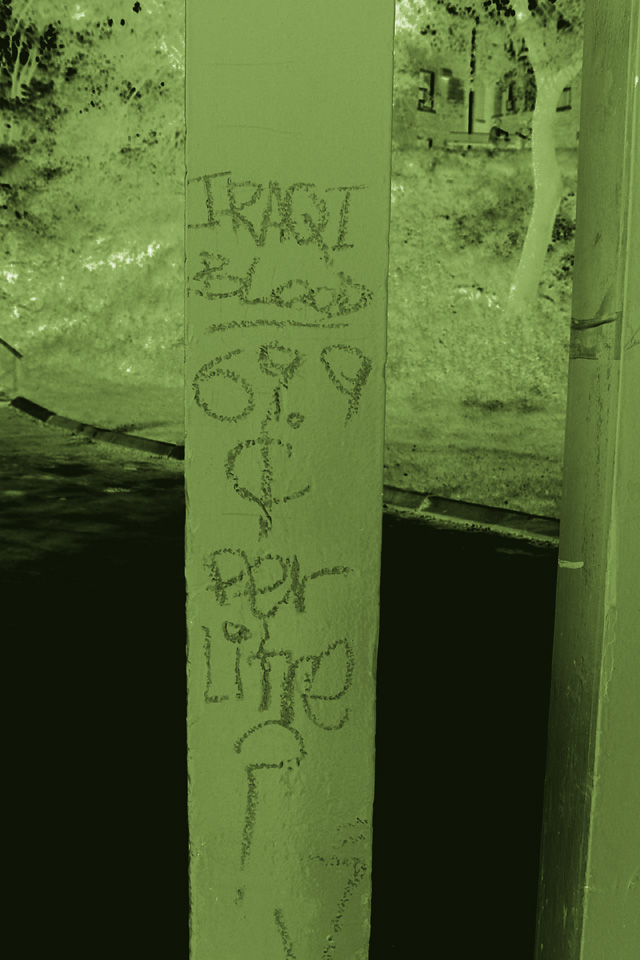
This is interesting. I've never heard of the West referred to as "Crusader governments" before. Under the circumstances, I suppose it's an apt characterization. Of course I'm not in favour of having our cities bombed, but given what certain Westerners are happy to see done to Baghdad and other places in the Middle East, I can hardly claim to be surprised, or even particularly outraged. I'm sure if the shoe were on the other foot, we'd be doing exactly the same thing.
Tuesday, July 05, 2005
Somewhere, Carl Sagan is weeping
Astrologer Sues NASA Over Comet Mission
MOSCOW - NASA's mission that sent a space probe smashing into a comet raised more than cosmic dust — it also brought a lawsuit from a Russian astrologer.
Marina Bai has sued the U.S. space agency, claiming the Deep Impact probe that punched a crater into the comet Tempel 1 late Sunday "ruins the natural balance of forces in the universe," the newspaper Izvestia reported Tuesday. A Moscow court has postponed hearings on the case until late July, the paper said.
Scientists say the crash did not significantly alter the comet's orbit around the sun and said the experiment does not pose any danger to Earth.
The probe's comet crash sent up a cloud of debris that scientists hope to examine to learn how the solar system was formed.
Bai is seeking damages totaling $300 million — the approximate equivalent of the mission's cost — for her "moral sufferings," Izvestia said, citing her lawyer Alexander Molokhov. She earlier told the paper that the experiment would "deform her horoscope."
NASA representatives in Russia could not be reached for comment on the case.
MOSCOW - NASA's mission that sent a space probe smashing into a comet raised more than cosmic dust — it also brought a lawsuit from a Russian astrologer.
Marina Bai has sued the U.S. space agency, claiming the Deep Impact probe that punched a crater into the comet Tempel 1 late Sunday "ruins the natural balance of forces in the universe," the newspaper Izvestia reported Tuesday. A Moscow court has postponed hearings on the case until late July, the paper said.
Scientists say the crash did not significantly alter the comet's orbit around the sun and said the experiment does not pose any danger to Earth.
The probe's comet crash sent up a cloud of debris that scientists hope to examine to learn how the solar system was formed.
Bai is seeking damages totaling $300 million — the approximate equivalent of the mission's cost — for her "moral sufferings," Izvestia said, citing her lawyer Alexander Molokhov. She earlier told the paper that the experiment would "deform her horoscope."
NASA representatives in Russia could not be reached for comment on the case.
And the Universe's Stupidest Invaders Award goes to...
[SPOILER ALERT]
At this point in history, I trust I'm not really giving anything away when I point out that the aliens in War of the Worlds are done in not by human efforts, but the agency of bacteria and molds...?
[/SPOILER ALERT]
I saw War of the Worlds on Sunday. It was actually pretty good; a little better than I expected. It came tantalizingly close to capturing the sense of nightmare you have as a child when you dream about the end of the world. I had a dream when I was very young about alien ships hanging in the sky, the neighbourhood I knew empty of people, me hiding under a bed while unseen aliens murdered my friends living next door; I still remember the depths of the terror of that dream very well. There comes a point in War of the Worlds, around the time Ray and his family watch a train rush by in flames, that a sense of global helplessness and doom really sinks in. We're largely inured that kind of thing as adults; we learn not to think about it (especially those of us who grew up during the Cold War). Movies like this, done well, can get in under that thick hide and remind a person evocatively of a time in one's life when that sense of horror was only a blink away.
That said, something about premise doesn't quite work. In updating the movie, Spielberg changes the myth slightly. No more are the aliens desperate invaders in search of a new home. They are, instead, simply hunters on a lark — and I have to say that here, Spielberg is extremely effective; you suddenly see humans as simply clever animals (but not quite clever enough) under the gun in abject terror; it's not at all hard to sympathize with deer or flocks of birds — hunters who have long ago stashed their weapons, waiting for a time when, presumably, we'd be advanced enough, but only just enough, to provide a sporting challenge. Now to me, this implies that they've done this before. If they patiently set these traps and wait millenia to spring them, they must be very long-lived, or else while they're setting up for their descendents, they're also springing traps laid by their remote ancestors. Either way, plenty of time to get acquainted with the concept of the risks of xenomicrobiology. No world could have evolved beings as complex as them without single-celled organisms; they would have to be aware of them. Yet, these aliens capable of crossing space, waiting thousands or millions of years to finally attack us, are still so spectacularly stupid as to get out of their ships and wander around an alien world naked. If they'd been in space suits, and the key to our survival had been to somehow penetrate the suits in some clever way to the let the germs in, fine; I'd have some respect for the whole concept. But this way doesn't make sense.
The only stupider aliens I've ever seen are M. Night Shyamalan's crop-circle morons, who can effortlessly abduct millions so long as they're not hiding behind a wooden door, who can make their ships invisible but can't turn out their lights at night, who can cross space but have to flatten crops because they can't muster a GPS system, and for whom water is like hydrochloric acid, and yet who pick a planet utterly awash in it (and whose beings are, in fact, largely made of it) to cavort upon — again, naked. Meanwhile, we quarantined the first three Apollo missions to return from the lunar surface in case there was anything alive on such an utterly dead world... and we're hardly as smart as aliens who can cross the space between the stars. If we're going to defeat aliens far more knowledgable than us, I would like it to be by some means satisfyingly clever, not because they're inexplicably stupid.
At this point in history, I trust I'm not really giving anything away when I point out that the aliens in War of the Worlds are done in not by human efforts, but the agency of bacteria and molds...?
[/SPOILER ALERT]
I saw War of the Worlds on Sunday. It was actually pretty good; a little better than I expected. It came tantalizingly close to capturing the sense of nightmare you have as a child when you dream about the end of the world. I had a dream when I was very young about alien ships hanging in the sky, the neighbourhood I knew empty of people, me hiding under a bed while unseen aliens murdered my friends living next door; I still remember the depths of the terror of that dream very well. There comes a point in War of the Worlds, around the time Ray and his family watch a train rush by in flames, that a sense of global helplessness and doom really sinks in. We're largely inured that kind of thing as adults; we learn not to think about it (especially those of us who grew up during the Cold War). Movies like this, done well, can get in under that thick hide and remind a person evocatively of a time in one's life when that sense of horror was only a blink away.
That said, something about premise doesn't quite work. In updating the movie, Spielberg changes the myth slightly. No more are the aliens desperate invaders in search of a new home. They are, instead, simply hunters on a lark — and I have to say that here, Spielberg is extremely effective; you suddenly see humans as simply clever animals (but not quite clever enough) under the gun in abject terror; it's not at all hard to sympathize with deer or flocks of birds — hunters who have long ago stashed their weapons, waiting for a time when, presumably, we'd be advanced enough, but only just enough, to provide a sporting challenge. Now to me, this implies that they've done this before. If they patiently set these traps and wait millenia to spring them, they must be very long-lived, or else while they're setting up for their descendents, they're also springing traps laid by their remote ancestors. Either way, plenty of time to get acquainted with the concept of the risks of xenomicrobiology. No world could have evolved beings as complex as them without single-celled organisms; they would have to be aware of them. Yet, these aliens capable of crossing space, waiting thousands or millions of years to finally attack us, are still so spectacularly stupid as to get out of their ships and wander around an alien world naked. If they'd been in space suits, and the key to our survival had been to somehow penetrate the suits in some clever way to the let the germs in, fine; I'd have some respect for the whole concept. But this way doesn't make sense.
The only stupider aliens I've ever seen are M. Night Shyamalan's crop-circle morons, who can effortlessly abduct millions so long as they're not hiding behind a wooden door, who can make their ships invisible but can't turn out their lights at night, who can cross space but have to flatten crops because they can't muster a GPS system, and for whom water is like hydrochloric acid, and yet who pick a planet utterly awash in it (and whose beings are, in fact, largely made of it) to cavort upon — again, naked. Meanwhile, we quarantined the first three Apollo missions to return from the lunar surface in case there was anything alive on such an utterly dead world... and we're hardly as smart as aliens who can cross the space between the stars. If we're going to defeat aliens far more knowledgable than us, I would like it to be by some means satisfyingly clever, not because they're inexplicably stupid.
Monday, July 04, 2005
Constitution, anyone?
Anyone with any lingering doubts about the validity of same-sex rights in the Constitution, or the competency of the courts to make decisions about the Charter, is invited to read the following, which is little short of brilliant, in my opinion...
On Section 15.
On Section 15.
Saturday, July 02, 2005
Hi diddly dee, a bachelor's life for me
I just had the weirdest dream. I was married to the sister of a woman I vaguely know. The marriage had been rocky from the start and despite my best efforts, she'd left me nearly at once. I could not even remember what she looked like. How was I to reconcile if I couldn't even recognize her? I was out on the patio of a bar with her family, with whom I seemed to get along just fine. The woman, my sister-in-law, seemed sympathetic, but of course she had her relationship with her sister to consider. I suppose I ought to have married the sister.
I remember sitting there in the dream, nursing a beer, and suddenly realizing I was no longer "single". I was, in fact, "married", and about to be "divorced", which is like single except without the stigma of never having paired up in a serious way, which obviously is something nagging at me, even if I'm rarely consciously aware of it. Ah well, such is life, at least for me.
Friday, July 01, 2005
The obligatory artsy shot
Apropos of nothing, I thought I'd post this shot. It's one of the pictures I took while photographing that 10 acre property on the close stretch of Fifth Line a couple weekends ago. The cumpled up Hewlett-Packard box, with its high tech reference, slowly rotting in a field of green plants, just strikes me as poignant, and kind of lovely.

Ashes to ashes, etc.
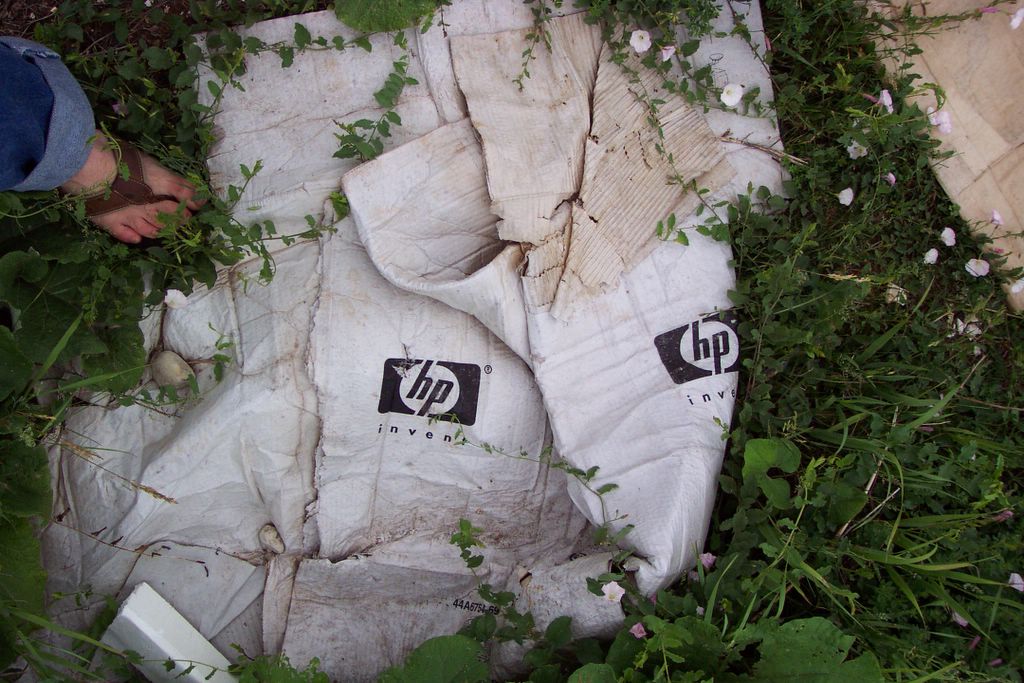
Ashes to ashes, etc.
The city in the trees
I thought it might interest folks to see why some people call Toronto "the city in the trees". This is a shot of "downtown" North York (along the spine of Yonge Street), seen from about five miles east, with the Don Valley in the foreground.
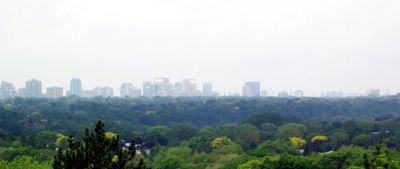
The City in the Trees

The City in the Trees
Four-Oh-Wonderful
This is a photo of Highway 401 I took for a friend in Ireland last winter. The view faces west, and was taken from the bridge of Don Mills Road. West of here is the Don Valley, the Leslie Street interchange, and the Bayview Avenue interchange at the top of the hill. Beyond that, out of sight, is the Yonge Street interchange. The 401 bridges at Yonge Street carry more traffic than any other highway bridges on the continent.
Highway 401, facing west from Don Mills Road
When I was twelve and we were just moving to Ontario from Nova Scotia, we came along the 401 once we left Quebec. For the most part, it was two or three lanes each way; nothing all that remarkable to me; we had superhighways in Nova Scotia. But when we entered Scarborough and came over a rise and suddenly the 401 branched out into express lanes and collector lanes and was ten, twelve, sixteen lanes wide, I was awed. That, and the fact that we were moving from city to city to city with nothing between them and only signs to indicate the change, was what most impressed me when we arrived. It was the first, big difference between what I'd known before, and how my life was going to be from then on.
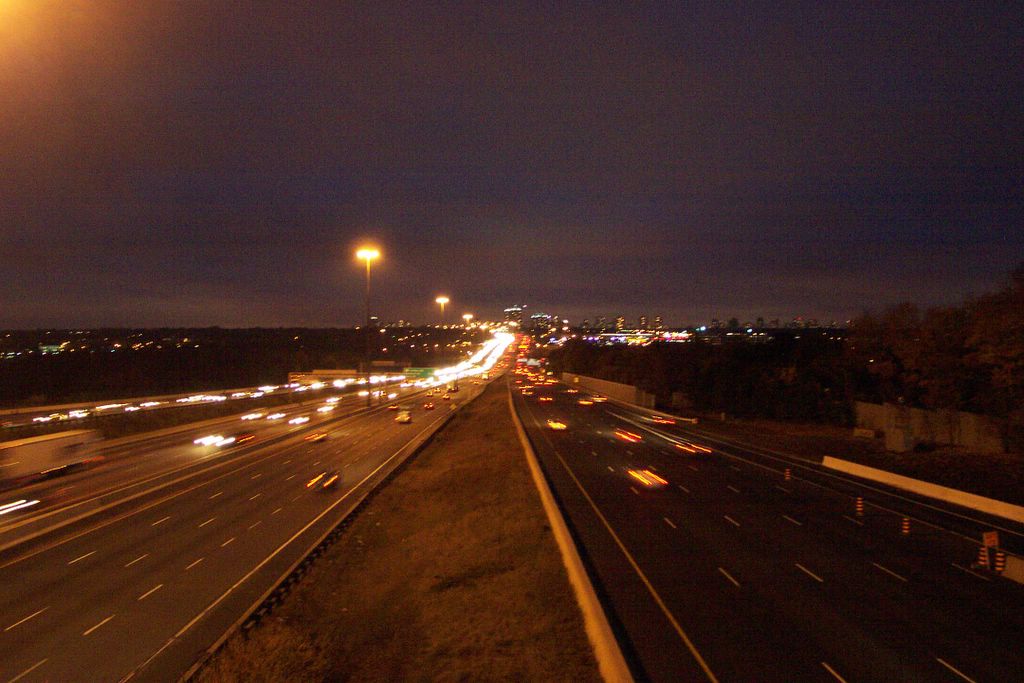
Highway 401, facing west from Don Mills Road
When I was twelve and we were just moving to Ontario from Nova Scotia, we came along the 401 once we left Quebec. For the most part, it was two or three lanes each way; nothing all that remarkable to me; we had superhighways in Nova Scotia. But when we entered Scarborough and came over a rise and suddenly the 401 branched out into express lanes and collector lanes and was ten, twelve, sixteen lanes wide, I was awed. That, and the fact that we were moving from city to city to city with nothing between them and only signs to indicate the change, was what most impressed me when we arrived. It was the first, big difference between what I'd known before, and how my life was going to be from then on.
Thoughts on the Maple Leaf
 Like I said (below... I hate how blogs arrange things), it's Canada Day. Canada, as a federal union, is 138 years old today. We have had our own flag for just over 40 years now, as of February 15, 1965. Of course, everyone is familiar with the current flag...
 But how many people these days are aware that we had a rather different flag before 1965? I think this is lost on many people just a little younger than me. This was never my flag; I was born under the Maple Leaf. But when I was younger, I had a special affinity for the old Red Ensign. It was the flag of a Twilight Zone Canada I never knew.
 This was nearly our flag. When Prime Minister Lester Pearson set out in 1964 to give us our own flag in time for the Centennial (1967), this was the design he favoured. The sprig of three maple leaves is traditional, particularly to Quebec and Ontario (it still appears on Ontario's flag). You can also see it in the Red Ensign above, which features Canada's coat of arms.
While this, too, is not my flag, and the design of the leaves is hideous, I do sometimes find myself wishing the blue had made it onto the flag we have today... either one or both bars in blue. Many of the flags of free countries are red, white, and blue, and we would not have been out of place among them. But then I reflect on how beautiful our flag is in the wind... how alive it looks in red... how much it looks like flame. And then I can really only regret instead that blue, no matter how lovely, could never give me the same catch in the throat of that rippling, living flame.
 Here's a revision to the Canadian flag, proposed in 1995, that incorporates blue in the design. It's not bad. But I guess it's too late in history; that ship has sailed. I'm not one to change our flag every generation or two.
I have a book about the history of the Flag Debate, and it features a number of the designs Canadians proposed over the years. Some are a testament to bland mediocrity, all character stripped away in an attempt to offend no one. Others are crammed with references to every ethnic group that ever found its way to these shores. Religious symbols. Animals. Union Jacks, fleurs-de-lys. Stripes, stars, mountains, lakes, Natives, and the ubiquitous maple leaf itself. When I look at them and see what we might have been stuck with, I'm deeply thankful we found the wisdom to adopt the flag we did. It gave us a symbol, the stylized leaf, that's unique, instantly recognizable, and infinitely utilitarian as a graphic element. I believe Canada is better known in the world simply by dint of having such a singularly striking flag. But if you're interested in seeing some of the bullets we dodged, click here.
If you would like to know a little bit about the stormy labour that gave birth to the flag, the CBC has a wonderful retrospective site about just how difficult it actually was.
The first flag (again?)
It's Canada Day, and as I write this, Prime Minister Martin is addressing the nation on Parliament Hill. He's talking about the gift we just received back from Europe -- the first Canadian flag (the current one, I mean) that ever flew atop the Peace Tower over the Centre Block of the Parliament Buildings, back on Feb. 15, 1965. It's been lost for 40 years.
A few years ago, the Liberal Party donated to Canada "the first flag", but it turned out not to have been. Don't ask me how you confirm something like this. I confess, I'm dubious about this one too. There must have been a lot of new Canadian flags floating around in 1965. How can we possibly know for sure this is the one? I guess we just have to accept it on faith. You can believe and be proud, or disbelieve and rob yourself of something small and valuable about the country. So... okay, we have our first flag back.
Happy Canada Day. :)
A few years ago, the Liberal Party donated to Canada "the first flag", but it turned out not to have been. Don't ask me how you confirm something like this. I confess, I'm dubious about this one too. There must have been a lot of new Canadian flags floating around in 1965. How can we possibly know for sure this is the one? I guess we just have to accept it on faith. You can believe and be proud, or disbelieve and rob yourself of something small and valuable about the country. So... okay, we have our first flag back.
Happy Canada Day. :)
Subscribe to:
Posts (Atom)